
Vintage Japanese Tin Toys
Collector Quick Guide
What collectors look for
Collectors look for original lithographed paint, working wind-up or friction mechanisms, and manufacturer markings such as Bandai, Nomura, Alps, or Masudaya. Toys with their original box, bright colors, and minimal rust or dents are especially desirable. Condition has a major impact on value.
How to identify originals
Authentic examples are usually marked "Made in Japan" and often display the manufacturer's logo stamped or lithographed onto the toy. Original toys feature folded or crimped metal seams rather than glued construction, along with detailed lithographed artwork instead of modern decals.
Red flags / reproductions
Many modern reproductions have overly bright paint, artificial aging, Phillips-head screws, or stickers instead of lithographed graphics. Be cautious of toys described as "vintage style" or "retro," as these are often modern reproductions. Missing or replacement parts can also reduce both authenticity and collector value.
Related collectibles
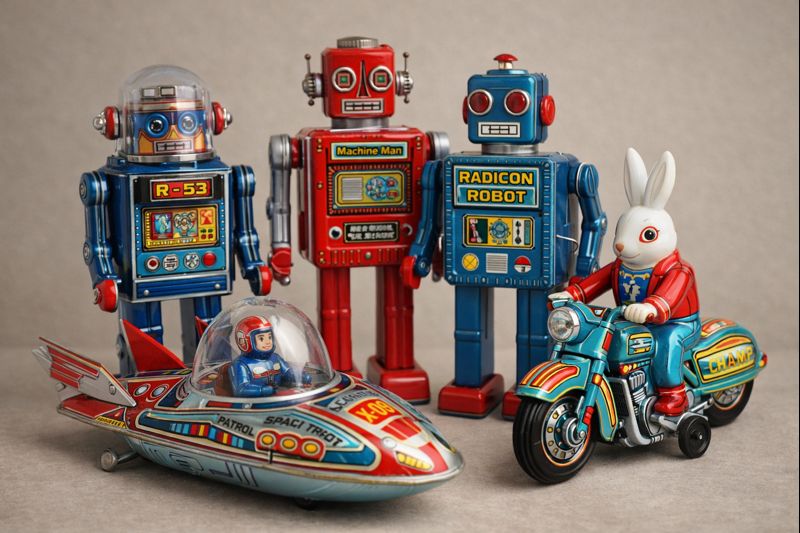
Vintage Japanese tin toys are among the most colorful and historically significant playthings of the twentieth century, celebrated for their bright lithographed surfaces, clever mechanical actions, and links to postwar manufacturing ingenuity. Made primarily from thin stamped metal sheets, these toys often featured clockwork mechanisms, friction motors, or simple wind-up systems that brought cars, robots, animals, and fantasy figures to life. Their bold graphics and imaginative designs captured the spirit of mid-century childhood while showcasing the rapid industrial growth of Japan after World War II.
Japan had been producing metal toys before the war, but the true boom occurred during the late 1940s through the 1960s, when export-focused factories began supplying Western markets with affordable, visually striking toys. Companies such as Nomura, Yonezawa, Bandai, Masudaya, and Alps Electric became household names among importers and retailers. Many toys were stamped “Made in Japan,” a marking that today instantly signals a collectible era. Space-age themes were especially popular, reflecting Cold War fascination with rockets, astronauts, and futuristic machines, while others depicted trains, fire engines, motorcycles, animals, or comic-style monsters.
Right now on eBay
Collectors are drawn to these toys for both their visual impact and mechanical charm. Large robots with flashing spark wheels, convertible cars with opening doors, and walking animals powered by internal cams remain favorites. Lithography quality is critical, as vivid colors and crisp graphics dramatically affect desirability. Original boxes, often printed with equally dramatic artwork, can sometimes be as valuable as the toys themselves. Condition plays a major role; dents, rust, replaced parts, or repainting can reduce appeal, while untouched examples with working mechanisms command strong attention in collector circles.
Beyond nostalgia, vintage Japanese tin toys represent a turning point in global toy production and design. They illustrate how manufacturing shifted toward export markets and how pop culture themes influenced playthings during the atomic and space eras. Many collectors specialize narrowly, focusing only on robots, vehicles, animal figures, or a single maker’s output. Others build broader displays that capture the vibrant variety of postwar tin production. Whether admired for engineering, graphics, or cultural history, these toys continue to spark fascination decades after they first rolled, walked, or whirred across living-room floors.