
The Curious World of Antique Scientific Instruments
- Jan 2026
- Rigo
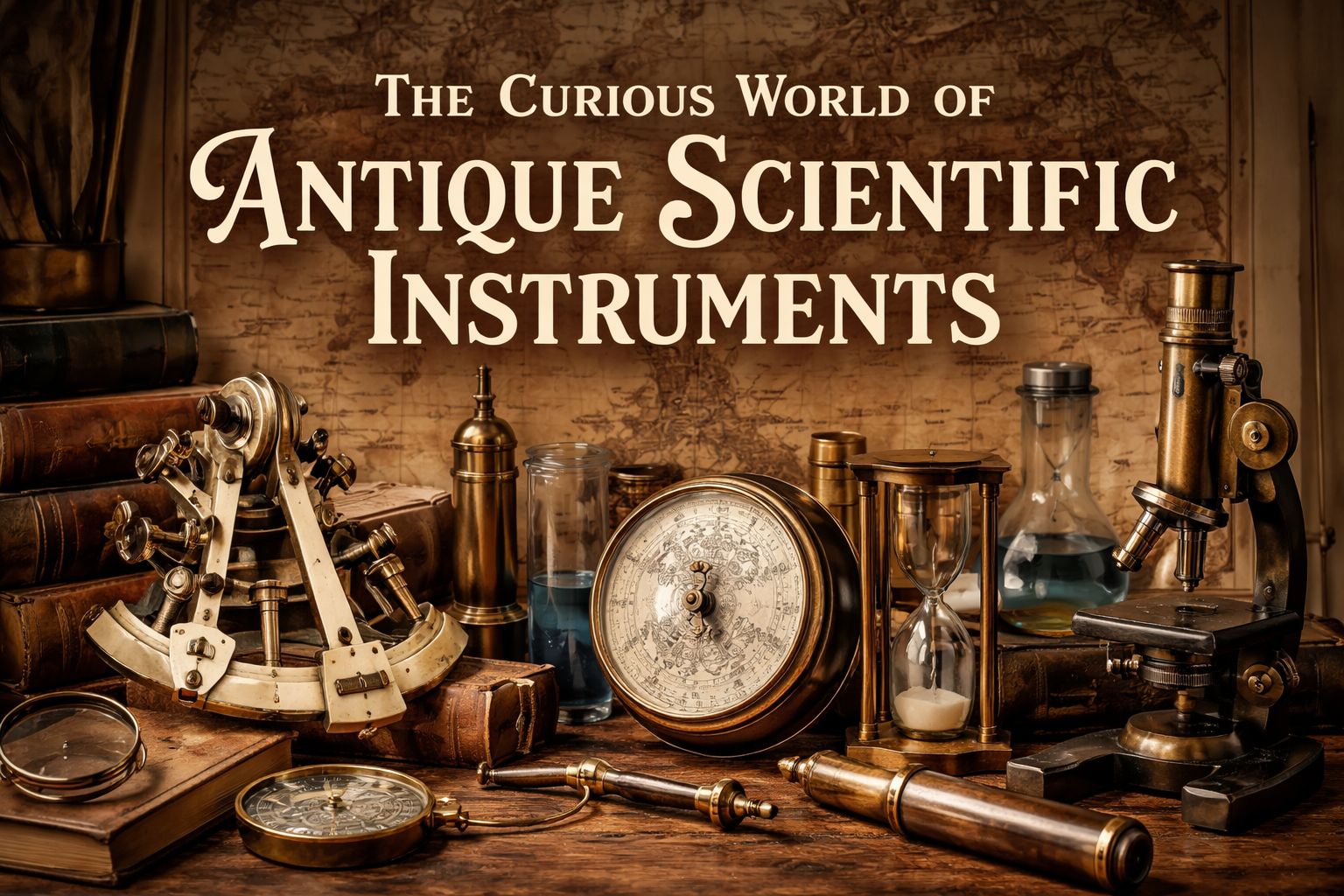
Long before digital screens and automated readouts became part of everyday life, scientists, navigators, and engineers relied on finely crafted instruments made from brass, wood, and glass. These tools were not only essential for discovery and exploration, they were often works of art in their own right. Today, antique scientific instruments have become a serious field of collecting, prized for their mechanical beauty, historical importance, and the stories they carry from centuries of experimentation and travel.
The history of these instruments stretches back to the Renaissance and Enlightenment periods, when curiosity about the natural world exploded across Europe. Devices such as  astrolabes, sextants, microscopes, barometers, and early telescopes helped sailors cross oceans, physicians study the human body, and astronomers chart the skies. Many were handmade by specialist craftsmen whose workshops supplied universities, naval fleets, and wealthy patrons. Makers often signed their work, and those names now matter greatly to collectors. London, Paris, and Amsterdam became major centers for scientific instrument production, with firms producing everything from surveying equipment to delicate optical devices.
Collectors today are drawn to these objects because they sit at the crossroads of history and engineering. A brass microscope from the 1800s or a ship’s sextant housed in a fitted wooden case feels personal in a way modern equipment rarely does. You can imagine it resting on a laboratory bench or being used on the deck of a rolling ship. Original cases, paper manuals, and calibration charts add another layer of interest and can significantly raise desirability.
Right now on eBay
Condition plays a major role, but honest wear is often welcomed. Tarnished brass, rubbed wooden boxes, and handwritten labels can add character, as long as the instrument has not been heavily altered or stripped of its original parts. Collectors pay close attention to engravings, serial numbers, and mechanical completeness. Instruments tied to navigation or astronomy tend to attract strong interest, especially if they come from respected makers or institutions.
Part of the fun is the sheer variety. One collection might focus on medical tools such as early stethoscopes and surgical kits, while another leans toward surveying equipment, compasses, and transit levels used to map growing cities and railroads. Some collectors concentrate on educational devices once used in classrooms, like orreries that demonstrate planetary motion or electrostatic generators meant to amaze students.
Antique scientific instruments appeal to people who enjoy objects with purpose. They are reminders of a time when discovery depended on patience, steady hands, and finely tuned mechanisms rather than software updates. Whether displayed on a bookshelf, tucked into a cabinet, or studied closely at a desk, these tools connect collectors directly to the age of exploration and early modern science.