
Chasing History Through Rare Airmail Stamps
- Jan 2026
- Rigo
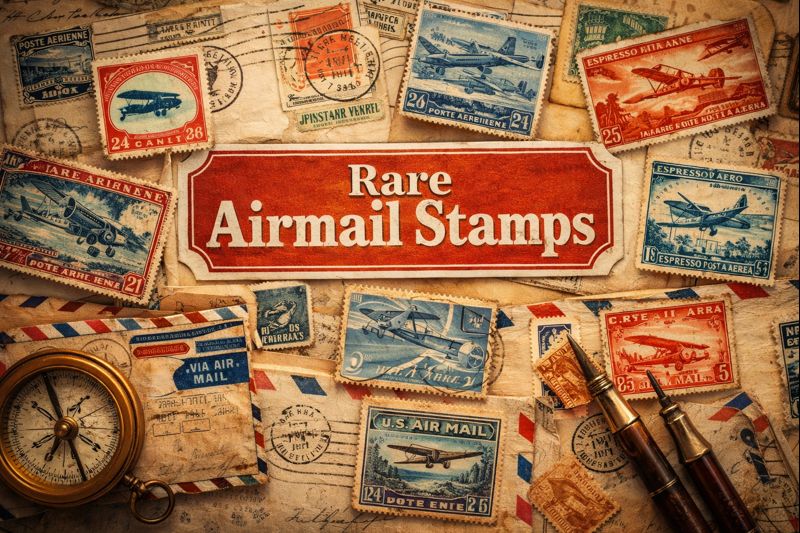
Long before email and overnight shipping, getting a letter across oceans or rugged terrain was a daring and uncertain business. Airmail changed everything. When airplanes began carrying mail in the early 20th century, postal services rushed to create special stamps to mark this new and thrilling chapter in communication. Those early airmail issues—often experimental, sometimes rushed into circulation—have become some of the most closely watched and studied collectibles in philately.
The first official airmail stamps appeared during the 1910s and 1920s, a time when aviation itself was still finding its footing. Planes were fragile, routes were risky, and crashes were not uncommon. Postal authorities commemorated these efforts with dramatic designs showing biplanes soaring above cities, allegorical figures of flight, and sweeping landscapes seen from above. In the United States, the 1918 Curtiss Jenny airmail stamp launched federal airmail service and instantly became famous—especially after a small number were printed upside down, creating one of the most legendary errors in stamp collecting.
Across Europe, Latin America, and Asia, postal systems followed suit. Countries issued short-run stamps for inaugural flights, experimental routes, and special deliveries. Some were overprinted regular stamps with bold lettering announcing “Airmail,” while others were entirely new designs created to celebrate aviation milestones. Collectors today prize these early issues because they document the birth of global air travel just as clearly as photographs or newspaper headlines.
What makes airmail stamps especially appealing to collectors is the variety of stories attached to them. Some were used on mail carried during record-breaking flights. Others traveled on routes that only operated briefly before being shut down due to weather, cost, or technical problems. Covers—envelopes that still bear the stamps along with postmarks and routing marks—are often even more desirable than unused examples because they show how the stamps actually functioned in the postal system.
Right now on eBay
Condition plays a major role in value, but rarity and context matter just as much. A common stamp can become highly desirable if it appears on a cover tied to a famous flight or pilot. Collectors study perforations, color shades, watermarks, and overprints, hunting for subtle differences that separate an everyday example from a scarce variety. Documentation is key, and provenance can turn a modest-looking piece into a showstopper.
Many stamp collectors enjoy focusing entire collections around aviation themes. Some track the evolution of aircraft depicted on stamps, from open-cockpit biplanes to sleek early airliners. Others concentrate on specific regions or airlines, while some chase inaugural flight covers that mark the opening of new air routes between cities and continents. The hunt is part of the fun—researching flight schedules, postal bulletins, and archival records to match a stamp to its moment in history.
Rare airmail stamps continue to hold strong interest at auctions, with standout pieces drawing global attention. But the field isn’t only for high-end buyers. Plenty of early airmail issues remain within reach for newcomers, offering a way to build a historically rich collection without chasing headline-grabbing rarities.
For collectors, these stamps represent more than postage. They capture the optimism and daring of a world learning to fly, when every successful delivery felt like a small miracle. Holding one in your hand is a reminder that global communication once depended on fabric wings, roaring engines, and pilots willing to brave the unknown.