
Antique Woodworking Planes: Reading the Marks, Wear, and Repairs Before You Buy
- Jul 2026
- The Hot Collector
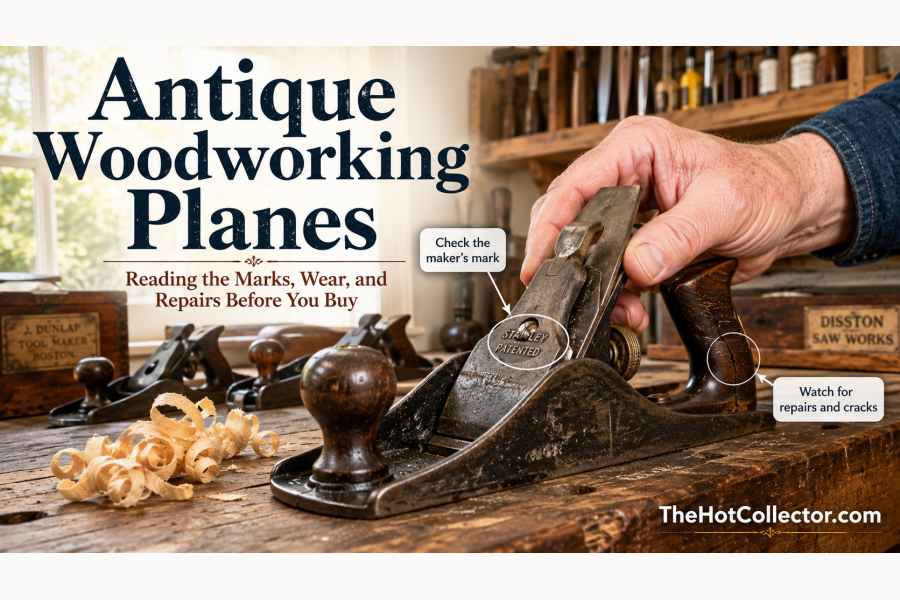
An antique woodworking plane rarely looks dramatic sitting on a flea-market table. It may be dusty, spotted with rust, and surrounded by mismatched screwdrivers and old saws. To an experienced tool collector, however, that small iron body can be a mechanical history lesson hiding in plain sight.
Woodworkers used planes to flatten boards, smooth surfaces, shape moldings, trim joints, and prepare lumber long before electric sanders and powered jointers took over much of the work. Early examples were commonly made from dense hardwood with an iron cutter held by a wooden wedge. During the 19th century, adjustable cast-iron planes became increasingly important, especially after inventors improved the mechanisms controlling blade depth, alignment, and mouth opening.
Names such as Stanley, Bailey, Millers Falls, Sargent, and Ohio Tool Company now carry strong recognition among collectors. Stanley’s Bailey-pattern bench planes are especially popular because their long production history created numerous variations. A plane that appears ordinary at first may belong to a short-lived manufacturing period identified by a particular lever cap, frog design, patent date, casting mark, or tote shape.
Collector’s Tip: begin with the entire plane, not just the brand name. A desirable body can lose much of its appeal when its blade, lever cap, frog, knob, or rear handle came from a different period. These assembled examples are often called “marriages” by collectors. They may still be perfectly usable tools, but they are usually less desirable than an original, period-correct plane.
Turn the plane over and inspect the sole. Heavy scratches are normal on a working tool, but deep pitting near the mouth can be troublesome. Cracks around the mouth, sides, or frog seat matter even more because they may weaken the casting. Old iron bodies were sometimes broken by falls from workbenches and later repaired by brazing or welding. A careful repair can make a plane usable again, but it should always be disclosed and priced accordingly.
The blade also deserves attention. Many old cutters were sharpened repeatedly until very little metal remained. A short original blade may be historically correct but impractical to use. A modern replacement blade may improve performance while reducing originality. Neither situation is automatically bad; the important part is knowing what you are buying.
Right now on eBay
Wooden knobs and rear handles—often called totes—are among the most frequently damaged parts. Look closely for hairline cracks, glued breaks, filled chips, and newly made replacements. A repaired tote can still display beautifully, especially when the work was done neatly. Sloppy glue lines, mismatched wood, or aggressively sanded surfaces are less appealing.
Watch Out For: fresh paint can conceal more than cosmetic wear. Some sellers repaint the japanned interior surfaces of metal planes to make them look cleaner. Collectors often prefer surviving original japanning, even when it shows honest loss. New paint may cover rust, filled cracks, or casting damage, so inspect edges and screw holes for signs that the finish was recently applied.
Maker’s marks can appear on the blade, lever cap, body casting, adjustment hardware, or wooden stock. On wooden molding planes, stamped names may identify the maker, owner, retailer, or city. Repeated owner stamps are not necessarily damage. They can reflect the long working life of a tool that passed through several shops.
The most valuable examples are not always the prettiest. Some collectors seek rare sizes, unusual transitional designs, specialized molding profiles, or early patented adjustments. Others prefer common user planes in excellent working condition. The Stanley No. 4 smoothing plane, for example, is widely available, but collectors still enjoy comparing its many production variations. Scarcity matters, yet condition and completeness often determine whether a particular example feels special.
Why Collectors Care: these tools retain physical evidence of skilled labor. Worn handles show where a carpenter’s hand rested. Sharpening marks reveal years of maintenance. Small initials may connect the plane to a cabinetmaker, patternmaker, shipwright, or home workshop. Unlike many antiques that spent their lives behind glass, woodworking planes were expected to earn their keep.
Before buying, check that the adjustment wheel turns, the lateral lever moves, the frog sits correctly, and the screws are not stripped or frozen. Avoid forcing stubborn hardware at a sale. A broken screw can turn a minor cleaning project into a frustrating restoration.
A good antique plane does not need to look untouched. In fact, spotless tools sometimes deserve more suspicion than worn ones. The best examples balance originality, mechanical completeness, and believable use. Once you learn to read those details, a box of rusty tools becomes something much more interesting—a row of individual machines, each carrying the fingerprints of the craftsperson who once depended on it.