
Vintage Mego Superheroes: How to Spot Original Figures, Clothing, and Accessories
- Jul 2026
- Rigo
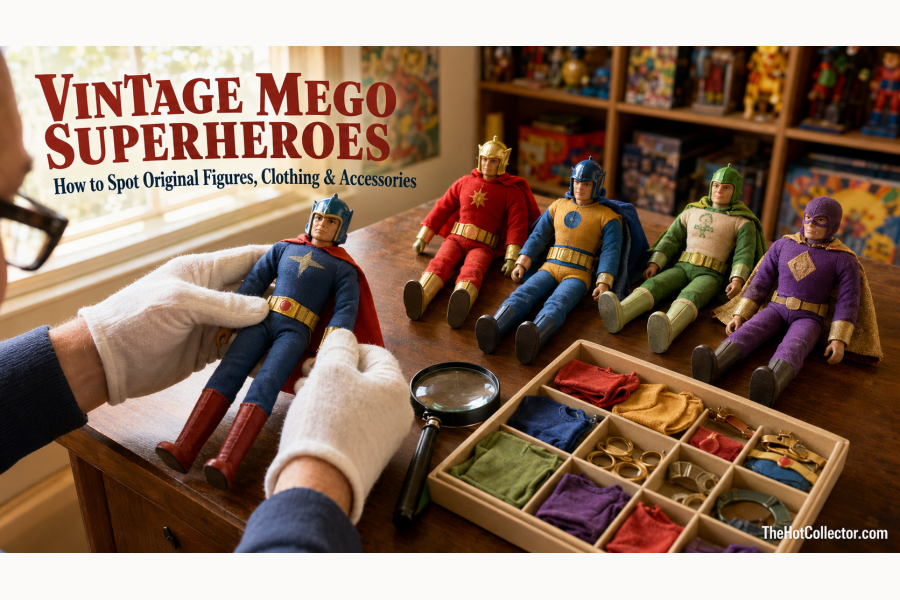
Before superheroes filled entire toy-store aisles, Mego gave children of the 1970s something that felt remarkably close to holding a comic-book character in their hands. Batman, Superman, Spider-Man, Captain America, Wonder Woman, the Green Goblin, and many others appeared as approximately eight-inch figures with removable cloth costumes and articulated bodies. They were toys meant to be dressed, posed, traded, and sent on adventures across living-room furniture. Decades later, those same qualities make complete and original examples challenging for collectors to find.
Mego was founded in 1954, but its best-known period began after Marty Abrams took charge in 1971 and moved the company toward licensed characters. The company’s official history credits its eight-inch figures and interchangeable bodies with establishing a widely adopted action-figure format. Its World’s Greatest Super Heroes line brought characters from both DC and Marvel Comics into a shared toy style, while other Mego lines covered Star Trek, Planet of the Apes, television personalities, monsters, and additional pop-culture properties. Mego’s official history provides an overview of that transformation.
A loose vintage Mego may look simple at first: a head, cloth outfit, boots, belt, cape, and perhaps a character-specific weapon. The difficulty begins when a collector tries to determine whether all those pieces originally belonged together. Mego reused bodies and certain costume components, children frequently swapped clothing between characters, and damaged pieces were often replaced. Modern companies and customizers have also produced convincing replacement bodies, costumes, heads, boots, belts, capes, and accessories.
The body is one of the first places worth examining. Early Type 1 male bodies were less muscular, used visible metal rivets, and were held together with elastic. Later Type 2 bodies had a more muscular shape, plastic joints, and an internal hook-and-rubber assembly. Both are legitimate vintage constructions when paired with the correct character and production period. A body type that does not match the expected release is not automatically evidence of deception—Mego made running changes—but it should encourage closer research.
Condition problems are common because these were heavily played-with action figures rather than objects originally sold as collectibles. Elastic can loosen, rubber connectors can deteriorate, limbs may crack around the joints, and heads can become discolored or hardened. A figure that stands poorly may simply need restringing, but cracked knees, split wrists, repaired necks, or glued joints deserve careful attention. Repairs can make a figure displayable, yet they should be disclosed because they affect originality and collector interest.
Right now on eBay
Clothing often tells more of the story than the body. Original costumes may show light fading, frayed seams, stretched fabric, small stains, or wear around snaps and openings. Those signs should make sense for the figure’s age and construction. A bright, crisp suit on a body showing decades of wear may be a replacement, although a carefully stored original outfit can also remain remarkably clean. Collectors should compare the fabric texture, stitching, hem style, emblem placement, fasteners, and colors with documented examples rather than relying on age alone.
Small accessories frequently separate an ordinary loose figure from a difficult-to-complete collectible. Green Arrow, for example, originally came with several character-specific pieces, including his hat, bow, quiver, belt, and boots. Thor’s hammer and helmet are commonly missing, and the helmet’s attachment point may be broken. The Lizard’s removable laboratory coat is another component that often disappears. Buying an incomplete figure cheaply can be tempting, but locating one authentic missing part may prove harder and more expensive than purchasing a complete example from the beginning.
Reproductions are not inherently bad. They allow collectors to restore childhood figures, build affordable displays, and enjoy characters whose original accessories may be scarce. The issue is disclosure. A reproduction belt, boot, cape, or weapon should not be represented as an original Mego component. Some professionally manufactured replacements carry markings such as “DM,” “CTV,” “7th Street Toys,” or “Figures, Inc.,” depending on the maker and part. Other differences may include plastic hardness, thickness, color, molding details, stitching, or surface finish. The Mego Museum Accessory Check was created specifically to compare known originals, variations, and factory-made replacements.
Collectors should avoid using one universal test for every figure. A marking that proves one Superman head is a replacement may not apply to Batman, Thor, or the Riddler. Even closely related releases can have legitimate variations. The Mego Museum documents, for example, that an original Superman head normally carries copyright information on the back of the neck, while the company’s rare Clark Kent secret-identity head is distinguished by the absence of that marking. Boots and accessories can present entirely different clues. Careful identification usually requires a character-by-character comparison.
Packaging adds another level of complexity. Mego figures appeared in solid boxes, window boxes, blister-card packages, retailer-specific cards, and international packaging. Card artwork and copyright dates can help identify a release, but a correct-looking package does not guarantee that the figure inside has remained untouched. Collectors should look for evidence of resealing, replaced bubbles, disturbed fasteners, mismatched inserts, unusual adhesive, color photocopying, or wear that seems inconsistent between the package and its contents. An authentic vintage figure placed into recreated packaging should be described as a recard, not as factory sealed.
The strongest purchase is not necessarily the cleanest figure available. It is the one the buyer understands. Ask for clear photographs of the back of the head, torso markings, joints, costume seams, feet, accessories, and packaging edges. Request a written list of any reproduction parts, repairs, or replacements. Then compare the figure with reliable character galleries before deciding what it is worth to you.
Vintage Mego superheroes remain appealing because their cloth costumes and expressive designs capture a playful chapter of comic-book history. A slightly faded cape or gently worn suit can give an original figure character. What matters is knowing which parts survived from the 1970s, which were replaced later, and whether the seller has represented them honestly.