
Nintendo World Championships 1990: How Collectors Identify the Legendary NES Competition Cartridge
- Aug 2026
- The Hot Collector
Most rare video games became rare because relatively few people bought them.
The Nintendo World Championships 1990 cartridge is different. It was never meant to sit on a Toys "R" Us shelf beside Super Mario Bros. and The Legend of Zelda in the first place.
In 1990, Nintendo took a nationwide competition across the United States, challenging players in a timed contest built around modified portions of Super Mario Bros., Rad Racer, and Tetris. Nintendo continues to reference that 1990 competition in its modern Nintendo World Championships: NES Edition, which deliberately revisits the speed-running spirit of the original event.
The special NES cartridges used during the competition became collectibles almost by accident.
Gray versions were connected to the competition itself, and 90 finalists received cartridges after the event. Nintendo also produced 26 distinctive gold versions for winners of a Nintendo Power magazine contest. Those tiny production numbers helped turn both versions—especially the gold cartridge—into some of the most recognizable trophies in retro video-game collecting.
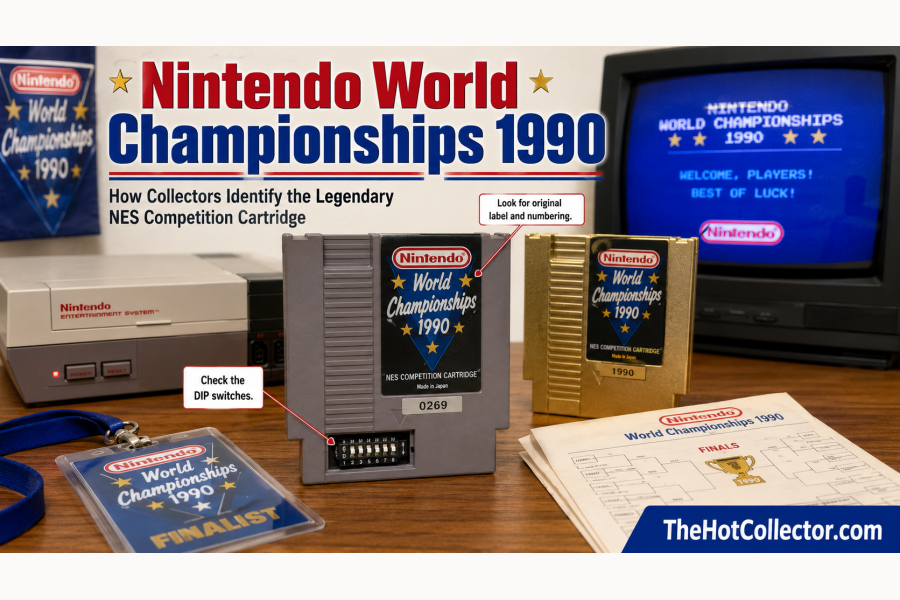
Collector's Tip: if someone claims to have found one, don't begin with the color of the plastic. Begin with the construction.
A genuine NWC cartridge is unlike an ordinary NES game. One of its most obvious characteristics is an exposed bank of DIP switches used to adjust the competition's time limit. The internal hardware and physical construction are therefore important authentication points, particularly because an ordinary gray NES shell by itself proves nothing.
Gray cartridges also carry identifying labels and individual numbers. Provenance becomes particularly interesting when a numbered example can be connected to an actual contestant. Heritage Auctions sold gray cartridge #0176 in August 2024 for $62,500; its auction history identified it with Detroit champion John Wyman.
That's the sort of provenance collectors love because the cartridge stops being merely a rare game and becomes an artifact from a specific moment in gaming history.
Condition, however, can be strange with NWC cartridges.
Collectors accustomed to sealed games may expect the most valuable pieces to look almost untouched. Competition cartridges were working equipment. They could be handled, transported, labeled, scratched, or otherwise show evidence of their unusual life. Wear doesn't automatically destroy their importance.
A genuine, heavily used cartridge can be far more desirable than a beautiful reproduction.
Right now on eBay
Look Closely: study the label before deciding that damage makes an NWC cartridge undesirable.
Known examples can have substantial label wear, scratches, handwriting, discoloration, or missing portions. One gray cartridge sold through Heritage with a Wata 5.0 grade, demonstrating that collectors remain interested even when the cartridge is far from mint.
Gold cartridges bring another level of caution.
The gold shell immediately attracts attention, but Nintendo produced other gold-colored cartridges, and replacement shells can be manufactured. A gold plastic case alone is therefore not authentication. Serious examination should consider the cartridge's circuitry, switches, label characteristics, construction, known history, and ideally professional verification.
Watch Out For: reproduction shells and labels.
The more valuable a collectible becomes, the more worthwhile it becomes for someone to imitate it. A convincing outer shell can fool a buyer who has only studied online photographs. For an NWC cartridge carrying a five- or six-figure asking price, detailed internal and external comparison is not excessive—it is basic due diligence.
The game's behavior itself is another clue. The original competition software combines specially modified challenges based on Super Mario Bros., Rad Racer, and Tetris rather than functioning like an ordinary retail cartridge. Contemporary reporting around a 2024 gold-cartridge auction noted that actually testing the cartridge is one way to help verify that the hardware behaves as expected.
That doesn't mean you should casually insert a six-figure collectible into an aging NES without understanding the risks. Expensive examples deserve careful handling, and inspection by experienced specialists is much smarter than experimenting.
Grading can add another layer of confidence, but read the holder instead of simply admiring the number on it. Confirm the version, grade, certification number, and any identifying information included by the grading company.
Recent auction results demonstrate why that effort matters. In July 2024, CGC reported that a gray NWC cartridge sold through Goldin for more than $78,000. A month later, CGC reported the $207,400 sale of a gold example. Those aren't prices to assume for every cartridge, but they illustrate why authenticity and provenance are treated so seriously.
Why Collectors Care: the NWC cartridge represents something different from a conventional rare game.
It wasn't simply entertainment software.
It was competition equipment.
These cartridges were present during a period when Nintendo was turning home video games into enormous public events years before modern esports became commonplace. Players traveled, competed for high scores, and chased championship titles using hardware created specifically for the event.
The gray cartridges connect directly to those competitors. The gold versions connect the event to the readers of Nintendo Power and the culture surrounding Nintendo during the NES era.
That's why collectors sometimes refer to Nintendo World Championships cartridges as grail pieces. Their rarity is certainly part of the attraction, but scarcity alone doesn't explain it.
They combine Nintendo, the NES, competitive gaming, Nintendo Power, unusual hardware, documented ownership, and one of the best stories in retro-game collecting.
Plenty of rare NES cartridges are difficult to find.
The Nintendo World Championships 1990 cartridge is one of the few that feels like a trophy even before you put it on the shelf.