
WWII M1 Helmets: How Collectors Identify Wartime Shells, Liners, and Reproductions
- Aug 2026
- The Hot Collector
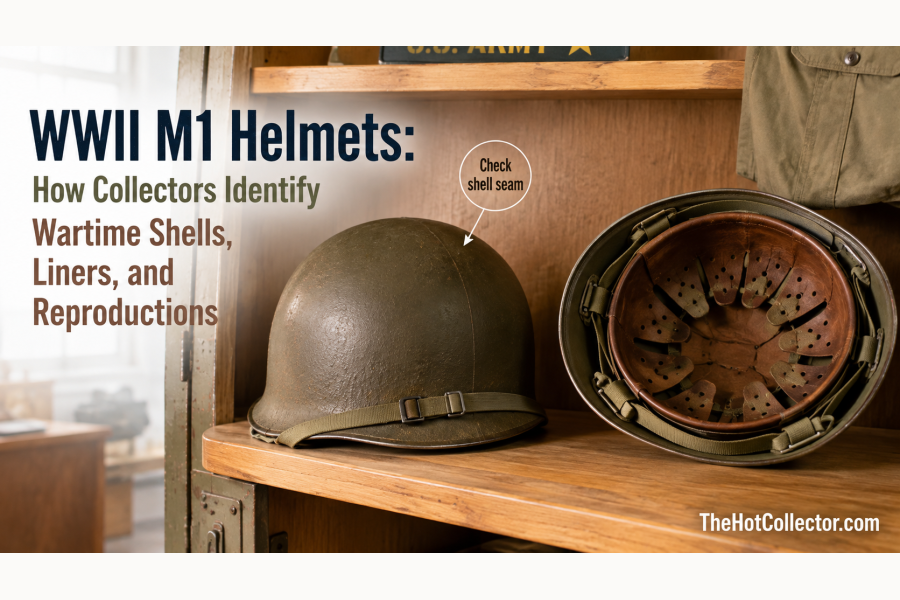
Few pieces of American militaria are as instantly recognizable as the  M1 helmet.
The silhouette is simple: rounded steel shell, short brim, web chinstrap, and a separate liner tucked inside. Yet once you start collecting them, you quickly realize that “M1 helmet” covers a huge range of production periods, manufacturers, repairs, field modifications, and postwar combinations.
That is exactly why experienced collectors rarely buy one based on appearance alone.
The first thing to understand is that the helmet is really two collectibles working together: the steel shell and the liner. A genuine wartime shell can easily be paired with a later liner, while a correct liner can be placed inside a postwar shell. Mixed examples are common because these helmets remained useful military equipment for decades.
Collector’s Tip: inspect the shell and liner separately before deciding whether the helmet is a matched WWII example.
One of the most discussed features is the rim seam. Early M1 shells generally have the seam at the front, while later production moved the seam to the rear. That makes a front-seam helmet a useful clue when researching WWII production, but it is not enough by itself to prove originality.
The chinstrap loops, commonly called bales or bails by collectors, matter too. Earlier shells used fixed loops, while later wartime production introduced swivel loops. Both can belong on legitimate WWII helmets depending on when the shell was made.
Heat stamps are another important clue. These numbers and letters were stamped into the inside of the steel shell during production and can help collectors estimate when a helmet was manufactured and which company made it.
Look Closely: the stamp is often faint, hidden beneath paint, or difficult to see under decades of grime. Avoid aggressively sanding the shell just to expose it. Removing original finish can destroy exactly the evidence you are trying to preserve.
Right now on eBay

US Army Rear Seam M1 Helmet McCord/Schlueter heat lot stamped price for 10 pcs
New


WWII rear seam swivel bale stainless rim M1 helmet heat stamp # 502 RSSS41
New


US ARMY REAR SEAM M-1 HELMET LOT. # M 337 D POST WAR REPLACEMENT CHINSTRAP
Used


WWII US Army M1 Helmet Liner Original Leather Chinstrap Named Warren Mattson
Used


Original Vintage US Army M1 Helmet with Firestone Liner Rear Seam Named
Used

Vintage 67 Sargent 76th Infantry US Army M1 Helmet & Liner Vietnam Korean War?
Used

WWII rear seam swivel bale stainless rim M1 helmet heat stamp # 626 RSSS39
New

WWII rear seam swivel bale stainless rim M1 helmet heat stamp # 623 RSSS42
New


WWII-Korea US Army M1 Helmet CAPAC Liner Named Lieutenant Colonel Vitrauo
Used


US ORIGINAL M1 HELMET LINER LEATHER CHINSTRAP DOT MAKER STAMP LATE WW2 - KOREA 3
Used


Vintage US Army M-1 Helmet Fiberglass Liner WW2 WWII Vietnam Leather Headband
Used

Vtg WWII M1 Helmet Swivel Bail Front Seal Original Paint Army Military No Liner
Used

WWII rear seam swivel bale stainless rim M1 helmet heat stamp # 602 RSSS37
New

WWII rear seam swivel bale stainless rim M1 helmet heat stamp # 700 RSSS38
New


Matching Identified WWII US Army McCord M1 Helmet 1053A Firestone Liner
Used

Vintage WW2 US Military Front Seam McCord M1 Helmet w/ Firestone US 138 Liner
Used


WWII M1 Helmet Rear Seam Fixed Bale National Guard MP Repaint Original Liner
Used


WWII rear seam swivel bale stainless rim M1 helmet heat stamp # 509 RSSS40
New



Rare WWII M1 Helmet Liner St. Clair SC Low Pressure Rayon Suspension Leather
Used


Original Late WWII M1 Helmet USGI USMC Complete RSSB Original Paint With Liner
Used


Original ww2 McCord M1 Helmet Shell With 1975 DSA Liner 958D Serial Number
Used


Original US Army M1 Helmet w/ Liner Ground Troops Type I Vintage Vietnam Era
Used


US Army M1 Helmet Liner Ground Troops Type 1 DLA100-80-86? Suspension Assembly
Unspecified


WWII Front Seam M1 Helmet Swivel Bails w/ Original Westinghouse Liner Named
Used


Vtg US Army M1 Helmet Liner WW2 No Straps Reads Bobby Inside Great Patina
Used

Original 1943 WWII USN SeaBee Front Seam Swivel Bail M1 Helmet -was my Uncle’s
Used

WWII M1 Helmet US Army Combat GI WW2 Infantry Vietnam Korean Korea War Steel Pot
Used


WW2 US Army M1 Helmet, WW2 Gear, WW2 Uniform, WW2 Helmet Metal Steel Shell Re...
New

Korean War/Vietnam War Era Rear Seam M1 Helmet Shell Dark Green (I 9433)
Used


Original WWII US Army M1 Helmet M1944 Camouflage Net and Elastic Band M44 w/ Tag
Used


Vintage US Army M-1 helmet & rare BSA liner collectible original military item
Used

WWII US Army M1 Helmet & CAPAC Liner – Top Pots 551st PIR Medic Airborne Conv.
New


Vietnam Era US Army M1 Helmet Complete w/Liner Dated 1973, Camo 1969, 1960s Pot
Unspecified

US Army M1 Helmet W/ Mitchell Camo Pattern Cover Vietnam War Era Original Named
Used


The liner deserves just as much attention.
The U.S. Army’s own historical records document the development of the M1 helmet liner as part of wartime research and production. Early liners and later wartime versions can differ in materials, suspension, hardware, and maker markings, so the inside of the helmet can tell a very different story from the outside.
Do not assume that age equals authenticity.
Original helmet components have been mixed, repainted, restored, and assembled into “complete” examples for decades. Reproduction chinstraps, insignia, liner webbing, decals, and camouflage finishes can make an ordinary shell look far more important than it really is.
Watch Out For: paint that appears too perfect.
Genuine wartime finishes often show scratches, oxidation, edge wear, stains, and different layers from field use or later depot repainting. A helmet with flawless textured paint, bright markings, and pristine straps deserves careful inspection—especially when the seller is claiming a rare unit or airborne connection.
Unit markings can dramatically increase collector interest, but they also create one of the biggest areas for fakery. Divisional insignia, officer bars, medic crosses, and camouflage patterns should be studied closely for age, wear, paint consistency, and provenance.
The Smithsonian preserves wartime M1 examples connected to specific individuals, including a helmet associated with Brigadier General Claire Chennault. That kind of documented ownership shows why provenance can transform an ordinary military object into a much more important historical artifact.
The same logic applies to named helmets.
A laundry number, service number, handwritten name, or period photograph can open an entire research trail. Sometimes a collector can connect a helmet to enlistment records, unit histories, or family provenance. Even when the soldier was not famous, that connection can make the object far more meaningful.
Why Collectors Care: M1 helmets are personal objects.
They were worn, carried, stacked, repainted, dropped, slept beside, and used in places where history was unfolding in real time. A dent may be simple handling damage. A scraped rim may come from years of ordinary service. Not every mark has a dramatic battlefield story, but every authentic example reflects the military system and the people who used it.
That is also why over-restoration can hurt them.
A rusty but honest shell with original finish may tell a better collecting story than a freshly painted example assembled from reproduction parts. Clean does not always mean better.
Before buying an expensive helmet, examine the shell seam, loops, chinstrap hardware, interior stamp, liner suspension, rivets, markings, and overall wear pattern. Ask whether any straps or webbing have been replaced. Ask whether the shell and liner were found together.
Most importantly, buy the helmet that actually exists—not the story someone wants you to believe.
The best WWII M1 helmets are not always museum-perfect. They are the ones where the construction, wear, parts, and history all make sense together.