
PSA 10
Collector Quick Guide
What collectors look for
Collectors look for sharp corners, clean edges, strong centering, an attractive surface, and excellent overall eye appeal. Even tiny defects can separate a PSA 10 from a lower grade.
How to identify originals
Check the certification number through PSA's verification resources and inspect the holder and label carefully. Remember that the PSA 10 grade applies to the card's assessed condition—it does not mean every PSA 10 card will look absolutely identical.
Red flags / reproductions
Be cautious of altered cards, counterfeit cards, fake holders and labels, or listings using photographs that hide surface problems. A PSA-style holder by itself should never be treated as proof without checking the certification.
Related collectibles
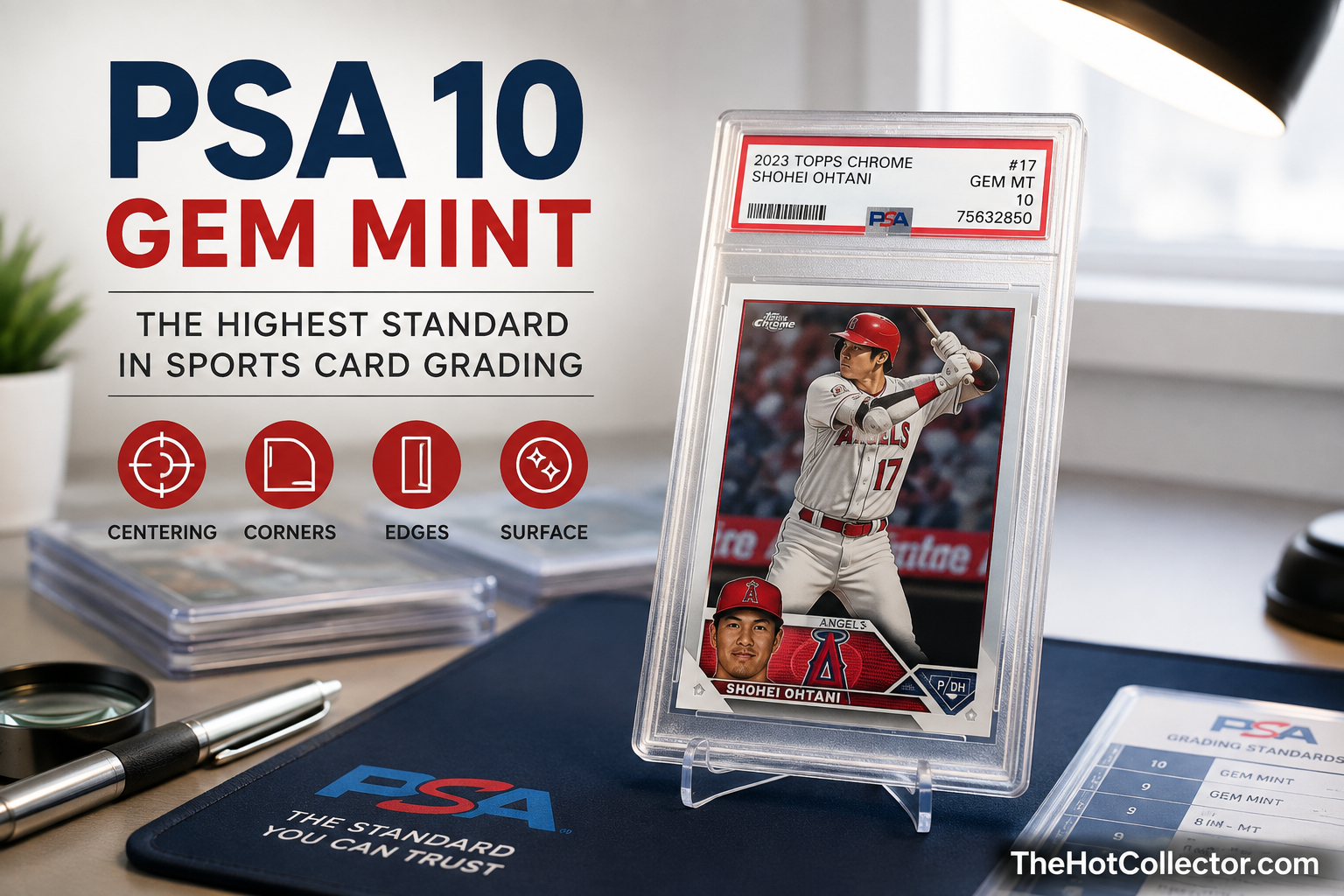
The number 10 has become one of the most powerful numbers in modern card collecting. Place it beside the letters PSA on a grading label and an otherwise familiar sports card can suddenly become the centerpiece of a collection. A PSA 10 represents PSA's Gem Mint grade, the highest numerical grade on its standard card grading scale. But understanding what that designation means requires looking beyond the number itself.
Professional Sports Authenticator was established in 1991 as third-party authentication and grading became increasingly important to the sports-card hobby. Before standardized grading services became widespread, descriptions such as "Mint," "Near Mint," and "Excellent" could vary considerably from seller to seller. One dealer's Mint card might have been another collector's Near Mint example. Encapsulation and standardized numerical grading gave buyers and sellers a common reference point for discussing condition.
PSA defines Gem Mint 10 as a virtually perfect card. Characteristics include four sharp corners, sharp focus and full original gloss, while staining is not permitted. PSA also distinguishes a 10 from a PSA 9 Mint card, which can exhibit a minor flaw such as a slight wax stain on the reverse, a minor printing imperfection, or slightly off-white borders. That difference between PSA 10 Gem Mint and PSA 9 Mint may sound small on paper, but in the collector marketplace it can be enormous.
Centering is another part of the equation. Collectors sometimes assume a PSA 10 must have mathematically perfect 50/50 borders, but PSA's published standards allow approximately 55/45 to 60/40 centering on the front and 75/25 on the reverse for a Gem Mint 10. That is an important detail because it helps explain why two cards carrying the same grade may not look perfectly identical.
The rise of online auctions, population reports and registry collecting made the number on the holder even more visible. Buyers could compare not simply a particular player and card but the population of that card at each grade. Suddenly, owning one of the finest graded examples became a collecting goal of its own. The grade wasn't merely describing the collectible anymore; for many collectors, it became part of the collectible.
That transformation is why PSA 10 deserves its own glossary entry. It represents the convergence of card history, condition, authentication and the modern pursuit of measurable quality.
Right now on eBay
The easiest mistake for a new collector is assuming that a card pulled directly from a fresh pack should automatically receive a 10. Manufacturing defects can exist before anyone ever handles the card. Slightly uneven borders, rough factory cuts, tiny print defects, surface scratches or imperfect corners can all be present on a card that has never been played with.
When examining a potential Gem Mint sports card, collectors commonly concentrate on four areas: centering, corners, edges and surface. Corners should appear sharp rather than softened or frayed. Edges deserve close inspection for chipping, particularly on cards with dark borders. The surface can hide scratches, print lines, dimples, stains and other defects that become much easier to see when the card is tilted beneath strong light.
This is also why two cards that look almost identical through a plastic sleeve can receive different grades. One may have a tiny surface indentation that only appears at an angle. Another could have a corner showing extremely slight wear under magnification. A third might simply have noticeably better centering. Collectors submitting cards for grading often learn quickly that the difference between "looks perfect to me" and Gem Mint can be surprisingly small.
Then there is the PSA 10 premium. Depending on the card and its graded population, the market difference between a PSA 9 and PSA 10 can be substantial. Scarcity matters: if thousands of examples exist in PSA 9 but relatively few have earned a 10, collectors competing for the highest grade can push prices considerably higher. On other cards where 10s are plentiful, the premium may be far less dramatic.
Population numbers should therefore be considered alongside demand rather than in isolation. A low population does not automatically make a card valuable if few people want it, while a relatively common PSA 10 belonging to an enormously popular player can still attract strong competition.
Collectors should also remember that the grade does not replace their own eyes. Two PSA 10 examples of the same card can differ slightly in centering, print quality and overall eye appeal while remaining within the grading standard. Experienced buyers frequently compare several 10s before choosing the example they find most attractive.
That's ultimately what makes PSA 10 fascinating. It appears to be a simple number, yet behind that number are manufacturing tolerances, preservation, professional judgment, scarcity and collector psychology. For serious card collectors, learning to understand those details is far more useful than simply chasing the biggest number on the holder.