
Draped Bust Half Cent 1800 - 1808
Collector Quick Guide
What collectors look for
Original condition, age, maker marks, materials, completeness, unusual variants, and documented history usually matter most.
How to identify originals
Compare markings, construction details, finish, size, period-correct materials, and known design features before assuming authenticity.
Red flags / reproductions
Watch for reproductions, heavy restoration, replaced parts, fantasy pieces, unclear photos, and listings with vague descriptions.
Related collectibles
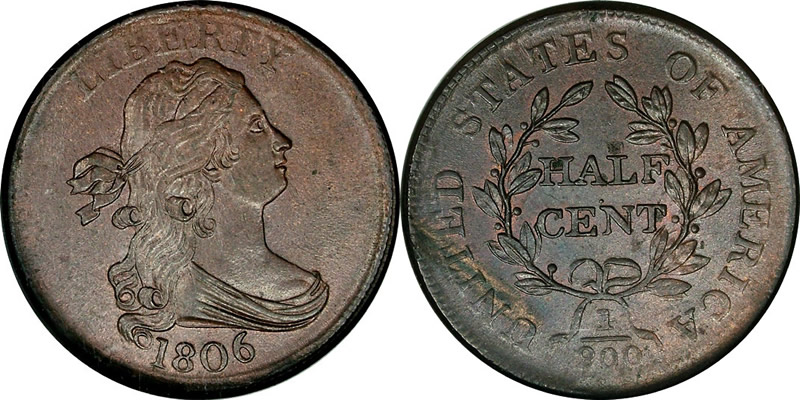
During the late 18th and early 19th centuries, the half cent faced a long period of neglect and was often unwanted in America. It circulated scarcely for 60 years, mainly in the larger cities of the rapidly expanding nation. Dr. Warren A. Lapp, a numismatist, fittingly referred to these coins as the "little half sisters" and considered them the stepchildren of U.S. coinage.
The half cent's journey began in 1793 with the Flowing Hair design, which was later replaced by Engraver Robert Scot's Liberty Cap motif in 1794. Throughout its existence, the half cent underwent various design, weight, and edge-marking changes similar to contemporary cents.
The Draped Bust design, featuring an ample Liberty based on a drawing by renowned artist Gilbert Stuart, made its debut on the 1800 half cents. However, the process of transitioning from the Flowing Hair designs was not straightforward. Mint Director Henry William DeSaussure commissioned John Eckstein to create bas-relief models from Stuart's drawing, resulting in a portrayal of Liberty that differed significantly from the original sketch.
Draped Bust half cents also came in several varieties, with some coins struck on stock made from cut-down large cents, while others were made from England's Boulton and Watt Co. planchets. Despite this variety, demand for the denomination was relatively low, and no half cents were struck in 1801.
The year 1802 saw a unique situation where the 1800 obverse die was overdated to 1802 and combined with two different reverse dies. Some coins even featured the 1797 reverse with its single leaves at the top. The coins dated 1803 also exhibited minor variations in the fraction.
The year 1804 was particularly eventful, with variations in the date and reverses with or without stem ends. These coins continued to be struck through 1806 due to the U.S. Mint's scarcity of high-quality die steel.
In 1807, John Reich, a German-born artist, joined the Mint and designed new coins for various denominations. The Draped Bust half cent, however, inexplicably continued with three varieties dated 1808.
Finally, in 1809, Reich's Classic Head design replaced the Draped Bust on half cents. By then, a total of 3,416,950 Draped Bust half cents had been struck at the Philadelphia Mint. The series didn't produce any proofs or presentation strikes.
Over time, half cents of the Draped Bust series have become rare in full, mint red. The attractive ones available today tend to display an even, glossy brown. However, surviving coins often show signs of wear, mechanical damage, and corrosion due to the soft copper composition.
Despite the rich history and fascinating journey of half cents, they have not received as much scholarly attention as large cents or early silver coins. Only in recent years have comprehensive works, such as Roger S. Cohen's "American Half Cents, the Little Half Sisters," and Walter Breen's "Encyclopedia of U.S. Half Cents," shed light on this long-neglected series.
Interestingly, due to the historical neglect and lack of scholarly research, Draped Bust half cents are relatively undervalued compared to large cents or early silver coins from the same era. This provides a unique opportunity for collectors to own a piece of history and witness the exciting growth and development of the United States during its early years.
Right now on eBay
The relatively low value of Draped Bust half cents compared to other contemporary coins presents an intriguing contrast for collectors. These coins offer not only a tangible piece of history but also a window into the fascinating years of America's early growth and development.
While large cents and early silver coins have been extensively studied and researched since the 19th century, half cents remained relatively overlooked until the latter half of the 20th century. Ebenezer Gilbert's 1916 handbook, "The United States Half Cents," provided some initial insights, but it wasn't until Roger S. Cohen's "American Half Cents, the Little Half Sisters" in 1971 and Walter Breen's "Encyclopedia of U.S. Half Cents" in 1983 that comprehensive and scholarly treatments of the series became available.
This long period of neglect has contributed to the undervaluation of Draped Bust half cents in the modern market. Collectors who appreciate the historical significance and scarcity of these coins can acquire them at a more affordable price compared to their larger counterparts or early silver issues from the same era.
Acquiring a Draped Bust half cent can be like owning a piece of art with an intriguing story. The design variations and historical context add layers of fascination for numismatists and history enthusiasts alike. Each coin tells a unique tale of the early United States, the challenges faced by the young Mint, and the artistry involved in creating these miniature masterpieces.
When examining Draped Bust half cents, collectors should be aware of the various varieties and potential wear and damage on these soft copper coins. Some coins may display vibrant mint red color, while others might showcase a beautiful, even, glossy brown patina. The condition and striking quality can vary due to the longevity of die usage, and it is common to find signs of wear, especially around Liberty's hair and the drapery on the obverse.
For type collectors or those interested in a specific period, the 1800 and 1806 half cents have seen hoards surface in the past, which means collectors may find more readily available specimens in varying degrees of red coloration. However, true mint red examples for any date within the Draped Bust series are rare and highly sought after.
As the popularity of half cents grows, thanks to the renewed interest spurred by comprehensive works, it is likely that their value will gradually increase. Collectors who recognize the significance of these coins and their place in American history may discover that acquiring Draped Bust half cents is not only a rewarding endeavor but also a wise investment in the numismatic realm.
In conclusion, the Draped Bust half cent stands as an alluring and underappreciated series in American numismatics. From its neglected past to its current status as a valuable historical artifact, these coins offer a glimpse into a formative period of the United States. As more collectors recognize their unique appeal, the Draped Bust half cent is poised to gain the attention and recognition it truly deserves in the world of coin collecting.