
Washington Quarter 1932 - 1998
Collector Quick Guide
What collectors look for
Original condition, age, maker marks, materials, completeness, unusual variants, and documented history usually matter most.
How to identify originals
Compare markings, construction details, finish, size, period-correct materials, and known design features before assuming authenticity.
Red flags / reproductions
Watch for reproductions, heavy restoration, replaced parts, fantasy pieces, unclear photos, and listings with vague descriptions.
Related collectibles
In 1931, the United States grappled with the grim realities of the Great Depression, with soup kitchens, rampant unemployment, and the Dust Bowl casting a shadow over the nation. However, a glimmer of hope awaited in 1932, the bicentennial year of George Washington's birth. The Treasury Department, in collaboration with the Commission of Fine Arts and the Washington Bicentennial Commission, announced a design competition for a half dollar coin to honor the founding father.
The competition's rules specified that designs should draw inspiration from the famous bust of Washington created by French sculptor Jean Antoine Houdon. This lifelike bust, fashioned from a life-mask obtained at Mount Vernon in 1785, was widely revered. Over 90 entrants submitted nearly 100 designs, ranging from amateurish to impressive. One design, in particular, stood out and earned unanimous approval from the Commission: a submission by Laura Gardin Fraser, renowned for her work on the Oregon Trail commemorative coin and wife of James Earle Fraser, the designer of the Buffalo nickel. Mrs. Fraser's design exuded power and artistic excellence, reminiscent of the golden era of numismatics championed by Theodore Roosevelt.
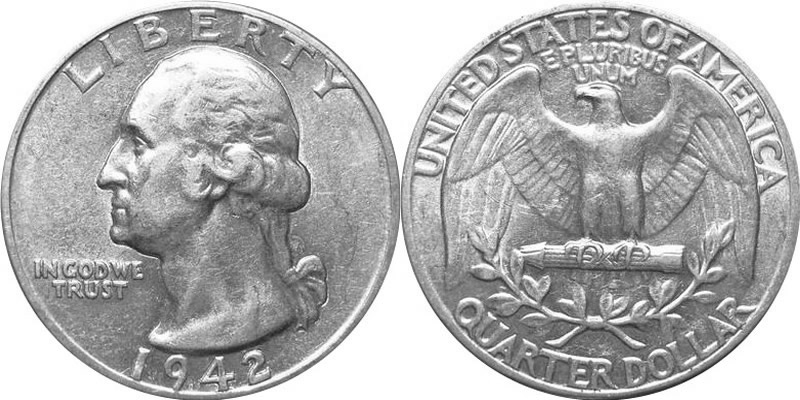
However, complications arose as Congress decided to shift its attention from changing the half dollar design to altering the quarter, thus bringing an end to the acclaimed Standing Liberty design introduced in 1916. Treasury Secretary Andrew Mellon, a collector of vast wealth and stature, refused to consider Fraser's design, ultimately choosing John Flanagan's proposal. Flanagan's design, although simple, was more suited to a portrait than a medallic art piece, characterized by low relief. Washington's left-facing image dominated the obverse, with LIBERTY above, the date below, and the motto IN GOD WE TRUST on the left. Mintmarks appeared under the wreath on quarters dated 1964 and earlier.
Right now on eBay
In 1965, the quarter's composition transitioned from  90% silver (from 1932-1964) to a clad material of 75% copper and 25% nickel bonded to a pure copper core. Another significant change occurred in 1975 when Jack Ahr's Bicentennial "Drummer Boy" design graced the reverse, featuring the dual date 1776-1976 on the obverse. In 1977, the original design returned.
Washington quarters remain highly sought after by collectors and are typically assembled by date and mint. With annual issuance except for 1933, these quarters offer a rich history of American coinage. Notably, the 1932-D and S quarters have low mintages, making them scarce issues. Additionally, mint-state 1936 Denver coins, despite their substantial mintage, are considered elusive, often eluding hoarders. Fortunately, diligent collectors like Wayte Raymond preserved many bank-wrapped rolls in the 1930s, providing modern enthusiasts with a wealth of history to explore.
The "Silver Series" of Washington Quarters spans from 1932 to 1964; during many years in the series it will appear that certain mints did not mint Washington Quarters for that year. No known examples of quarters were made in 1933, San Francisco abstained in 1934 and 1949, and stopped after 1955, until it made proofs in 1968. Denver did not make quarters in 1938, and Philadelphia never stopped (except in 1933). Proof examples from 1936 to 1942 and 1950 to 1967 were struck in the Philadelphia Mint and in 1968 switched to the San Francisco Mint.