
Barber Quarter 1892 - 1916
Collector Quick Guide
What collectors look for
Original condition, age, maker marks, materials, completeness, unusual variants, and documented history usually matter most.
How to identify originals
Compare markings, construction details, finish, size, period-correct materials, and known design features before assuming authenticity.
Red flags / reproductions
Watch for reproductions, heavy restoration, replaced parts, fantasy pieces, unclear photos, and listings with vague descriptions.
Related collectibles
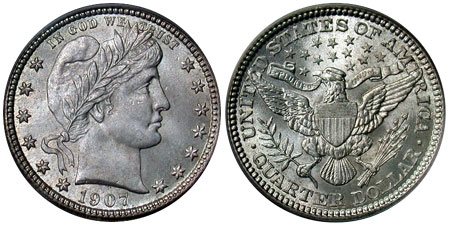
Coins are typically known for their designs rather than the artists behind them. The Mercury dime, the Franklin half dollar, the Walking Liberty half dollar, the Lincoln cent, and most other coins provide no overt clues to the designer's identity, except for perhaps their initials hidden somewhere on the coin's surface. For newcomers to the world of coin collecting, the term "Barber Coinage" might initially conjure images of haircuts or barber poles. In the realm of American coinage, only four designs are recognized solely by the names of their designers. Among these, Christian Gobrecht and George T. Morgan are renowned for their contributions to the creation of beautiful dollar coins, while the celebrated sculptor Augustus Saint-Gaudens crafted the magnificent 20th-century twenty-dollar gold coin. However, it is Charles Barber who is remembered not only for his coin designs but also for the controversies that swirled around his tenure.
Charles Edward Barber hailed from a lineage of engravers. Born in London in 1840, he journeyed to the United States with his father in 1852. William Barber, his father, worked as an engraver for private enterprises in New England until 1869 when he was appointed as the Chief Engraver of the United States Mint. Charles joined him as an assistant engraver at the mint's Philadelphia branch. Following William Barber's passing in 1879, President Rutherford B. Hayes appointed Charles as the Chief Engraver, solidifying his role in the annals of American coin design.
In 1887, Mint Director James P. Kimball expressed his belief that the United States' coinage was in need of a modernization, emphasizing the necessity of change. At his request, Senator Justin S. Morill introduced a bill authorizing the Treasury Department to redesign coins without the requirement of prior Congressional approval, as long as the design had been in use for twenty-five years or more. The Seated Liberty dime, quarter, and half dollar had remained virtually unaltered since 1837. Consequently, when the bill was enacted on September 26, 1890, these coins were the first to be slated for a transformation.
Right now on eBay
The Treasury Department, contrary to Charles Barber's advice, organized a competition to create new designs. Barber, Augustus Saint-Gaudens, and engraver Henry Mitchell were tasked with evaluating the entries. Unfortunately, the competition yielded poor results, primarily due to the judges' belief in their own superior design abilities compared to the contestants. Ultimately, Charles Barber achieved what he had sought all along. With the support of the new Mint Director Edward O. Leech, he was chosen to undertake the design work.
The Barber Quarter, adopted in 1892, features a depiction of Liberty, facing right in a style reminiscent of the Morgan Dollar. Liberty wears a Liberty cap adorned with a laurel wreath, with a ribbon tying her hair at the back of her neck. The motto IN GOD WE TRUST is positioned above her head, while the date appears below. Six stars on the left and seven stars on the right symbolize the original thirteen colonies. The reverse design mimics the Great Seal of the United States, showcasing an eagle with outstretched wings. The eagle clutches an olive branch with thirteen leaves in its right claw and a sheaf of thirteen arrows in its left. A ribbon with the motto E PLURIBUS UNUM is held in the eagle's beak, and thirteen stars grace the field. The designer's initial "B" is situated at the base of Liberty's neck.
When examining high-grade  Barber quarters, pay close attention to slide marks and light scratches, especially on the obverse. These coins were frequently collected in albums that employed plastic slides. Inspect Liberty's cheek, forehead, and the area above her eye for traces of wear. Additionally, scrutinize the "puff" of the Liberty cap for signs of wear. On the reverse, the eagle's wingtips, head, and tail are the areas most likely to exhibit wear.