
Draped Bust Large Cent 1796 - 1807
Collector Quick Guide
What collectors look for
Original condition, age, maker marks, materials, completeness, unusual variants, and documented history usually matter most.
How to identify originals
Compare markings, construction details, finish, size, period-correct materials, and known design features before assuming authenticity.
Red flags / reproductions
Watch for reproductions, heavy restoration, replaced parts, fantasy pieces, unclear photos, and listings with vague descriptions.
Related collectibles
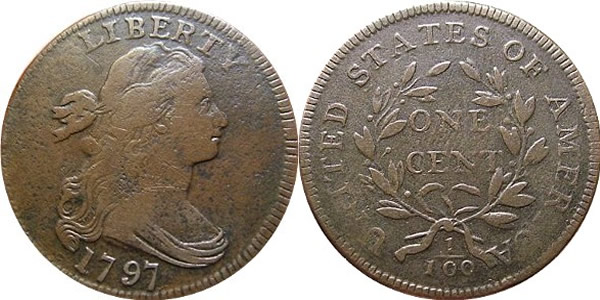
During the closing years of the 18th century, the one cent coin held unprecedented importance in American history. It served a crucial role in small transactions when foreign coins of various types were in circulation, making them less practical. However, the Mint encountered numerous challenges that hindered its ability to produce these vital coins effectively. Inadequate machinery, inexperienced employees, lack of funds, and frequent epidemics of yellow fever all contributed to the difficulties faced.
Interestingly, the cost of producing the one cent coin often exceeded its face value, highlighting the struggles faced by the Mint. At times, Congress even contemplated handing over coin production to private companies, considering the venture's apparent inefficiency.
The early years of the Philadelphia facility, which housed the Mint, were plagued by production issues and the scarcity of high-quality copper supplies. The metal used, often referred to as "black copper," was of inferior quality, resulting in coins that wore out quickly and were of poor overall quality. Consequently, the majority of the copper needed for coin production had to be imported from the Boulton & Watt Company in Liverpool, England.
The initial design for the one cent coin, created by Robert Scot in 1793, featured a flowing haired Liberty with a chain of thirteen links on the reverse. However, this design drew objections as it symbolized slavery and dominance, conflicting with Scot's intended message of unity. The chain was soon replaced by a wreath design. Over time, various artists contributed to the design, leading to the adoption of Scot's new Draped Bust design in July of 1796.
The Draped Bust design portrayed Liberty with flowing hair, a ribbon behind her head, and draped fabric at her neckline. The inscription "LIBERTY" appeared above the bust, with the date below. On the reverse side, the denomination "ONE CENT" was encircled by an open wreath composed of two olive branches tied with a bow. The phrase "UNITED STATES OF AMERICA" surrounded the wreath, and the fraction "1/100" was placed between the ends of the bow. Over time, the reverse design underwent some variations, mainly concerning the leaves and berries on the wreath.
Due to the manual process of punching lettering into the dies, numerous errors occurred during the production of these coins. Some notable errors include the "LIHERTY" blunder, where the "B" was mistakenly rotated 180 degrees before being corrected crudely. Another error was the "T" over "Y" mistake seen on coins from 1802. The spacing and positioning of the lettering and date also varied in different coins. On the reverse side, errors included displaying the wrong fraction, "1/000," which was later corrected. The letters "T" in "STATES" or "U" in "UNITED" were sometimes punched inverted and then corrected. Additionally, some coins had a large fraction punched over a small fraction or a stemless wreath.
Over the years between 1796 and 1807, more than sixteen million  Draped Bust large cents (on eBay) were produced, creating a series with numerous scarce varieties. Among these, the 1799 issue stands out as particularly rare and highly sought after by collectors. Despite having a relatively high mintage, 1799 cents are elusive in all grades. There is an intriguing story linking their scarcity to a shipment of coins bound for Africa in exchange for slaves, which was lost at sea while being transported by a company in Salem, Massachusetts, adding to the coin's mystique and allure for collectors.
Right now on eBay
In the early 1850s, coin collecting wasn't a widespread hobby, which inadvertently led to the preservation of coins from that era. Craftsmen and individuals working with scarce or expensive copper would unwittingly save large cents by purchasing kegs of these coins to melt down. Interestingly, large cents had diverse uses beyond their intended purpose; they were employed as home medical remedies, hotel key fobs, and even mechanical devices. Notably, notched large cents were also used as a means of identifying runaway slaves traveling northward.
Remarkably, some unopened kegs of large cents survived intact, leading to the discovery of uncirculated specimens. One fascinating story involves a group of coins from a bag of one thousand pieces purchased by Senator Benjamin Goodhue for his daughters around 1798. These coins were carefully preserved through several generations and eventually sold in 1863 by David Nichols of Gallows Hill, near Salem, Massachusetts, leading numismatists to refer to this as the "Nichols Hoard."
As coin collecting gained popularity, a niche industry emerged both within and outside mint premises to reproduce scarce date coins. For instance, around 1858, the rare 1804 Draped Bust cent (on eBay) was "restruck" using copper and mint dies that were originally sold as scrap metal. Distinguishing these restrikes from the originals is relatively easy due to evidence of tooling to correct flaws in the rusted dies. Additional restrikes and uniface examples of this date are known in white metal.
Dedicated collectors of large cents often aspire to acquire as many varieties as possible, relying on the works of experts like Dr. William H. Sheldon, particularly "Early American Cents" and its 1958 update "Penny Whimsy," as a guide. On the other hand, general collectors typically seek large cents based on their design type. A representative collection might include seven coins, namely the Chain cent of 1793, the Wreath cent of 1793, the Liberty Cap (1793-96), the Draped Bust (1796-1807), the Classic Head (1808-1814), the Coronet Head (1816-1839), and the Braided Hair (1839-57).
Draped Bust large cents (on eBay), like other early coins, exhibit peculiar characteristics and issues. It is common to observe clipped planchets and uneven striking. Even on uncirculated pieces, the denomination "ONE CENT" might be weakly struck. When grading this design, experts look for wear on specific points on the obverse, such as the hair above the forehead, the hair above the ear and shoulder, and the lines of the draped bustline. On the reverse, they examine the leaves of the olive branches and the knot of the ribbon for signs of wear.
The Draped Bust design was eventually succeeded in 1808 by the "Classic Head" motif, introduced by the new Assistant Engraver, John Reich. This design change coincided with an improvement in die steel, allowing an unprecedented 300,000 impressions per working die, contributing to a new era in coin production and numismatics.