
Draped Bust Half Dime 1796 - 1805
Collector Quick Guide
What collectors look for
Original condition, age, maker marks, materials, completeness, unusual variants, and documented history usually matter most.
How to identify originals
Compare markings, construction details, finish, size, period-correct materials, and known design features before assuming authenticity.
Red flags / reproductions
Watch for reproductions, heavy restoration, replaced parts, fantasy pieces, unclear photos, and listings with vague descriptions.
Related collectibles
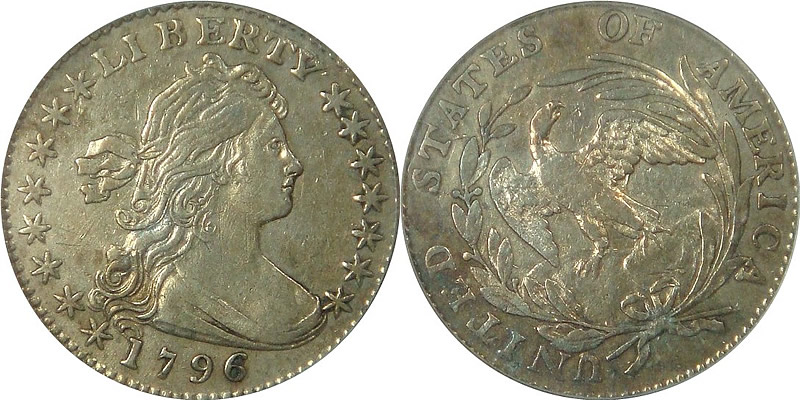
There are two types of the draped bust half dime. Plain Eagle Reverse (1796-1797),released in 1796, the coin's obverse design consists of a draped bust profile of Liberty facing right, with flowing hair secured by a ribbon. The word LIBERTY is above her head, and the date is below the bust. Stars flank each side. The 1796 half dime has eight stars on the left and seven on the right representing the fifteen states, including the new states of Vermont (#14) and Kentucky (#15). In 1797, a fifteen-star variety was struck, and later a sixteenth star (eight right, eight left) was added after Tennessee was admitted to the Union on June 1, 1796. Director DeSaussure's successor, Elias Boudinot, realized that they couldn't go on adding stars ad infinitum, so the last variety of 1797 had only thirteen stars (seven right, six left). From this time on, thirteen stars would be used to symbolize the union of states. The coin's reverse depicts an open wreath surrounding a small eagle that is perched on a cloud. The eagle is smaller than the one on the Flowing Hair design of 1794-95, but it has a fuller breast. The inscription UNITED STATES OF AMERICA surrounds the wreath.
One reason for the paucity and low quality of coinage during this period was the yearly outbreak of yellow fever in Philadelphia during the summer and fall months. The epidemic was particularly ferocious from 1797 through 1804, and during some of these years the Mint was temporarily closed throughout the yellow fever season. Key employee, engraver Joseph Wright and assayer Joseph Whitehead succumbed in 1793, and Mint Treasurer Dr. Nicholas Way was felled in 1797. Official procedures were instituted for closing the Mint in these emergencies, including provisions to pay off the workers and instructions for coining or securing the bullion that remained on hand. All dies were to be packaged and sent to the Bank of the United States for safe keeping.
Right now on eBay
Eagle With Shield Reverse (1800-1805)
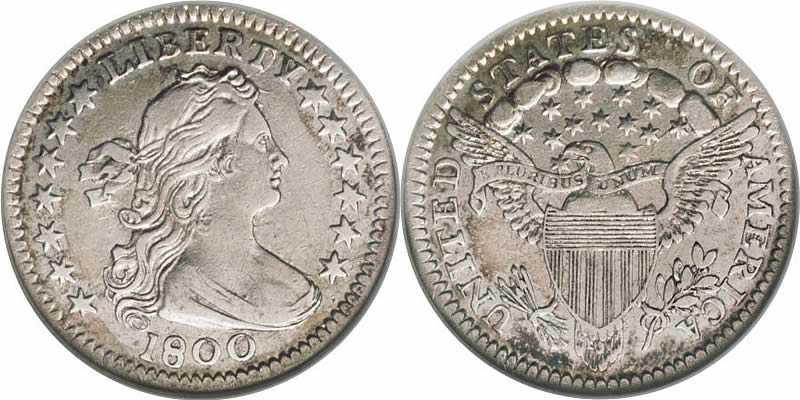
Scot's design for the Draped Bust/Heraldic Eagle half dime of 1800 was first used on the gold quarter eagles in 1796, the gold half eagle in 1797 and the dollars and dimes in 1798. It features a strengthened and more aesthetic rendering of Stuart's draped bust portrait of Liberty, her hair tied with a ribbon. The inscription LIBERTY appears above her head, and surrounding the bust are seven stars to the right and six to the left. The reverse depicts a large eagle with outstretched wingsthe Union Shield on his breastclutching thirteen arrows and an olive branch. His beak holds a ribbon inscribed with the Latin motto E PLURIBUS UNUM (One made up of many). Thirteen stars are above the eagle, with an arc of clouds above the stars. UNITED STATES OF AMERICA surrounds the periphery.
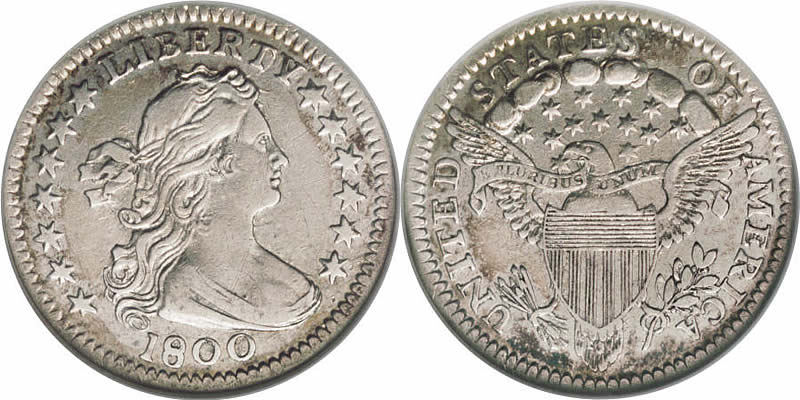
When grading this design, take into account that, due to poor striking quality, these coins usually exhibit weakness on one or more high points. It is important to discern the difference between strike and wear. Weak areas often include Liberty's hair and drapery, the obverse stars and the stars and clouds above the eagle. The first places to show wear are the hair above the forehead and by the ear, on the drapery just over the date and the drapery lines at the bust. On the reverse, look for wear on the eagle's wing tips and tail feathers.
Though the half dime denomination was important in commerce as a convenient way to make change, the Mint's ability to make enough of these coins was limited. Production ceased of the Draped Bust/Heraldic half dimes in 1805. The markets, and especially the banks, preferred the large quantities of legal tender Mexican silver half reales (valued at about six cents) then in widespread use. The half dime was not minted again until 1829, when the denomination returned with the William Kneass / John Reich Capped Bust design.