
Capped Bust Half Dime (1829 - 1837)
Collector Quick Guide
What collectors look for
Original condition, age, maker marks, materials, completeness, unusual variants, and documented history usually matter most.
How to identify originals
Compare markings, construction details, finish, size, period-correct materials, and known design features before assuming authenticity.
Red flags / reproductions
Watch for reproductions, heavy restoration, replaced parts, fantasy pieces, unclear photos, and listings with vague descriptions.
Related collectibles
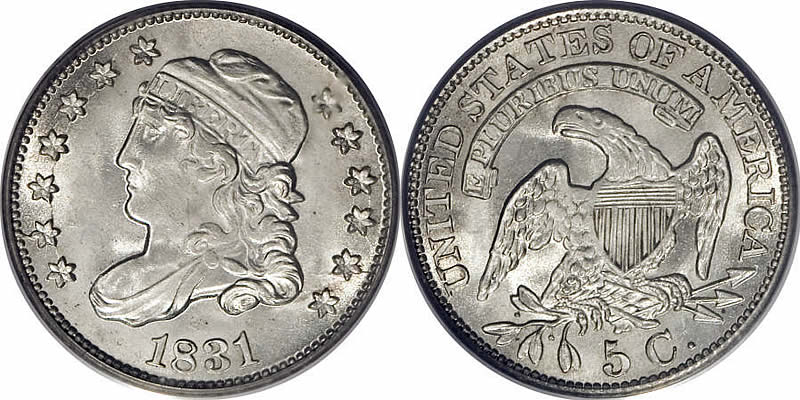
Not until 1829, the year of Andrew Jackson's arrival at the White House, did the half dime finally emerge from hibernation. When it did, it had a different look. For one thing, it was slightly smaller in diameter (although its weight was the same). More noticeably, it had undergone a face lift: The Draped Bust design was gone, and in its place was a left-facing portrait of Liberty with curly hair tucked inside a mobcap (a cap with a high, puffy crown)a likeness sometimes called the Turban Head but more commonly referred to as the Capped Bust. Gone, as well, was the old heraldic eagle; instead, the reverse depicted a naturalistic eagle with a shield superimposed on its breast.
These were not entirely new designs: Portraits very much like them had graced some of the nation's larger silver coins (the half dollar, quarter and dime) since as far back as 1807, when the basic designs were fashioned by German-born Mint engraver John Reich. They were new to the half dime, though and in any case William Kneass, the Mint's chief engraver in 1829, had modified Reich's portraits sufficiently to be credited as designer of the later Capped Bust issues.
Right now on eBay
The Capped Bust half dime's lifespan coincided almost exactly with Andrew Jackson's tenure in the White House. It was issued annually from 1829 through 1837 the year "Old Hickory" returned to Tennessee after finishing two terms as the nation's seventh president. Production took place entirely at the Philadelphia Mint; the first branch mints didn't start issuing coins until 1838, by which time the Capped Bust half dime had been replaced by the Seated Liberty type (both types having been struck in 1837).
Capped Bust half dimes are relatively plentiful in grade levels up to Mint State-64 and fairly abundant even in MS-65. The supply drops off sharply, however, in grades of MS-66 and above. Points to check for wear include the drapery at the tip of Liberty's bust, the hair above her eye and the edges of the eagle's wings.
Given the brevity of the series and the absence of any major rarities, collectors would face no formidable obstacles in putting together a complete date set of Capped Bust half dimes. In practice, however, many are content to treat it as a type coin and acquire just a single high-grade piece to represent the series as a whole.