
Seated Liberty Half Dime 1837 - 1873
Collector Quick Guide
What collectors look for
Original condition, age, maker marks, materials, completeness, unusual variants, and documented history usually matter most.
How to identify originals
Compare markings, construction details, finish, size, period-correct materials, and known design features before assuming authenticity.
Red flags / reproductions
Watch for reproductions, heavy restoration, replaced parts, fantasy pieces, unclear photos, and listings with vague descriptions.
Related collectibles
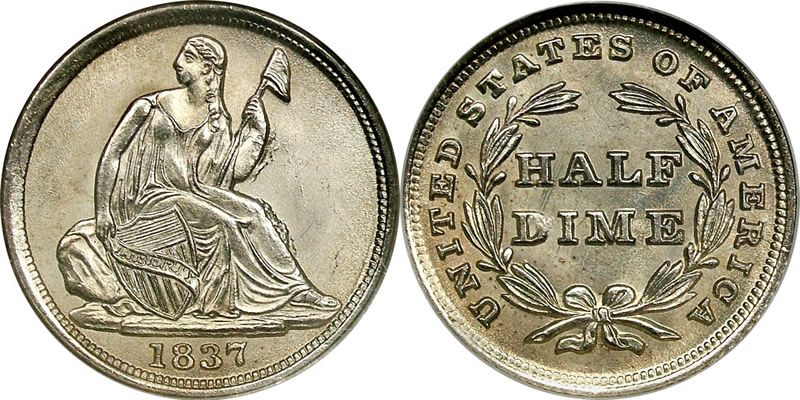
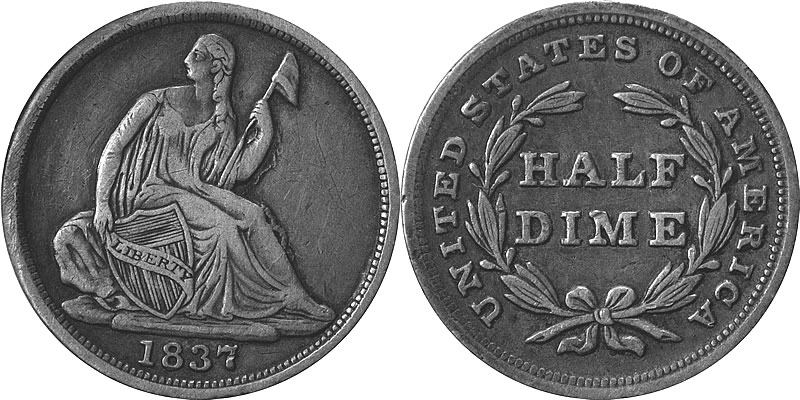
1837-38 Half Dime Seated Liberty No Stars
The Sully/Gobrecht Seated Liberty design was adapted for use on half dimes and dimes in 1837. It depicted a robed Liberty seated on a rock, holding the Union Shield inscribed with LIBERTY in her right hand and a pole topped with a Liberty cap in her left. Except for the date, the figure sits alone in clear fields. The reverse features a laurel wreath enclosing the denomination HALF DIME, with the legend UNITED STATES OF AMERICA encircling the periphery. As opposed to the later coins issued with stars, the cleanness of the fields gave the coin a powerful, aesthetic impact, often presenting a cameo appearance on higher grade pieces.
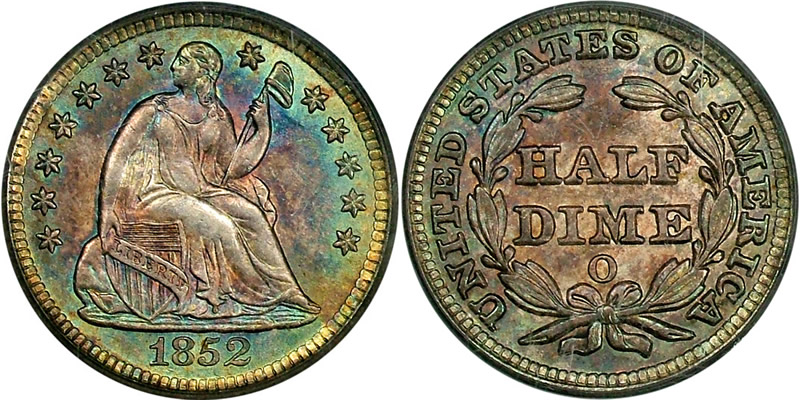
1838-59 Half Dime Seated Liberty With Stars
Only No Stars half dimes (and dimes) of 1837-38 accurately reflect Gobrecht's original concept. Liberty is seated on a large rock, holding a pole topped with a Liberty cap. The figure sits alone in the field with only the date below, imparting a cameo, medal-like appearance to the coin. The reverse essentially the same on all half dimes from 1837 to 1859 features the denomination HALF DIME encircled by a laurel wreath, in turn surrounded by UNITED STATES OF AMERICA. In 1838, 13 stars were arranged around the image of Liberty, creating the Stars Obverse type, with each star hand-punched into a previous No Stars die. Collectors refer to the coins of 1838-1840 slightly different in appearance than later issues as the "No Drapery" variety and often include them in type sets as a separate design.
In 1840, Robert Ball Hughes made the first of many modifications to come. He added extra drapery behind Liberty's elbow, and unfortunately, "fattened" the overall design. Thirteen years later, to combat widespread melting of silver coins following the California Gold Rush, Chief Engraver James B. Longacre added arrowheads on either side of the date, denoting a slight weight reduction. The Stars obverse design, without arrows, resumed in 1856 and continued until 1860, when the Legend Obverse design debuted. The last changes were made in 1859, when engraver Anthony Paquet slimmed Liberty's arms, reduced the size of her cap and enlarged her head. But the most notable difference of Paquet's revision is the hollow center of each peripheral star. Some type collectors include this minor variety in their sets.
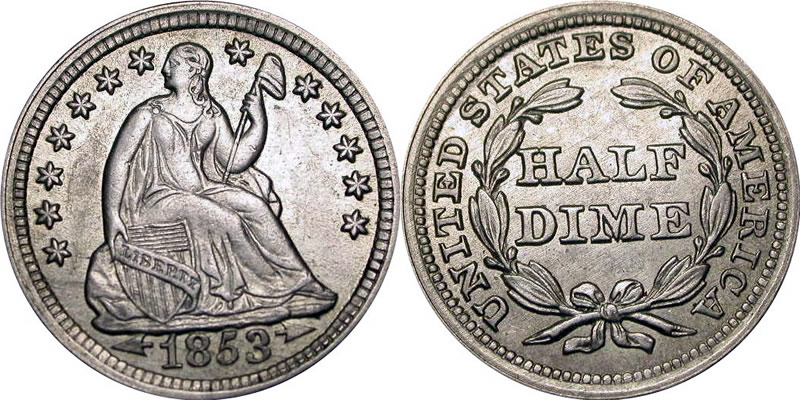
1853-55 Half Dime Seated Liberty With Arrows
More than 13 million Arrows half dimes were struck in Philadelphia in 1853, more than half the total output of 25,060,020 for the three years arrows were used. Only Philadelphia and New Orleans produced the issue, and the New Orleans pieces are significantly scarcer than their Philadelphia counterparts. Proofs were struck in all three years but are of the utmost rarity.
Arrows half dimes are easily collected in all but the highest grades. There are no real "stoppers" in the three-year set, but the New Orleans coins are considerably more elusive and expensive than those from the Philadelphia Mint. For decades coin dealers would not stock low grade Arrows half dimes because they were considered so common. This disdain carried over to higher grade coins as well, and it has only been in recent years that type collectors have elevated this series to respectability because of the need for gem coins for type sets (few of which had survived). As one might expect, the wholesale removal of all pre-1853 silver coins did create several rarities, and in the half dime series 1853-O Without Arrows is a significant rarity that has sometimes been counterfeited by altering an 1858-O coin.
Right now on eBay
1860-73 Half Dime Seated Liberty Legend Obverse History
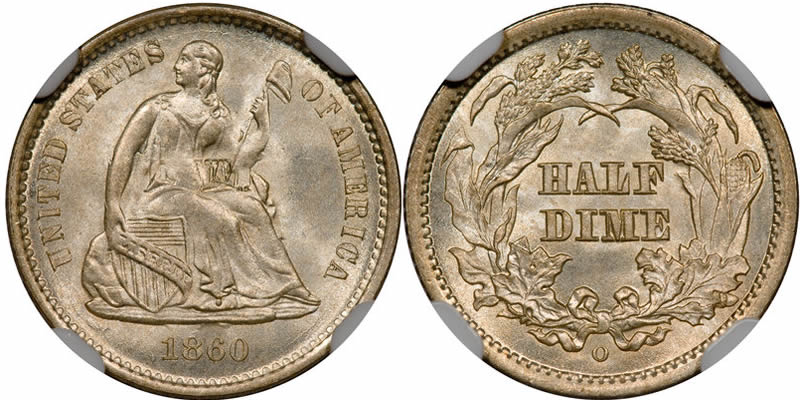
In 1860, Longacre redesigned the Seated Liberty half dime for the last time. Known as the Legend Obverse type, it retains the seated Liberty figure holding a pole topped with a Liberty cap. The legend UNITED STATES OF AMERICA replaced the thirteen stars that surrounded Liberty on previous versions. Longacre discarded the simple reverse wreath, using an elaborate one made up of sprigs of corn, wheat, oak and maple and tied with a bow at the bottom (this "wreath of cereals" motif was also used on the Seated Liberty and Barber dimes). The denomination HALF DIME appears within the wreath. Besides the Philadelphia Mint (no mintmark), the coin was minted in New Orleans in 1860 (O) and in San Francisco (S) from 1863-1873. The mintmark is found below the bow, except on the San Francisco issues of 1870 through early 1872, where it appears within the wreath.
Although 15,573,280 Legend half dimes including 10,040 proofs were minted in the thirteen years of its existence, the effects of civil war, bullion melts and use as jewelry ravaged the issues from the 1860s. Several small hoards have been uncovered that yielded a few uncirculated specimens from this period. Other uncirculated specimens have surfaced in original mint wrapped proof sets. Whether this occurred due to indifference or carelessness by mint employees remains unclear. The dates found most frequently in uncirculated condition are those from 1860 through 1862 and from 1870 through the end of the series in 1873.
Unquestionably, 1870-S is the rarest and most fascinating Legend half dime. When construction started on the second San Francisco Mint in 1870, coins minted specifically to commemorate the occasion were placed inside the cornerstone. Only one 1870-S half dime was supposed to exist (and the mint building still stands), but in 1978 a duplicate specimen was reportedly found in a dealer's junk box. The coin's display at the 1978 ANA convention caused quite a stir. It subsequently sold for a six-figure price.