
Liberty V Nickel (1883 - 1913)
Collector Quick Guide
What collectors look for
Original condition, age, maker marks, materials, completeness, unusual variants, and documented history usually matter most.
How to identify originals
Compare markings, construction details, finish, size, period-correct materials, and known design features before assuming authenticity.
Red flags / reproductions
Watch for reproductions, heavy restoration, replaced parts, fantasy pieces, unclear photos, and listings with vague descriptions.
Related collectibles
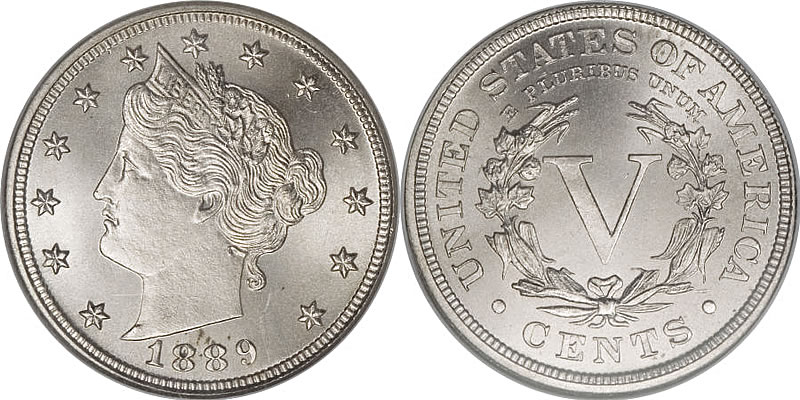
In 1883, the United States Mint introduced the Liberty Head five-cent piece, a coin designed by A. Loudon Snowden, the Mint's Superintendent. Snowden envisioned a uniform design and composition for the nation's minor coins, including the cent, three-cent piece, and five-cent piece. Chief Engraver Charles Barber was tasked with creating suitable sketches for these denominations, all featuring a classical head of Liberty. Trial strikes were made, but only the five-cent piece, the Liberty Head nickel, saw significant changes.
The Shield nickel, in use since 1866, was the first base-metal five-cent coin in U.S. history. However, its plain design made it a candidate for remodeling. Snowden admired Barber's new design and sought to increase the nickel's diameter to improve durability. The Liberty Head nickel was unveiled in January 1883. Unfortunately, the initial coins lacked the word "CENTS" on the reverse, leading to counterfeiters gold-plating them and passing them off as $5 gold pieces.
Barber swiftly designed a new version with "CENTS" prominently displayed. By then, millions of the "Type 1" nickels had been struck and gold-plated. This led to the coining of the term "racketeer nickels" due to their history. The mint produced over 16 million nickels with "CENTS" on the reverse by the end of 1883, but the "no CENTS" variety remains more common today in choice condition.
The Liberty Head nickel continued with minimal changes, primarily produced in Philadelphia, except for 1912, when Denver and San Francisco mints also minted it. There are low-mintage issues, such as 1885, 1886, and 1912-S, but no great rarities. In 1913, the Buffalo nickel replaced the Liberty Head design, but five 1913 Liberty Head nickels surfaced later, becoming highly sought-after collectibles.
Despite spanning 30 years, the Liberty nickel series is compact and collectible, mainly due to the scarcity of branch-mint issues. Collectors often seek specific dates and mintmarks. Proofs were made in every year, usually in the thousands. Liberty nickels are generally well-struck and available in high grades, with wear typically seen on Liberty's hair and the wreath and corn ears on the reverse.
Right now on eBay
The Liberty Head nickel series, despite its 30-year duration, remains a compact and sought-after set among collectors. This popularity is partly due to the absence of branch-mint issues for most years, making it feasible to collect by date and mint. Alternatively, some collectors opt for a representative type set.
Proof coins were struck in significant numbers each year, a noteworthy feature for that period, making them accessible to collectors. Due to their low relief, Liberty nickels are often well-struck and can be found in high-grade conditions. When evaluating these coins for wear, collectors pay close attention to areas like the hair above Liberty's ear and the wreath and corn ears on the reverse.
In 1913, the Liberty Head nickel made way for the iconic Buffalo nickel, marking the end of its production. However, it left behind a rich history, including the intriguing episode of the 1913 Liberty Head nickel, a coin that defied expectations and became one of the most prized and valuable collectibles in the world of numismatics.
The Liberty Head nickel's legacy endures not only through its coins but also through the stories and history it carries, making it a treasured part of American numismatic heritage. Collectors continue to appreciate these coins for their historical significance, elegant design, and the unique tales they tell of a bygone era in American coinage.