
Buffalo Nickel 1913 - 1938
Collector Quick Guide
What collectors look for
Original condition, age, maker marks, materials, completeness, unusual variants, and documented history usually matter most.
How to identify originals
Compare markings, construction details, finish, size, period-correct materials, and known design features before assuming authenticity.
Red flags / reproductions
Watch for reproductions, heavy restoration, replaced parts, fantasy pieces, unclear photos, and listings with vague descriptions.
Related collectibles
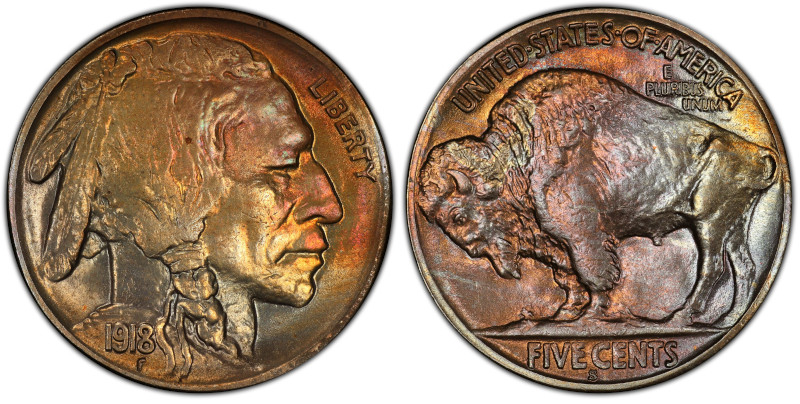
During Charles Barber's tenure as Chief Engraver of the U.S. Mint, he faced challenging times. The desire for more classical coin designs, as advocated by Theodore Roosevelt to Augustus Saint-Gaudens in 1905, persisted even after Roosevelt's presidency ended. Barber's uninspiring Liberty Head nickel had been in production since 1883, and the Coinage Act of 1890 mandated a change. Secretary of the Treasury Franklin MacVeagh, originally appointed by Roosevelt, saw an opportunity for transformation. Prompted by his son in May 1911, MacVeagh initiated the process for a new nickel design.
Less than two years later, the Buffalo nickel came to life. On March 4, 1913, the first coins from the initial batch to enter circulation were presented to outgoing President Taft and 33 Indian Chiefs during the groundbreaking ceremonies for the National Memorial to the North American Indian at Fort Wadsworth, New York.
James Earle Fraser, a former assistant to Saint-Gaudens and a renowned artist known for the monumental "End of the Trail" Indian sculpture, crafted a truly distinctive design for the new coin. Prior to this, American coins depicted "Indians" who were essentially Caucasian figures wearing Indian headdresses. Fraser's design accurately portrayed Native Americans, with the obverse portrait being a composite of three chiefs who posed for him. Staying true to the American theme, he featured an American bison on the reverse, skillfully placing inscriptions like UNITED STATES OF AMERICA, E PLURIBUS UNUM, FIVE CENTS, LIBERTY, and the date.
Fraser's design was both artistic and beautiful, a quality that appealed to Secretary MacVeagh but seemed to elude Barber. Barber argued that the design elements were too large and interfered with proper inscription placement. However, Fraser's design prevailed despite objections. Vending machine companies also raised concerns, believing the new coins would not function properly with counterfeit detection devices. Eventually, Secretary MacVeagh instructed the Mint to proceed with the original design and encouraged vending machine companies to adapt their mechanisms to accommodate the coin.
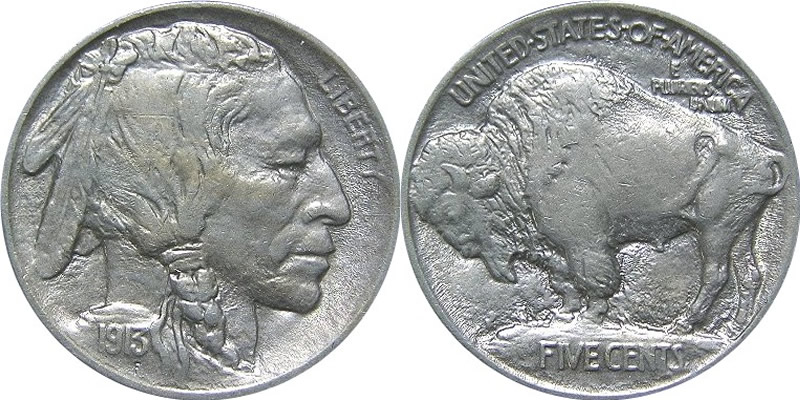
From 1913 to 1938, over 1.2 billion Buffalo Nickels were minted across three mints: Philadelphia (no mintmark), San Francisco (S), and Denver (D). The mintmark can be found on the reverse under the denomination, and the designer's initial "F" appears below the date. Two varieties of Buffalo Nickels were produced, with Type 1 nickels having the denomination FIVE CENTS on a raised mound, but this design was quickly modified due to wear issues in circulation. Barber finally had the opportunity to modify Fraser's design because the Type 1 Buffalo Nickels, produced only during the first few months of 1913, revealed rapid wear on the raised mound where the denomination "FIVE CENTS" was located. This change addressed the concerns of vending machine companies and allowed for smoother circulation.
"FIVE CENTS" On Mound
Right now on eBay
The Type 2 Buffalo Nickel, introduced as a modification, lacked much of the artistic impact of the original design. In 1916, Barber made additional minor adjustments, which some specialists consider a third type. However, most type collectors recognize only Type 1 and Type 2 as genuine varieties. Remarkably, despite these alterations, Barber never addressed the issue of the date wearing down too quickly.
"FIVE CENTS" In Exergue
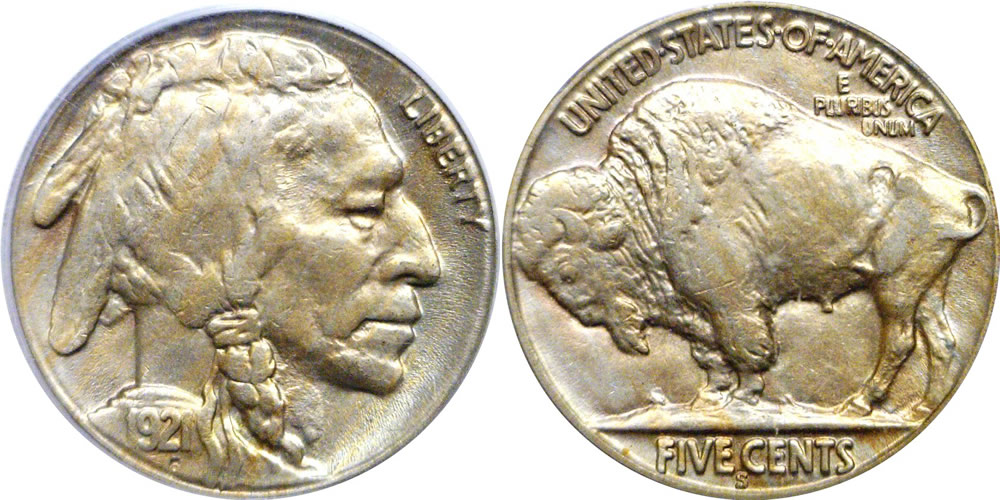
Notably, there were no Buffalo Nickels minted in the years 1922, 1932, and 1933. A total of 5,967 Matte Proofs were produced from 1913 to 1916, and 10,189 Brilliant Proofs were minted in 1936 and 1937. The coin's strike quality had been problematic from the outset, leading to confusion between well-struck business strikes and matte proofs. Many mint-marked coins, particularly those from 1918 to 1934, are exceedingly scarce in well-struck condition. When evaluating these coins, including other weakly struck Buffalos, surface condition is crucial. Even full-luster pieces may lack rounded relief detail on the horn or the fringe on the tail. Typically, weakly struck pieces exhibit faint dates and LIBERTY inscriptions. The areas most susceptible to wear are the high point of the Indian's cheekbone and the hair near the part on the obverse, while on the reverse, wear often appears on the bison's hip, the fringe of its tail, and the horn.
Collectors of Buffalo Nickels have a captivating array of challenging dates and rarities to pursue. Among the toughest to acquire is the exceedingly rare 1918/7-D overdate variety. Scarce to rare dates in high grade encompass all San Francisco coins from 1913 to 1928, with 1918, 1920, and 1924 through 1927 being the rarest. Denver coins, usually exhibiting weaker strikes than their San Francisco counterparts, present collectors with challenges, especially with the 1918 through 1920 issues and the 1925 and 1926 coins. Additionally, the famous 1937-D 3-legged Buffalo variety, caused by excessive die-polishing to remove clash-marks, is highly sought after. This variety wasn't discovered until most coins had entered circulation, making well-struck gem specimens exceptionally rare today. For coins like the "3-legger" or the 18/7-D overdate, authentication by experts is recommended due to the presence of numerous counterfeit versions.