
Draped Bust Dime 1796 - 1807
Collector Quick Guide
What collectors look for
Original condition, age, maker marks, materials, completeness, unusual variants, and documented history usually matter most.
How to identify originals
Compare markings, construction details, finish, size, period-correct materials, and known design features before assuming authenticity.
Red flags / reproductions
Watch for reproductions, heavy restoration, replaced parts, fantasy pieces, unclear photos, and listings with vague descriptions.
Related collectibles
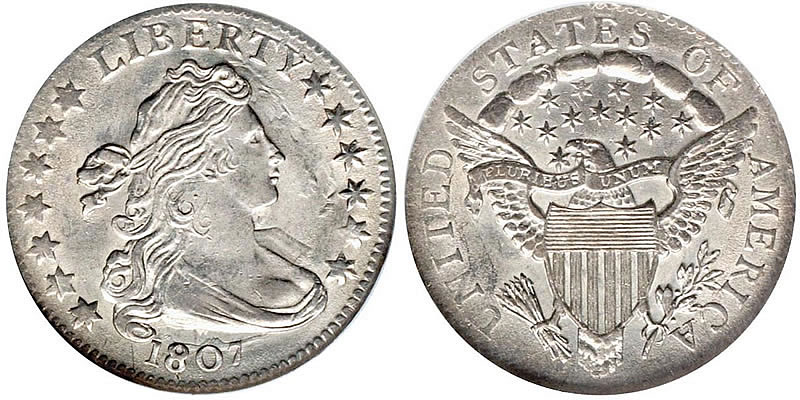
The Draped Dime, minted from 1796 to 1807, holds a significant place in the history of United States coinage. This coin is known for its elegant design and historical importance. The Draped Dime was introduced at a time when the United States was still finding its identity as a nation. It was part of the early coinage efforts of the newly formed U.S. Mint.
The Draped Bust/Small Eagle design, crafted under the supervision of Mint Chief Engraver Robert Scot, showcased an image of Liberty exuding an air of elegance. She was portrayed with her hair flowing and adorned with a ribbon, her neckline gracefully covered by drapery. This exquisite depiction was framed by stars on either side, with the word "LIBERTY" inscribed above and the date below. Notably, dimes from 1796 bore 15 stars, symbolizing each state in the young Union at the time. However, in 1797, the coin saw variations with 16 stars, marking Tennessee's entry as the 16th state, and others with 13 stars, harking back to the original 13 states. This adjustment signaled the abandonment of the practice of adding a new star for each state's admission. On the reverse side, a small, outspread-winged eagle perched amid clouds, framed by palm and olive branches, was accompanied by the motto "UNITED STATES OF AMERICA." Interestingly, this coin did not bear any denomination, despite the requirement of the 1792 Mint Act that only copper cents and half-cents be inscribed with their values.
The inspiration for Liberty's portrait stemmed from a drawing of the renowned Philadelphia socialite Ann Willing Bingham, celebrated as one of the most beautiful women of her era. The distinguished portraitist Gilbert Stuart, purportedly at the urging of President George Washington himself, created this drawing. It was subsequently translated into plaster by artist John Eckstein, with Mint Chief Engraver Robert Scot executing the coin dies. When assessing the condition of this design, signs of wear typically manifest first on Liberty's bust, shoulder, and the hair above her ear and forehead. On the reverse side, attention should be given to the eagle's head and wingtips.

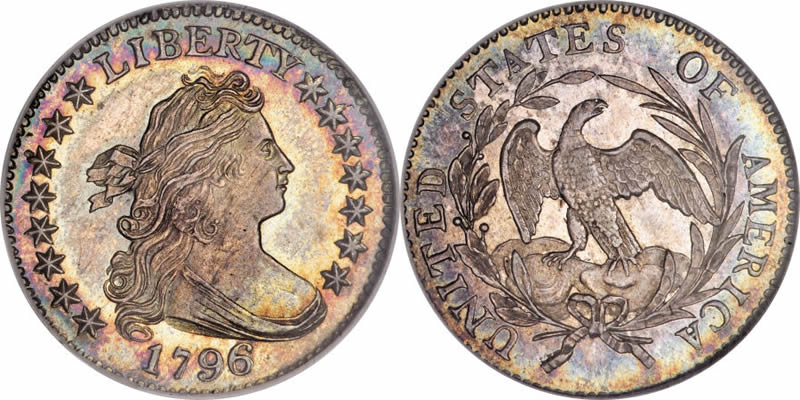
This inaugural regular-issue dime was produced for a brief two-year period. In 1798, it underwent a transformation, transitioning to a larger, more heraldic eagle design, marking the beginning of a new type. Throughout this relatively short duration, the U.S. Mint minted a total of 47,396 dimes. Within this series, there exist only three fundamental variations: the 1796, the 1797 with 16 stars, and the 1797 with 13 stars. Consequently, some collectors aspire to assemble complete sets, despite the considerable cost of each component. Conversely, many collectors choose to regard this coin as a representative type, acquiring a single specimen to signify the entire series. While comprehensive research on these early dimes was once limited, contemporary specialists in coin varieties recognize eight distinct varieties (six from 1796 and two from 1797), meticulously detailed in "Early United States Dimes, 1796-1837," a publication released in 1984 by the John Reich Collectors Society.
Right now on eBay
Mint employees faced immense pressure right from the inception of the U.S. Mint. In fact, Congress had contemplated the possibility of abandoning the idea of a federal mint even before it was established. The challenges were multifaceted, encompassing issues related to both design and execution quality. The 1793 Chain cent, in particular, received scathing criticism, prompting Mint officials to become acutely attuned to public opinion. It became evident that the nation's newly minted coins needed to possess not only the correct weight and purity but also exude a sense of solidity and respectability akin to their European counterparts. In pursuit of this goal, Robert Scot, as the Chief Engraver, embarked on the task of refining the coin designs.
However, there were limitations to the extent of improvement that could be achieved. Robert Scot's skills as an engraver and die-sinker were, at best, modest, and ironically, his initial designs had been a focal point of the criticism. Nevertheless, a transformation was on the horizon, and as the Chief Engraver, Scot was at the helm of this endeavor.
His creation, the Draped Bust/Small Eagle dimes, made their debut in 1796, drawing inspiration from a drawing crafted by the renowned portraitist Gilbert Stuart. These dimes featured a draped bust of Liberty, surrounded by thirteen stars, six on the right and seven on the left. While somewhat rudimentary and not aligning with contemporary aesthetics, this matronly bust resonated with the tastes of the era. It was purportedly modeled after Mrs. William Bingham, a celebrated Philadelphia socialite known for her beauty and charm. However, the coin's reverse design met with widespread disapproval due to its diminutive, fledgling eagle.
Heraldic Eagle With Shield Dimes
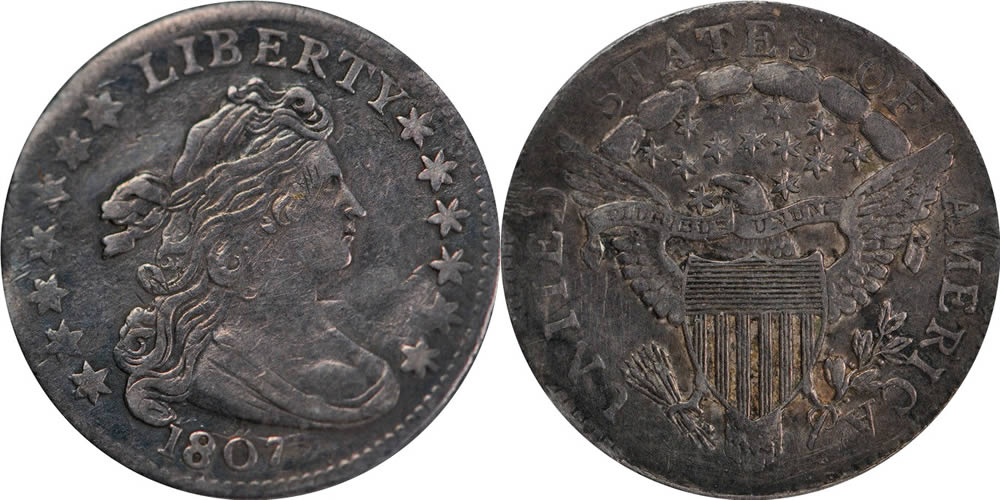
In 1798, Scot took a decisive step by replacing the small eagle with a scaled-down version of the Great Seal of the United States, initially featured on the quarter eagle of 1796. This new design showcased a heraldic eagle bearing the Union Shield on its breast, clutching a ribbon inscribed with "E PLURIBUS UNUM" in its beak. Judging by the absence of negative commentary, this updated Draped Bust/Heraldic Eagle combination evidently came closer to meeting the objections raised by critics, signifying a pivotal moment in the evolution of early American coinage.