
Capped Bust Dime 1809 - 1837
Collector Quick Guide
What collectors look for
Original condition, age, maker marks, materials, completeness, unusual variants, and documented history usually matter most.
How to identify originals
Compare markings, construction details, finish, size, period-correct materials, and known design features before assuming authenticity.
Red flags / reproductions
Watch for reproductions, heavy restoration, replaced parts, fantasy pieces, unclear photos, and listings with vague descriptions.
Related collectibles
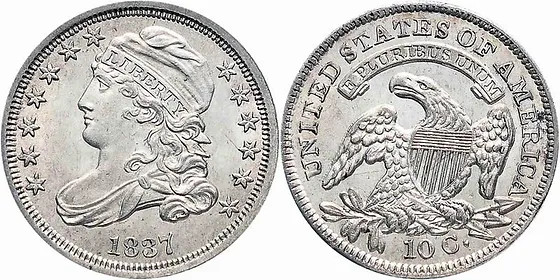
 1809-28 Capped Bust Dime Large Date
In March of 1807, the U.S. Mint witnessed a significant development when its fourth Director, Robert Patterson, made a pivotal decision to appoint John Reich as Assistant Engraver. Born in Fuerth, Bavaria, in 1768, John Reich had arrived in the United States as an indentured immigrant and settled in Philadelphia around 1800. His initial attempts to secure a permanent position at the Mint in 1801 had been unsuccessful. However, an unnamed Mint official recognized his exceptional talents and took the generous step of purchasing his freedom. While the Mint had been grappling with a shortage of skilled engravers and craftsmen since its inception in 1792, Elias Boudinot, Patterson's predecessor, had hesitated to offer Reich a permanent role until he could provide convincing evidence of his character. It is possible that Boudinot was also wary of offending the aging and moderately skilled Chief Engraver, Robert Scot.
During this period, the dime was still relatively unfamiliar to most Americans. The Act of April 1792 had established the decimal dollar and included "dismes or tenths... a disme being a tenth part of a dollar." However, the quarter was more commonly used and easily understood as it equated to the Spanish two reales or "two bits." The half, known as the Spanish silver reale, was equivalent to 12-1/2 cents. These two-reales coins were legal tender, as were Spanish coins of inferior silver alloy from the 1700s known as pistareens, despite not being officially recognized. A dime, in essence, was half the value of a pistareen, but the preference among the populace leaned toward the widely accepted one-reale coins, no matter their level of wear.
John Reich commenced his role as an assistant to Robert Scot, receiving an annual salary of $600. Between 1807 and 1817, he effectively performed the duties of the Chief Engraver without receiving the corresponding pay or recognition. In his new role, Reich wasted no time and began crafting dies for the 1807 half dollars within a day of his appointment. He subsequently tackled the half eagle, cent, and quarter eagle before turning his attention to the dime.
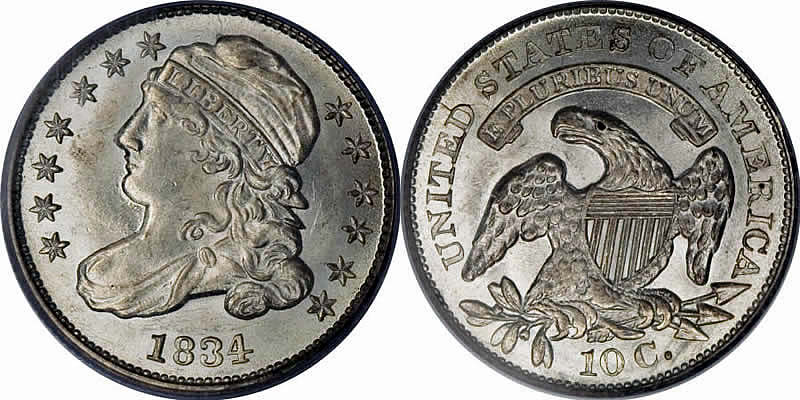
The reverse design of the Capped Bust dime featured an American eagle facing left, grasping three arrows symbolizing strength and an olive branch signifying peace. Adorning the eagle's breast was the U.S. Shield, comprised of six horizontal lines denoting blue, with 13 stripes below, six of which were represented by three vertical lines symbolizing red. These lines served as an 18th-century engraver's conventional method for depicting colors in black-and-white engravings, with blue representing dominion, red indicating force, and white symbolizing purity. Encircling the top of the eagle was the inscription "UNITED STATES OF AMERICA," accompanied by a scroll bearing the incuse motto "E PLURIBUS UNUM." Below the eagle, the denomination was displayed as "10 C." When evaluating coins from this series, it's important to note that weak strikes were common. On the obverse, signs of wear typically appeared on the drapery at the front of the bust, the hair above the forehead and ear, and the shoulder clasp. On the reverse, attention should be given to the eagle's claws, neck, and wings.
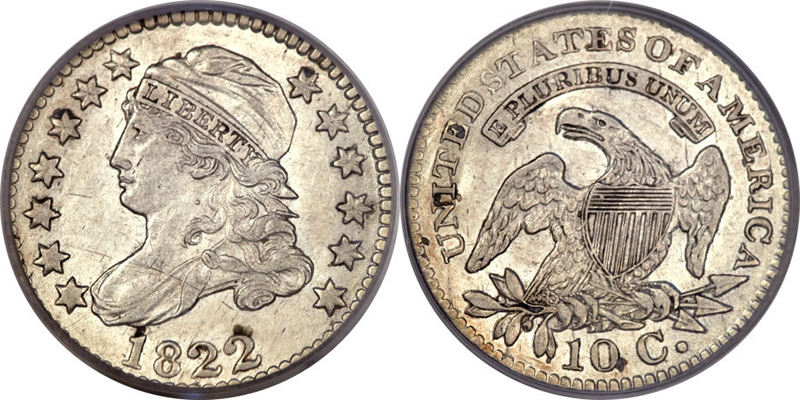
Production of the Capped Bust dimes was intermittent, with only three dates struck during Reich's tenure at the Mint. Dated issues include 1809, 1811, 1814, and then a sequence from 1820 through 1825, and 1827. A substantial number of dimes were minted in 1820, 1821, and 1827. In total, over five million pieces were produced. While all dates are obtainable, the scarcest among them are the low-mintage 1809, 1811, and 1822, though all can be found in gem uncirculated condition. Additionally, a number of proofs, which were essentially presentation pieces, are known from the years 1820 onward. For collectors, especially those focusing on variety, the Capped Bust dimes present a challenge. Although the practice of variety collecting has diminished over time, enthusiasts of Bust dimes remain a dedicated group.
Notably, the systematic identification of die varieties for early dimes came into practice relatively late. Most die varieties are categorized based on the date's position, star spacing and alignment, the size of "10 C," and the exact positioning of letters above the ends of the motto scroll. In contrast, many other denominations had their die varieties meticulously recorded decades before similar efforts were made for dimes. The information available to collectors was limited, with early coin books typically highlighting major varieties like large and small dates. A more comprehensive study of the denomination didn't occur until 1984 when the "Early United States Dimes 1796-1837" was published by the John Reich Collectors Society. This groundbreaking work was compiled by five devoted students of the series, marking a significant milestone in the numismatic exploration of early American dimes.
Right now on eBay
1828-37 Capped Bust Dime Small Date
In 1823, a little over a decade after the conclusion of the War of 1812, during which the United States had fought to secure its free access to international waters, President James Monroe issued a significant foreign policy declaration that would profoundly influence the development of the Western Hemisphere for the next century. This statement, known as the Monroe Doctrine, unequivocally conveyed the U.S.'s stance against any European attempts to interfere, control, or exert influence over North and South America. At the time, the United States was experiencing a sense of growing political and economic power.
The introduction of newly designed minting equipment in this era facilitated the striking of thicker planchets. To adhere to the weight and alloy specifications outlined in the Mint Act of 1792, the Mint needed to maintain the same standards as it had for the thinner and larger coins produced previously. As a result, the diameters of several coins, including the half dime, dime, quarter, quarter eagle, and half eagle, were reduced. While the proposed reduction in the size of the dime was intended to change it from 18.8 mm to 18.5 mm, recent research has shown that actual diameters varied over the years. Notably, there is no consistent distinction between the large and small size diameters, especially from 1828 through 1834. Due to this variance, it is more accurate to refer to this type as the Close Collar Capped Bust dime. The primary discernible difference from the earlier large size, or open collar type, lies in the small radial beads inside a raised border, as opposed to the flat, widely spaced denticles of the earlier production. The new coin was also significantly thicker at the edges.
The reduced-size Capped Bust dime made its debut in 1828, coinciding with the presidency of Andrew Jackson, known as "Old Hickory." Its production continued for nine years, concluding shortly after excessive speculation triggered the financial Panic of 1837, leading to a collapse in real estate, stock, and commodity prices. The total mintage during this period amounted to approximately 6,730,000 dimes. Small quantities of proofs are known for each year. Like many coins of its time, there are intriguing varieties among Capped Bust dimes. Notable examples include the 1830/29 overdate and the 1829 with the curled base '2.' However, contemporary collectors of variety coins are relatively few. As coins have become more expensive and widely dispersed over the years, only a handful of collectors pursue date sets of Bust dimes, let alone variety collections. Most opt for owning a representative type specimen. While circulated examples are readily available for every year, finding this design type in high grades above Mint State 64 can be quite challenging. Nevertheless, small quantities of exceptionally well-preserved pieces do exist, some grading as high as MS 67. Among the scarcer dates in high grade are the 1828 Small Date, 1830/29, and 1837.
Director Samuel Moore was eventually succeeded in 1835 by his original competitor for the appointment, his brother-in-law Robert Maskell Patterson, the son of former Director Robert Patterson. The younger Patterson introduced the use of steam-powered presses, significantly enhancing the Mint's efficiency and output. Additionally, he oversaw the introduction of the famous and enduring Seated Liberty silver coinage, designed by Christian Gobrecht, which replaced the Capped Bust dime in 1837.