
Seated Liberty Dime 1837 - 1891
Collector Quick Guide
What collectors look for
Original condition, age, maker marks, materials, completeness, unusual variants, and documented history usually matter most.
How to identify originals
Compare markings, construction details, finish, size, period-correct materials, and known design features before assuming authenticity.
Red flags / reproductions
Watch for reproductions, heavy restoration, replaced parts, fantasy pieces, unclear photos, and listings with vague descriptions.
Related collectibles
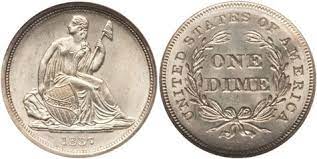
1837-38 Seated Liberty Dime Without Stars
The initial production of the 1837 No-Stars Seated Liberty dimes consisted of approximately 30 proof coins, which Director Patterson distributed as presentation pieces. Today, only around 20 of these proofs are known to exist. One distinctive feature of these proofs is a clearly visible raised spur, a die defect located above the first "T" in "STATES" on the reverse side of the coin. Additionally, there is a faint die scratch running through "ES" in "STATES" and extending toward the "O" in "OF." The act of striking proofs multiple times accentuated these distinctive defects. The same die was used for regular coinage as well, but the defects were less prominent due to the single strike.
The standard 1837 issue saw a mintage of 682,500 and featured both large and small date varieties. Typically, these coins exhibit good strikes, with occasional weakness in the lines of the shield. Many of these coins were preserved as souvenirs during their first year of issuance, and gem-quality pieces are frequently encountered. Due to incomplete records, the 1838 New Orleans issue's mintage remains uncertain, but estimates suggest a range between 406,000 and 490,000 coins were produced. Mintmarks for this issue were placed beneath the word "Dime." The 1838-O dimes are often characterized by soft strikes, especially in Liberty's head and the central parts of the design, likely due to immediate and heavy circulation. Mint state examples of these coins are considered rare.
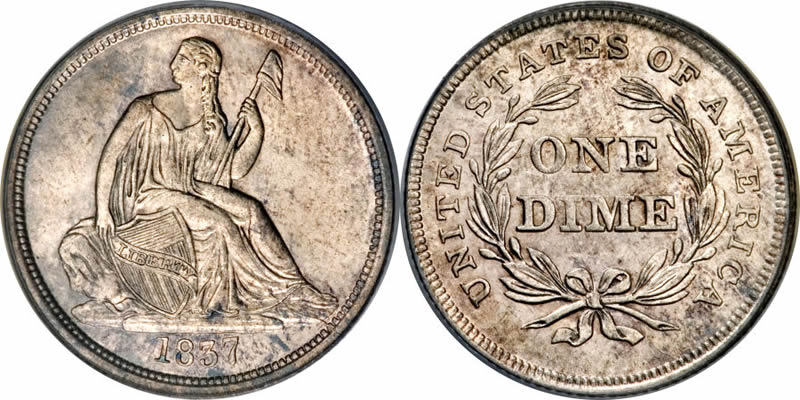
1838-60 Seated Liberty Dime With Stars
A dime held considerable value, equivalent to nearly two hours' pay at the Stevens mill. Therefore, the American public paid close attention to the introduction of the Seated Liberty dime, which began appearing in pocket change around this time. In fact, this coin had already made its debut in 1837, a year prior. However, in 1838, the United States Mint introduced a significant alteration to its design by adding 13 stars along the obverse border surrounding the central portrayal of Liberty. These stars would remain a distinctive feature until 1860, marking the "Stars Obverse" dimes as a prominent and separate element within the Seated Liberty series.
In 1838, very few coins of any denomination were in circulation for most Americans. The economic depression had led to the hoarding of federal coinage, with so-called "Hard Times tokens" widely used as substitutes for money. When coins did emerge, they were likely to include Seated Liberty pieces. During the late 1830s, the new design wasn't exclusive to the dime but also extended to all four other silver coins issued at the time: the half dime, quarter dollar, half dollar, and dollar.
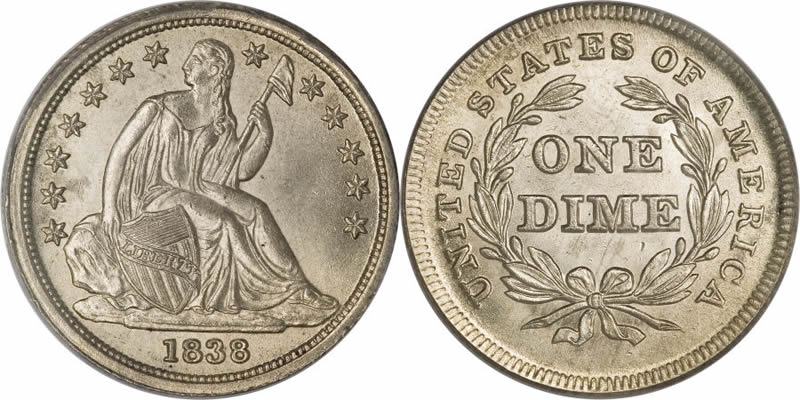
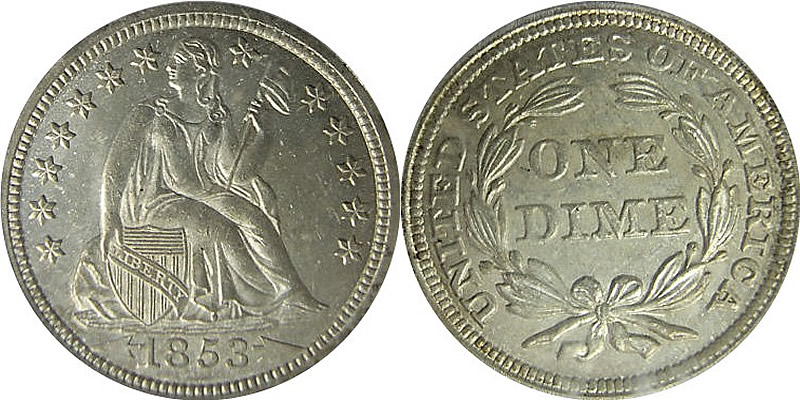
1853-55 Seated Liberty Dime With Arrows
The initial Arrows dimes were actually proofs, included in five sets that featured the newly designed coinage. Regular production commenced in April of 1853, and an abundance of these coins began flowing from the mints. Out of a total production of nearly 21.5 million dimes minted from 1853 to 1855, the Philadelphia Mint alone produced over 12 million in 1853. The intentions of Congress appeared to have been achieved, marking the first time in U.S. history when there was a sufficient supply of fractional U.S. coins available for everyday commerce. Foreign silver coins were largely withdrawn from circulation and re-minted into U.S. denominations. While many of the initial dimes of this type were initially hoarded, the sheer volume of these coins entering circulation convinced hoarders to release their stockpiles.
This three-year series encompasses five date and mint combinations. Arrows dimes were produced annually in Philadelphia (lacking a mintmark) and in New Orleans (marked with an "O") in 1853 and 1854. Mintmarks can be located above the bow of the wreath on the reverse side. Among these, the 1853 Philadelphia issue is most frequently encountered in gem uncirculated condition. Conversely, the 1853 New Orleans issue is the rarest within the series, particularly in mint state. The 1854-O also occasionally appears in high grade, with a small hoard of approximately 18 pieces surfacing in 1981. Additionally, a limited number of proofs were struck in 1854 and 1855, although the exact quantity remains unknown. While collectors can pursue all five issues based on date and mint, the primary appeal of this concise series lies in its five major varieties of Seated Liberty dimes. When assessing the condition of these coins, initial wear typically becomes apparent on Liberty's knee, breast, and head on the obverse. On the reverse side, close attention should be given to the highpoints of the bow and leaves.
Right now on eBay
1860-91 Seated Liberty Dime Legend Obverse
Legend Obverse dimes are one of the most popular 19th century U.S. coins and are available in a wide range of grades. Because of their smaller size, they usually have fewer abrasions than larger denomination coins. When grading this design, friction from circulation first begins to show on the head, breast and knee of Liberty; on the reverse, check the highest portions of the wreath and bow knot. Counterfeits are generally not a problem in the series, but mintmarks are known to have been removed from certain dates and added to others.
This design is generally collected either by date and mint in lower grades or by type, in which case only one business strike or proof of any date is needed. In addition, a few specialists collect the series by die variety. For the type collector, this series poses no difficulty. Many of the commoner issues are often available in grades above MS 65. Small hoards of many dates have come to light over the years, including some of the Philadelphia issues of the Civil War period. Availability of mint state specimens was again augmented in January, 1985, when two original rolls of Legend Obverse dimes were dispersed. The coins were dated 1883 and 1884, and most were brilliant gems, with a number of pieces that graded higher than MS 65.
1873-74 Seated Liberty Dime With Arrows
To acknowledge the increase in weight, the Mint opted to incorporate arrowheads on the obverse, flanking the date. Chief Engraver William Barber integrated these arrowheads into the existing Hughes-Gobrecht-Longacre design. Once this new design was introduced, officials began a meticulous process of melting down coins dated 1873 that lacked the arrow motif. In this process, the creation of one of the most renowned 19th-century rarities emerged—the 1873-CC No Arrows dime. It stands as a unique coin, the sole surviving piece from the melting pot. The arrows were individually punched into the dies, resulting in variations in their positioning among different die pairs. However, whether placed slightly higher or lower relative to the date, dimes from 1873 consistently exhibit arrow-points at the same level, whereas they point upward on the 1874 coins.
When combining the mintages of the six issues of Arrows dimes, a total of 6,042,308 coins were produced. Most Philadelphia and San Francisco issues are readily accessible and are sought after by collectors of all grades as representative type coins. In contrast, Carson City pieces are genuinely rare in any condition. Both Carson City issues are challenging to find without problems, with a significant portion of the surviving population exhibiting corrosion, damage, or other impairments. The areas most prone to wear on these coins are the breast and knees of Liberty on the obverse and the ribbon bow and tips of the leaves on the reverse.
A total of 1,500 proof Arrows dimes were minted over the course of two years. These proofs are highly sought after by collectors and type enthusiasts. Counterfeits have never posed a significant issue in this brief series. Notably, the well-known counterfeits pertain to the exceedingly rare 1874-CC dime, and these pieces are generally distinguishable by most collectors and dealers, as the die characteristics for these rare, high-profile dates are well-documented. An interesting authentication detail is that early Carson City dimes feature only 89 reeds on the edge, while their Philadelphia counterparts have 113, making it impractical to convincingly counterfeit a Carson City dime from a Philadelphia coin by simply adding the mintmark.
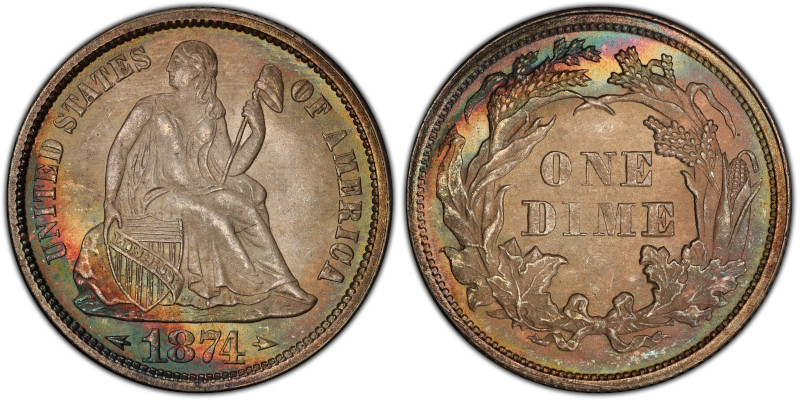
After 1874, the arrows on either side of the date were discontinued, even though the weight of the coins in subsequent years remained the same. The silver dime retained its new weight as did the quarter and half dollar, and all three denominations remained on the metric system until silver coinage was terminated in 1964. And what became of Senator Sherman and Representative Kelley's dream of a universal coinage system? Sherman later proposed to remove the eagle from the reverse of coins so their silver content could be inserted in place of the bird. He actually believed that adoption of the metric system for coinage would lead to Europeans using our coins as currency. His dreams, however, wilted soon enough in the bright light of reality.