
Barber Dime 1892 - 1916
Collector Quick Guide
What collectors look for
Original condition, age, maker marks, materials, completeness, unusual variants, and documented history usually matter most.
How to identify originals
Compare markings, construction details, finish, size, period-correct materials, and known design features before assuming authenticity.
Red flags / reproductions
Watch for reproductions, heavy restoration, replaced parts, fantasy pieces, unclear photos, and listings with vague descriptions.
Related collectibles
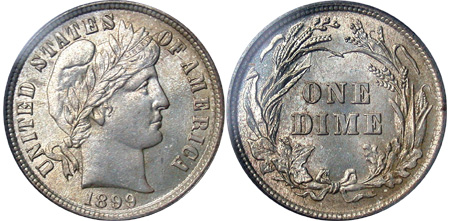
In the late 1870s, dissatisfaction with the Seated Liberty dime design began to echo in Washington and Philadelphia. The perception was that the nation's coin designs were lackluster, but what ensued was a transformation that surprised many with its simplicity. While several new designs were proposed by Mint engravers during the early 1880s, the only outcome was Chief Engraver Charles Barber's creation of a new nickel in 1883. In 1891, as discussions of a public competition for new dime, quarter, and half dollar designs arose, Barber expressed his skepticism about finding capable design assistance in the United States.
This air of self-assuredness extended to the renowned sculptor Augustus Saint-Gaudens, who claimed that only four individuals globally could undertake such redesigning, with himself as the fourth. Mint Director James Kimball believed otherwise and aimed to identify skilled designers within America. To achieve this, a panel of ten leading artists and sculptors was tasked with determining the best designs for the new coinage. However, they rejected the proposed terms for the competition, citing inadequate preparation time and compensation. Kimball, not swayed by the panel's stance, opened the competition to the public, yielding underwhelming results. Only two designs out of more than 300 submissions received honorable mentions, highlighting the difficulties in revamping coin designs.
Edward O. Leech succeeded Kimball as Mint Director and decided to circumvent the committee and public debates. He directed Chief Engraver Barber to create new designs, fulfilling Barber's desire all along. Barber's approach involved modifying the large head from the Morgan dollar, incorporating a Liberty cap and shortening Liberty's hair at the back, with his initial "B" on the neck truncation. The reverse borrowed the wreath from the Seated Liberty dime of 1860-1891. Although Barber faced skepticism from outsiders, he succeeded in designing a dime suitable for modern, high-speed coin presses, a crucial factor for efficient coin production.
On January 2, 1892, the first  Barber dimes were minted, and over half a billion would follow in the next quarter-century. Mintages ranged from as low as 500,000 (e.g., 1895-O, 1901-S, and 1913-S) to as high as 22 million (1907-P). Four different mints struck these coins, with the mintmarks of Denver (D), San Francisco (S), and New Orleans (O) found below the bow knot on the reverse (Philadelphia issues lack a mintmark). Barber dimes are generally accessible, lacking significant date or mintmark rarities, except for the enigmatic 1894-S dime. Only ten specimens of this rarity can be accounted for today, despite reports of 24 being struck. The story of the 1894-S dime remains one of the most intriguing mysteries in American numismatics, with tales of Mint Superintendent Daggett's daughter spending one on ice cream, known as the "Ice Cream Specimen," and the others sold in 1950.
Right now on eBay
The story of the 1894-S dime, one of the rarest coins in U.S. numismatics, continues to captivate collectors and enthusiasts. Allegedly, 24 of these dimes were struck on the orders of San Francisco Mint Superintendent J. Daggett. However, only ten of these elusive coins have surfaced to date, leaving numismatists with a century-old enigma: the whereabouts of the other fourteen 1894-S dimes that were reportedly minted.
All known examples of the 1894-S dime are proof coins, and they were all produced from the same set of dies. Over the years, much has been written about this fascinating rarity, giving rise to numerous stories and theories. Among the most famous tales is that Superintendent Daggett gave three of these dimes to his daughter, Hallie, with instructions to keep them until she reached his age. At that point, he believed they would be worth a substantial sum. However, on her way home from the mint, Hallie spent one of the dimes on a dish of ice cream, earning that particular coin the nickname "Ice Cream Specimen." She retained the other two and eventually sold them in 1950.
The 1894-S dime remains a legendary and prized treasure among coin collectors, and its mystique adds to its allure. While only ten specimens are known today, the ongoing search for the missing 1894-S dimes keeps the numismatic community intrigued, and it remains one of the most celebrated and enigmatic coins in American numismatic history.
♦ Barber Dimes on eBay |