
Winged Head or Mercury Dime 1916 - 1945
Collector Quick Guide
What collectors look for
Original condition, age, maker marks, materials, completeness, unusual variants, and documented history usually matter most.
How to identify originals
Compare markings, construction details, finish, size, period-correct materials, and known design features before assuming authenticity.
Red flags / reproductions
Watch for reproductions, heavy restoration, replaced parts, fantasy pieces, unclear photos, and listings with vague descriptions.
Related collectibles
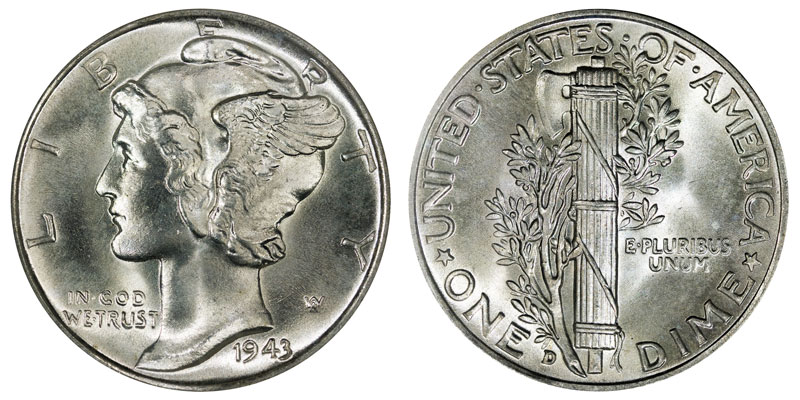
Despite its diminutive size, the "Mercury" dime stands as one of the most exquisite coins ever minted by the United States Mint. The sheer intricacy and aesthetic allure of its design are nothing short of remarkable for a coin of such modest dimensions.
Surprisingly, the coin's design doesn't depict Mercury, the Roman god of messengers. Instead, the obverse features Liberty donning a winged cap, symbolizing the freedom of thought. Thus, the coin is more accurately referred to as the Winged Head Liberty dime. Nevertheless, the nickname "Mercury" stuck due to early usage, and it has persisted over the years.
Regardless of nomenclature, the dime marked a refreshing departure when it was first introduced in 1916. It symbolized not only freedom of thought but also America's newfound vitality, reflecting the exuberance of the early 1900s. In contrast, the previous Barber dime was a relic of the 19th century, reflecting a more rigid and formal era. Artistically, the new dime brought a breath of fresh air while drawing inspiration from ancient Greek and Roman art.
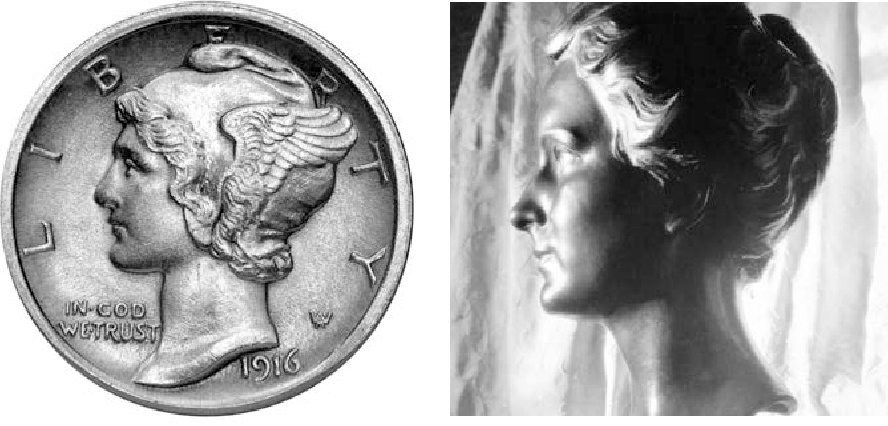
The Winged Liberty portrait is believed to be based on a 1913 bust sculpted by Adolph Weinman of Elsie Kachel Stevens, the wife of renowned poet Wallace Stevens. At the time, the couple rented an apartment owned by Weinman in New York City. On the reverse, the coin displays the fasces, an ancient symbol of authority, along with a battle-ax symbolizing preparedness and an olive branch representing love and peace. Given the backdrop of World War I in Europe, these themes carried significant emotional weight in 1916.
Right now on eBay
The release of the first Mercury dimes was delayed until late in the year due to unprepared dies. In the interim, coins featuring the old Barber design were hastily minted to meet demand. The Denver Mint produced a mere 264,000 of the new dimes, making the 1916-D a coveted rarity in the series as the only coin with a mintage below 1 million. The mintmark is located on the reverse, positioned below and to the left of the fasces. Other scarce coins in the series include the 1921, 1921-D, and 1942/1 overdates from both Philadelphia and Denver. Brilliant proofs were minted from 1936 through 1942, and at least one 1916 matte proof exists.
Collectors seeking perfection favor  Mercury dimes with "full split bands," showcasing distinct lines within the bands encircling the fasces. These coins command notably higher premiums compared to those lacking this detail. However, the absence of full bands doesn't necessarily imply that a coin is not in mint state; often, it simply indicates a weak strike. Nevertheless, the bands serve as a gauge for wear due to their prominent and exposed position. Other areas to inspect for wear include Liberty's hair and the region in front of her ear.
Throughout most of the series, production at the branch mints in Denver and San Francisco remained below 10 million coins annually. The main mint in Philadelphia, while experiencing higher outputs, surpassed 100 million only on five occasions. A large number of Mercury dimes exist in grades up to Mint State-65, with coins in MS-66 and 67 also readily available. This, coupled with their exquisite beauty, makes them highly sought after. With a total of 77 date-and-mint combinations (excluding overdates), many collectors opt for a single type coin. Some choose to assemble "short sets" spanning from 1934 through 1945 or 1941 through 1945.