Roosevelt Dime 1946 - Present
Collector Quick Guide
What collectors look for
Original condition, age, maker marks, materials, completeness, unusual variants, and documented history usually matter most.
How to identify originals
Compare markings, construction details, finish, size, period-correct materials, and known design features before assuming authenticity.
Red flags / reproductions
Watch for reproductions, heavy restoration, replaced parts, fantasy pieces, unclear photos, and listings with vague descriptions.
Related collectibles
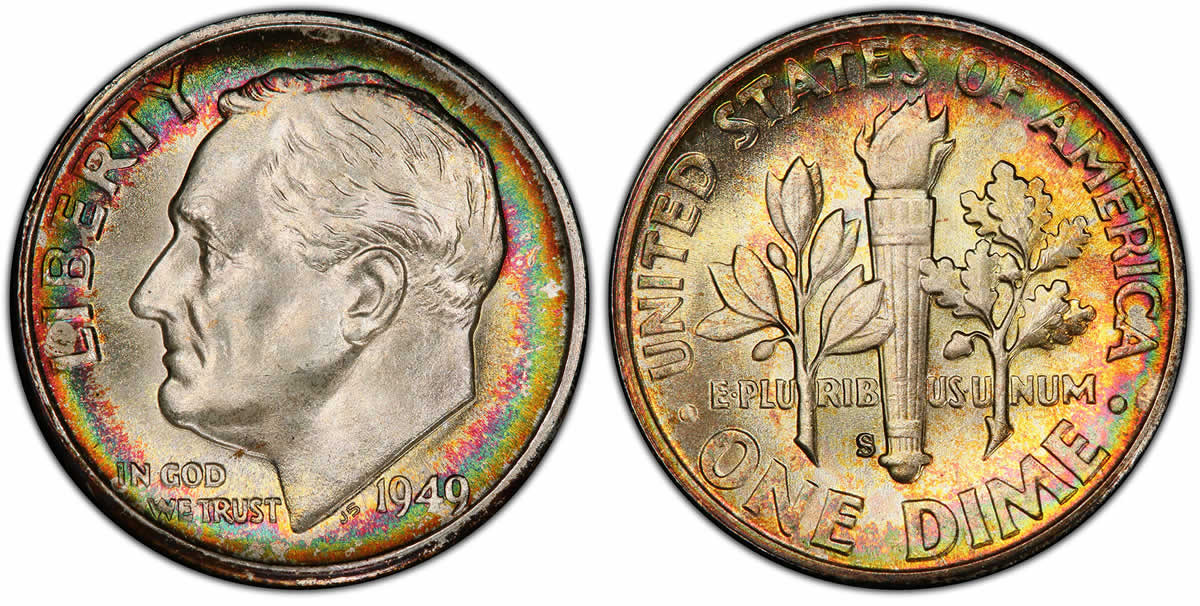
 90% Silver Planchets (1946 - 1964)
It is a historical fact that in 1945, the American public was longing for a fitting tribute to their beloved leader, whose untimely passing occurred just as he stood on the brink of a well-deserved victory, following years of relentless struggles and concerns. As the world witnessed the conclusion of World War II in April of that year, Franklin Delano Roosevelt, the nation's only four-term president, breathed his last at the age of 63, bearing the weight of leading the country through both the most severe economic depression in its history and the most devastating war ever experienced.
Within the Treasury Department, swift plans were set in motion to introduce a new coin in honor of Roosevelt. Given that the late president had battled polio, commonly known as infantile paralysis at the time, it seemed only fitting to feature his portrait on the dime. This modest coin symbolized the fight against polio through the "March of Dimes" fundraising campaign, a project initiated during Roosevelt's initial term. The responsibility for designing this coin fell to Chief Engraver John R. Sinnock.
Sinnock's initial coin designs were presented to the federal Commission of Fine Arts by Acting Mint Director Leland Howard on October 12, 1945. However, the Commission rejected these designs on specific grounds, suggesting an invitational competition involving five accomplished sculptors for the new dime's design. Given the limited time frame (the coins needed to be ready for release during the 1946 March of Dimes campaign on the late president's birthday, January 30), Mint Director Nellie Tayloe Ross swiftly dismissed this idea.
Instead, John R. Sinnock returned to his workshop to refine his designs. His original depiction of Roosevelt with prominent inscriptions was replaced by the now-familiar, larger portrait with a smaller "IN GOD WE TRUST." The word "LIBERTY" remained in bold letters but was shifted to the left, below the portrait. The date and Sinnock's initials, "JS," were placed discreetly below Roosevelt's neck. The reverse featured an upright torch symbolizing freedom, flanked by branches of olive and oak, signifying peace and victory. The motto "E PLURIBUS UNUM" was positioned between these elements. Around the periphery, "UNITED STATES OF AMERICA" and "ONE DIME" were arranged in arcs, separated by ornamental dots. These revised designs were approved on January 8, 1946, by the Commission of Fine Arts and Treasury Secretary Fred Vinson. Director Ross ordered the production of hubs and dies immediately and initiated coinage as soon as possible.
Right now on eBay
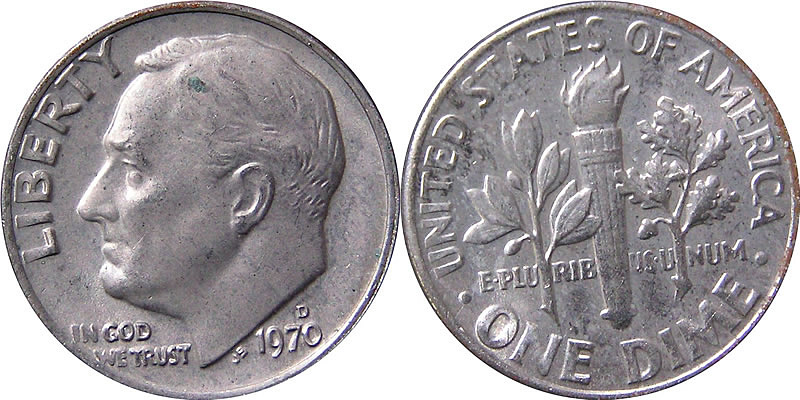
Copper Nickel, Copper Clad (1965 - Present)
From 1946 onward, millions of Roosevelt Dimes were coined annually. This series lacks rare dates, with the primary challenge for collectors lying in locating scarce varieties or coins in exceptional condition. Some minor hub changes occurred, notably in 1946, 1964, and 1981, to address wear resulting from repeated die sinkings. Roosevelt dimes were minted in Philadelphia, Denver, and San Francisco. Initially, the mintmark location was to the left of the base of the torch, but from 1968 onwards, mintmarks appeared above the date. Philadelphia-minted dimes did not have mintmarks until the introduction of the letter "P" in 1980.
While Roosevelt dimes are easily obtainable in mint state, some issues carry notable premiums, especially in grades MS-65 and higher. Notable among these are the 1948 and 1949 dimes, as well as the 1950-S and 1951-S. Although the three issues from 1955 had much lower mintages, they were widely hoarded, resulting in modest premiums. The only regular-issue dime worth more than its silver value in circulated grades is the 1949-S. Collectors should examine Roosevelt dimes for wear on the high points of FDR's hair and cheek, as well as the torch's flame and horizontal bands.
Proofs of Roosevelt dimes were produced at the Philadelphia Mint starting in 1950. These early proofs, from 1950 to 1955, hold higher values than later proofs. Proof coinage ceased with the shift to copper-nickel clad dimes in 1965, with no proofs minted in 1965, 1966, and 1967. However, "special mint sets" with prooflike surfaces were produced at the San Francisco Mint during those years. These sets, while not as sharply struck as true proofs, often exhibit nicks and abrasions due to less careful handling. Proof coinage resumed in 1968, exclusively at the San Francisco Mint. S-Mint dimes from 1968 onwards are genuine proofs bearing the letter "S" and are intended for collectors. Since 1992, these have been struck in both the traditional clad composition and the original silver standard. The Philadelphia and Denver Mints continue to produce copper-nickel clad dimes for general circulation.