
Twenty Cent Piece 1875 - 1878
Collector Quick Guide
What collectors look for
Original condition, age, maker marks, materials, completeness, unusual variants, and documented history usually matter most.
How to identify originals
Compare markings, construction details, finish, size, period-correct materials, and known design features before assuming authenticity.
Red flags / reproductions
Watch for reproductions, heavy restoration, replaced parts, fantasy pieces, unclear photos, and listings with vague descriptions.
Related collectibles
The concept of a Twenty-cent piece was not a novel idea. It was initially proposed by Thomas Jefferson in 1783 as part of the decimal coinage system. However, this idea was set aside during the deliberations for the Mint Act of 1792, in favor of the quarter dollar, which closely resembled the Spanish Eight Reales, known as "two-bits," widely used at the time. In 1806, the denomination was proposed once more and faced little opposition, but the legislation was ultimately defeated due to other aspects of the bill.
In February 1874, Nevada Senator John Percival Jones introduced a bill to make the Twenty-cent piece a reality, with the belief that it could address the scarcity of small change, particularly in the Western United States, where the problem was particularly acute.
The Mint Act of 1873 had abolished the silver trime, half dime, and dollar without granting the San Francisco or Carson City Mints the authority to produce minor coins. With the half dime vanishing from circulation, obtaining correct change for a quarter was becoming increasingly challenging. In 1874, numerous items were priced at 10 cents, resulting in customers often receiving a dime or Spanish bit worth 12-1/2 cents when paying with a quarter.
The bill to create the Twenty-cent piece, signed into law by President Grant on March 3, 1875, was seen as a political response to the problem. Mint Director Henry Linderman supported the bill, possibly influenced by the owners of the Comstock Lode silver mines, who had lost demand for their output due to the 1873 Mint Act.
Linderman, who had an interest in pattern coins, instructed Philadelphia Mint Superintendent James Pollock to acquire designs and submit patterns for approval. The final design closely resembled the quarter, leading to widespread public confusion.
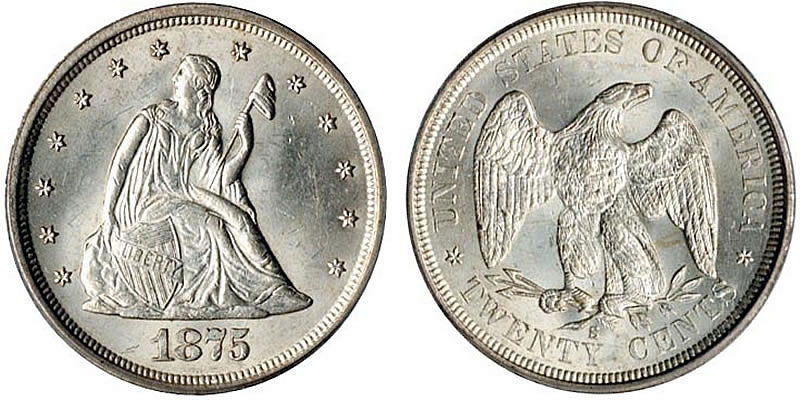
The obverse of the new coin featured Chief Engraver William Barber's rendition of Liberty seated on a rock with a Liberty cap-topped pole. The reverse displayed Barber's eagle from the Trade dollar, with inscriptions for "UNITED STATES OF AMERICA" and "TWENTY CENTS." The coin had a plain edge, designed to help the illiterate distinguish it from the quarter.
Right now on eBay
Unfortunately, the public's dislike for the coin led to its rapid decline. Although minting began in 1875, a bill was introduced in 1876 to repeal its authorization, eventually passing in May 1878. During its brief existence, only eight different date and mint combinations were produced, with the bulk coming from San Francisco (S), Carson City (CC), and Philadelphia (no mintmark). Proofs were made for two additional years, with a total of 5,000 produced before the denomination's demise in 1878.
Despite its short life, the Twenty-cent piece remains historically significant, with notable rarities such as the 1876-CC, one of the icons of American numismatics. Counterfeits are rare due to the doubling on "LIBERTY" present on genuine 1876-CC coins.
Another rarity is the 1875-S branch mint proof, with only a few known to exist. While some dates in the series are readily available, the 1876-CC is exceptionally rare, with only a handful in existence today. Collectors have shown increased interest in the series over the years, making it an appealing and relatively modest investment for numismatic enthusiasts.