
Capped Bust Quarter 1815 - 1838
Collector Quick Guide
What collectors look for
Original condition, age, maker marks, materials, completeness, unusual variants, and documented history usually matter most.
How to identify originals
Compare markings, construction details, finish, size, period-correct materials, and known design features before assuming authenticity.
Red flags / reproductions
Watch for reproductions, heavy restoration, replaced parts, fantasy pieces, unclear photos, and listings with vague descriptions.
Related collectibles
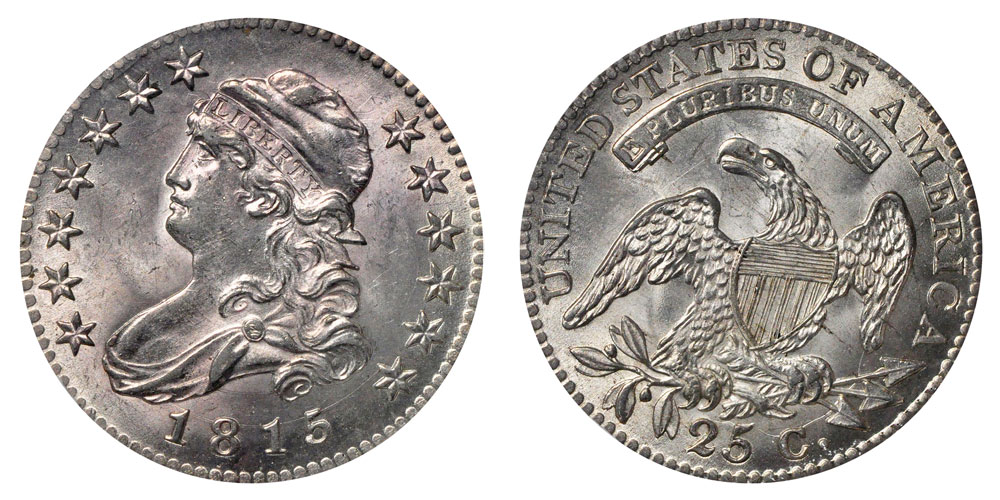
The American political experiment gave rise to numerous liberation movements across Europe, where the notion of the right to self-determination found eager acceptance. It all began in France, with the Revolution of 1789, and once more after Napoleon's downfall, the spirit of liberation spread to Naples, Greece, Belgium, and Poland. As the once-mighty Spanish Empire crumbled, it led to the birth of the Latin American Republics, all driven by this fervor for self-determination.
The turbulence in Europe beckoned to many immigrants seeking refuge in the dynamic, lively, and relatively peaceful United States. Among these individuals was John Reich, a German engraver entangled in the Napoleonic Wars. He financed his journey to America through indentured servitude and soon resumed his profession as an engraver by applying for a position at the U.S. Mint in Philadelphia. In 1807, he secured the job and was entrusted with the task of crafting new coin designs.
In this period, Reich effectively bridged the gap between Europe and America through his artwork. His obverse design featured Liberty, facing left and encircled by 13 stars, with the date placed beneath her bust. Liberty, though described in the press as resembling "the artist's plump lover," likely mirrored the appearance of the average European woman. Despite contrary opinions, she donned not a Phrygian liberty cap but a simple mob cap with the word "LIBERTY" inscribed on the band. Some critiqued the notion of Liberty wearing a cap associated with freed slaves, but even President Thomas Jefferson recognized it as typical women's attire during that era. Miss Liberty exuded a more rustic charm, quite distinct from the stern and no-nonsense visage of the earlier Robert Scot-designed Draped Bust.
On the reverse, an eagle with outstretched wings perched on a branch held three arrows, displayed the Union Shield on its chest, and bore the motto "E PLURIBUS UNUM" ("One made up of many") on a scroll above the eagle. The inscriptions "UNITED STATES OF AMERICA" and "25 C" framed the border. This eagle had a more domesticated and peaceful demeanor compared to the aggressive Heraldic Eagle design from 1804-1807 and was noticeably more robust than the somewhat feeble eagle on the 1796 quarter.
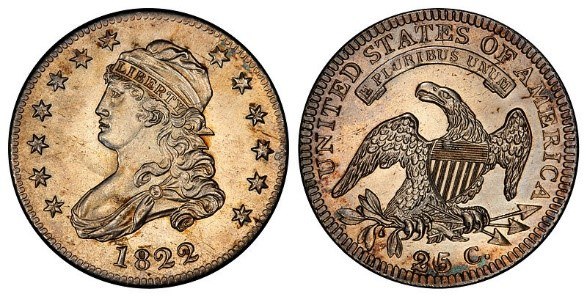
Scroll On Reverse (1815-1828)
Reich's design adhered to the policy established by the Mint's first director, David Rittenhouse, which mandated the use of a single design for all coins of the same metal. It made its debut on the half dollar in 1807, the dime in 1809, and finally, the quarter in 1815. Interestingly, there was a hiatus in quarter production from 1808 to 1814 due to limited demand. Early quarters became casualties of Gresham's Law, where the less valuable currency tends to circulate more while the more valuable one is hoarded. Spanish 2 reales coins, which were legal tender on par with the heavier U.S. quarters, satisfied commercial needs, making it unnecessary to produce large quantities of U.S. quarters during this time.
Right now on eBay
In the 1820s and 1830s, a significant wave of scientific breakthroughs laid the groundwork for subsequent technological advancements. In 1831, Charles Darwin embarked on his voyage aboard the H.M.S. Beagle, gathering the data that would later underpin his groundbreaking theory of evolution. Meanwhile, Charles Babbage's endeavors in 1833 to construct a calculating machine, though ahead of its time technologically, provided the foundational principles for future developments in this field. In 1830, Joseph Whitworth introduced the standard screw gauge and a machine capable of measuring to one-millionth of an inch, revolutionizing the production of more precise machine tools for tasks like planing, gear cutting, and milling.
During the initial three decades of coin production at the Philadelphia Mint, the methods used to mint coins remained relatively unchanged. Despite discussions about steam presses dating back to the 1790s, coins continued to be struck using traditional screw presses powered by human or animal muscle. It wasn't until 1829 that some mechanical enhancements were introduced in the striking of half dimes, with full integration into the production of quarter dollars occurring in 1831. This transformation was made possible by the adoption of a "close collar" device, which not only constrained the planchets during striking but also imparted a reeded edge to the coins, ensuring what Mint Director Samuel Moore termed "a mathematical equality" in the quarters produced. Additionally, a raised beaded border was incorporated along the rims to safeguard the inner surfaces of the coin.
Director Moore seized the opportunity presented by these mechanical upgrades to implement various modifications to the existing Capped Bust design. The first change he mandated from Mint Engraver William Kneass was the removal of the scroll above the eagle, which bore the traditional motto E PLURIBUS UNUM. Moore argued that this Latin phrase, translating to "One made up from many," was superfluous since the coin already featured the UNITED STATES legend, signifying the same concept. Although the elimination of the motto stirred some controversy within government circles, Moore personally advocated for its exclusion during a trip to Washington. His stance prevailed, and the motto wasn't restored to quarters until Charles Barber's redesign in 1892.
Kneass executed a comprehensive makeover of the coin. He retained the eagle design from John Reich's previous coin, known as the "sandwich board" eagle. The obverse still depicted Liberty facing left with a mob cap, but Kneass refined the design, giving the coin a more cameo-like appearance. He also deepened the coin's features, resulting in improved striking quality.
Small Size  Capped Bust quarters were struck for just eight years, yielding a total of 4,202,400 coins, all minted at the Philadelphia Mint between 1831 and 1838. While there are no major rarities in the series, 1832 and 1836 are notably scarcer in mint condition compared to other dates. In contrast, 1831 and 1834 are more frequently encountered. The 1831 issue is available in Small and Large Letters varieties, both of roughly similar rarity.
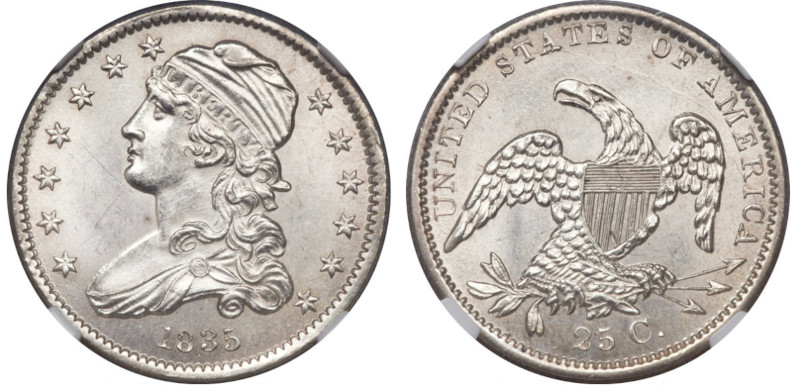
Scroll On Reverse (1815-1828)
Given the brief production span of Small Size quarters, this series is within reach for the average collector. However, relatively few collectors have assembled complete date sets over the years, perhaps because Bust quarters, in general, tend to be overlooked and undervalued by collectors. While there have been references listing die varieties on quarters from 1831 through 1838, collecting the series in this manner hasn't gained as much popularity as it has with other denominations like half dollars, dimes, and cents. Typically, Small Size Capped Bust quarters are sought after as type coins, and in AU and mint conditions without significant issues, they remain relatively scarce, with the majority of survivors falling into the XF or lower grade categories.