Seated Liberty Quarter 1838 - 1891
Collector Quick Guide
What collectors look for
Original condition, age, maker marks, materials, completeness, unusual variants, and documented history usually matter most.
How to identify originals
Compare markings, construction details, finish, size, period-correct materials, and known design features before assuming authenticity.
Red flags / reproductions
Watch for reproductions, heavy restoration, replaced parts, fantasy pieces, unclear photos, and listings with vague descriptions.
Related collectibles
For more than a decade, Christian Gobrecht, a distinguished banknote plate engraver and medalist, sought a permanent position within the Mint. However, during the early 1800s, the Mint's employment practices were entrenched with nepotism. The engraver was often a relative of the mint director, or another official's son, and this influenced hiring decisions. Despite his exceptional skills, Gobrecht, unrelated to influential individuals, unsuccessfully pursued the Chief Engraver position, even though he was arguably the most qualified candidate.
Born in Hanover, Pennsylvania, in 1785, Gobrecht, one of seven children of a German immigrant minister, displayed an early aptitude for mechanics and inventions. After apprenticing with a clock-maker, he relocated to Philadelphia in 1811. His talent as an engraver soon caught the eye of Mint Director Robert Patterson, who offered him a position as Assistant Engraver in 1817. Gobrecht initially declined but eventually accepted the role when Chief Engraver Robert Scot passed away in 1823. However, the influence of Chief Coiner Adam Eckfeldt led to the appointment of William Kneass, a less accomplished engraver, as Chief Engraver, despite Gobrecht's superior qualifications.
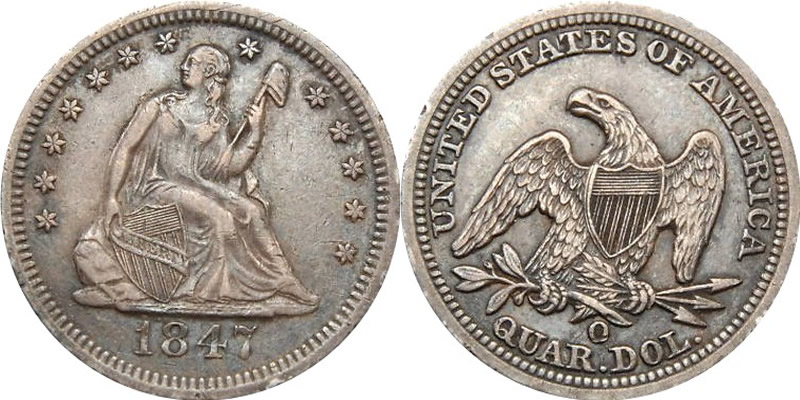
Without Motto On Reverse (1838-1853)
Necessity eventually overcame nepotism in the summer of 1835 when Kneass suffered a stroke. Gobrecht accepted the position of Assistant Engraver offered by Mint Director Robert Maskell Patterson. Gobrecht immediately set to work improving and modernizing coinage. Patterson, concerned about the artistic quality of federal coinage, selected a drawing by Thomas Sully as the model for a new dollar coin design, with Gobrecht tasked to bring it to life.
Following the release of the dollar patterns in December 1836, Gobrecht initiated work on updating the designs for other denominations due to the Mint's practice of using the same design on all silver coins. It wasn't until the fall of 1838 that the new quarter replaced the old John Reich Capped Bust design.
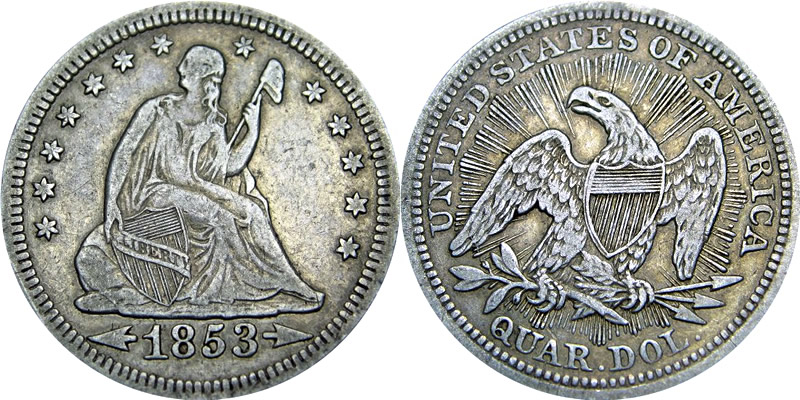
Arrowheads At Date With Rays On Reverse (1853 Only)
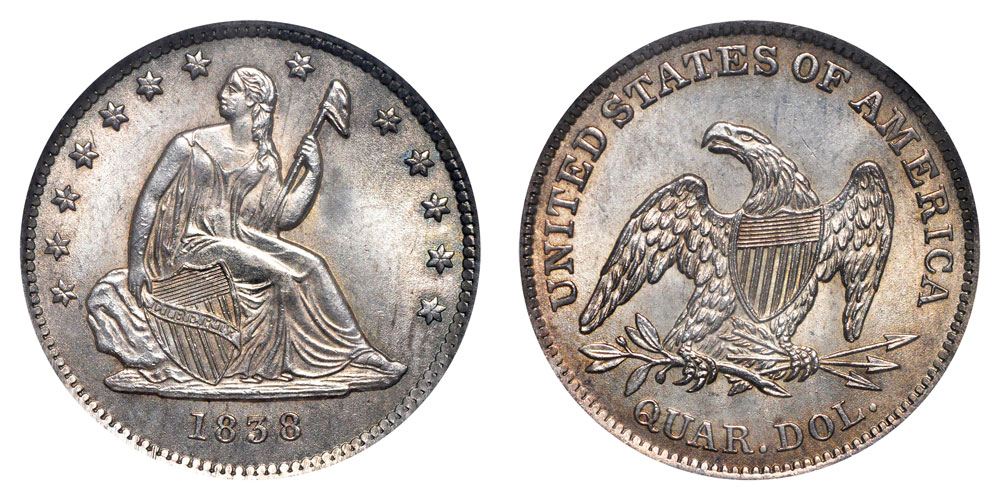
Gobrecht's design featured a modified version of Liberty seated on a rock, encircled by thirteen stars on the obverse. The reverse retained the Reich-Kneass eagle from the prior issue but replaced "25 C" with "QUAR. DOL." in 1840, marking an "improvement." This design, though different from Gobrecht's original, remained in place for the duration of the series.
The  Seated Liberty quarter in circulation during this period featured Gobrecht's design, modified by Robert Ball Hughes. It had been in use since 1838, replacing the Capped Bust motif. Liberty was depicted seated on a rock, surrounded by stars, holding the Union shield and a pole with a Liberty cap. The reverse featured the inscription "UNITED STATES OF AMERICA" and "QUAR. DOL.," encircling an eagle with arrows and branches.
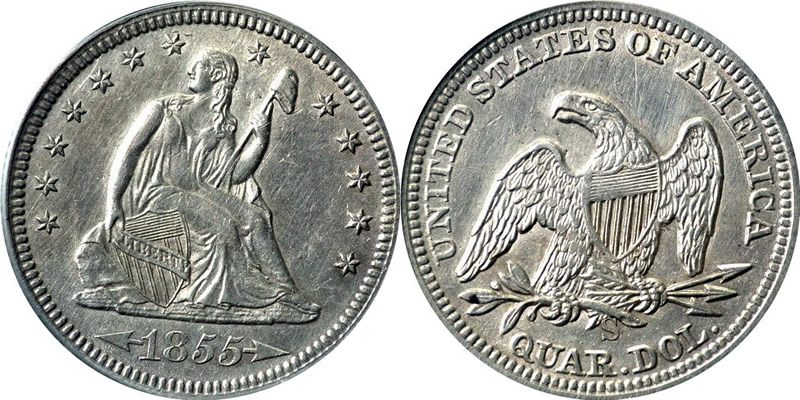
Arrowheads At Date Without Rays On Reverse (1854-1855)
With the oversupply of silver in the early 1870s, the Mint Act of 1873 was passed, demonetizing silver and significantly affecting U.S. coinage. The Seated Liberty quarter underwent cosmetic and technical changes, including the addition of arrows on each side of the date and rays emanating from the eagle on the reverse.
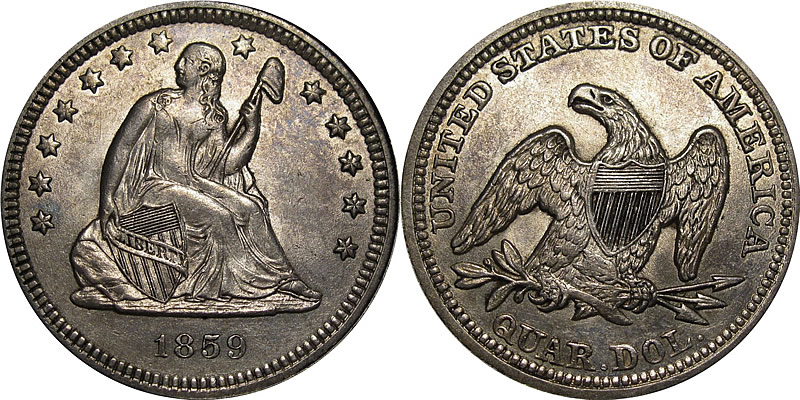
Without Motto On Reverse (1856-1865)
In 1854, Congress passed the Kansas-Nebraska Act, allowing residents of those territories to decide the slavery issue by popular vote, while the Mint Act of 1853 reduced the silver content in most U.S. coins. By 1854, the coin shortage had ended, and over a million dollars' worth of silver coins were stored in the Mint's vaults, waiting for buyers. In the early 1870s, silver was again in oversupply, with Germany and France dumping silver on the market and new silver discoveries in the western United States exacerbating the problem. This, alongside the reduction in the silver content in U.S. coins, had significant economic consequences.
Right now on eBay
In 1873, the Mint marked the Seated Liberty quarters with arrows to indicate the change in weight due to the Mint Act of 1873. However, this change in weight was minor, and old and new planchets were likely used interchangeably. The legislation had the effect of eliminating the standard silver dollar, half dime, and three-cent coin, while introducing the Trade dollar for use in the Orient.
Throughout its two-year run, just over 2.3 million Arrows quarters were minted for circulation, along with 1,240 proofs. This design is typically collected as a type coin, and a complete set includes just five coins: the Philadelphia (no mint mark) and San Francisco (S) issues of 1873 and 1874, and the Carson City (CC) issue of 1873. As part of the overall Seated Liberty series, it's one of six major varieties, marked by changes in design and content over the years. The "Arrows" coinage of 1873-74, with its significant legislative and economic background, remains an interesting and historically significant piece of numismatic history.
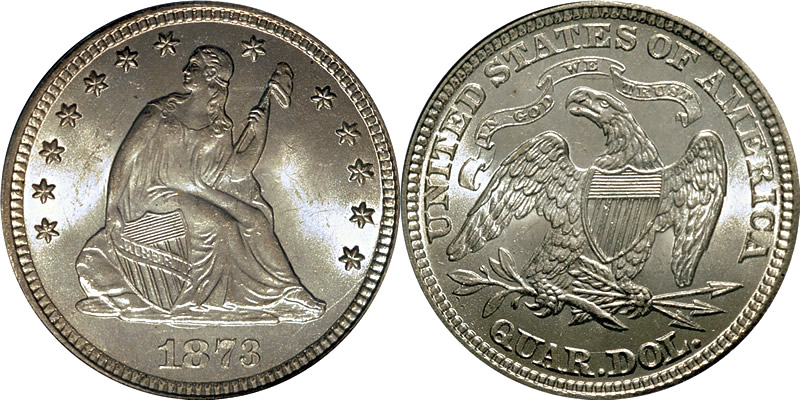
With Motto On Reverse (1866-1873)
This legislative action significantly affected the American monetary landscape. While the 1873-74 "Arrows" coinage is often collected as a type coin, it also serves as a historical testament to the economic and political changes taking place during the 19th century in the United States.
The "Arrows" design on the Seated Liberty quarter marked a moment in history when the United States grappled with issues related to silver coinage and the nation's financial system. The oversupply of silver due to international factors and domestic discoveries required the government to respond with changes in coinage standards. The addition of arrows and rays on the coin was a visual indicator of the revised weight standard imposed by the Mint Act of 1873.
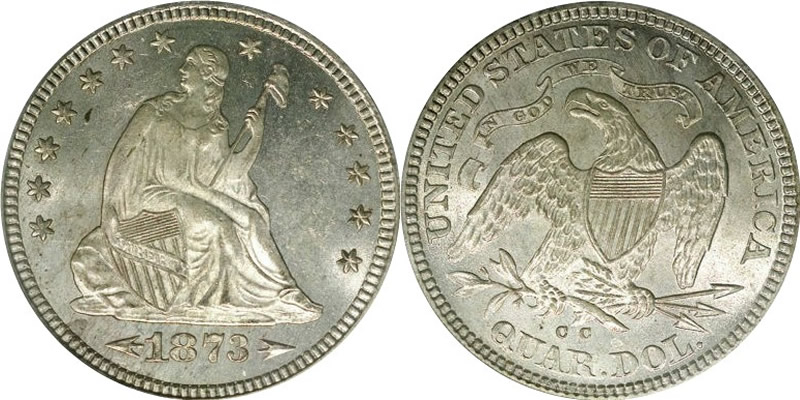
Arrowheads At Date (1873-1874)
Despite the minor weight adjustment and the economic turmoil associated with the Mint Act of 1873, the "Arrows" quarter remains a compelling numismatic piece for collectors and historians. This two-year design provides a tangible link to a pivotal period in American history when economic policy and financial standards were in flux.
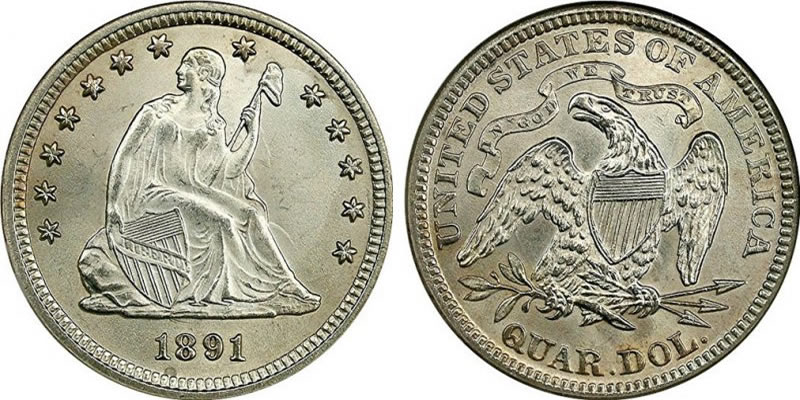
With Motto On Reverse (1875-1891)
Collectors often seek "Arrows" quarters as part of their coin collections due to their historical significance, limited mintage, and distinct design. While the coin itself may be collected for its aesthetic and historical value, it also symbolizes the broader economic and legislative changes that marked a turning point in the nation's monetary history. The presence of arrows and rays on the coin's design serves as a visual reminder of the economic adjustments made during that era.