
Teenage Mutant Ninja Turtles #1: How Collectors Identify the Valuable First Printing
- Jul 2026
- The Hot Collector
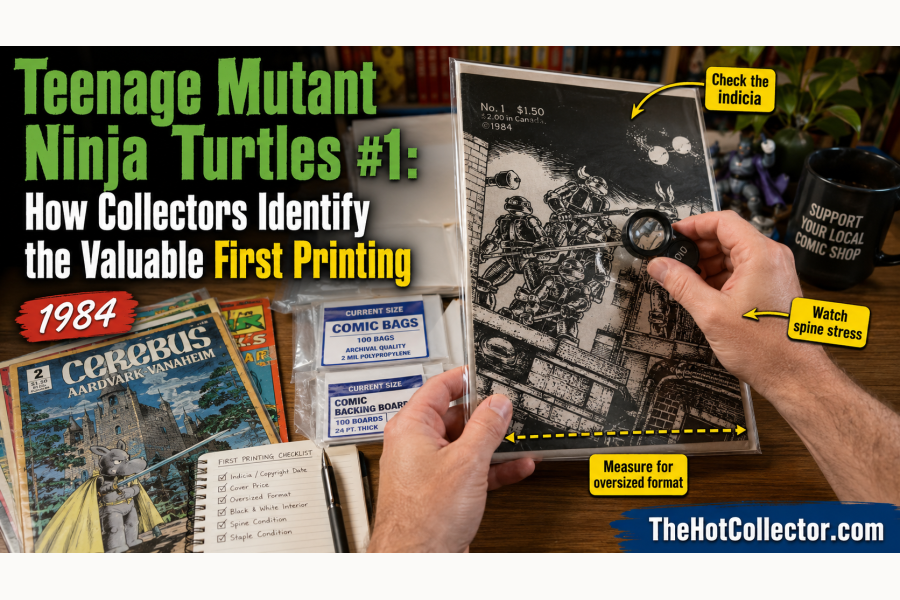
Before the cartoons, pizza jokes, action figures, arcade games, and colorful masks, the Teenage Mutant Ninja Turtles lived inside an oversized black-and-white comic published by two young creators working far outside the traditional superhero system.
Kevin Eastman and Peter Laird created the Turtles partly as a playful parody of the dark, dramatic comics popular during the early 1980s. The joke could easily have ended with a few sketches shared between friends. Instead, they self-published  Teenage Mutant Ninja Turtles #1 through Mirage Studios in 1984 and produced an initial run of just 3,000 copies. The comic introduced the Turtles, Master Splinter, Shredder, and the Foot Clan, making it one of the most important independent comics of the Copper Age.
The first printing went on sale in May 1984. Demand quickly led to additional versions, including a second printing dated June 1984, a third printing released in early 1985, and later fourth and fifth printings. That success is wonderful history, but it also created a challenge for modern collectors: several versions of issue #1 exist, and they can look remarkably similar to someone relying only on the familiar red cover.
Collector’s Tip: never identify a first printing from the cover alone.
Begin with the publication information inside the comic. The indicia should be checked for the publisher, date, and any wording identifying a later printing. Compare the entire book with documented examples, including its dimensions, interior pages, advertisements, paper, cover finish, and small printing differences. A seller who shows only the front cover has not provided enough information for a serious purchase.
The original comic was larger than an ordinary modern comic book, so trimming can be a major concern. Measure the copy and inspect all three exposed edges. Uneven borders, unusually sharp cuts, missing artwork, or edges that appear newer than the surrounding paper may indicate trimming. Because small differences can also result from the original manufacturing process, measurements should support other evidence rather than become the only test.
Look Closely: examine the red background and black ink under strong, neutral lighting. Color fading, rubbing, fingerprints, ink loss, and surface scuffs can be difficult to see in heavily edited photographs. Dark covers are especially unforgiving because stress lines along the spine quickly expose white paper beneath the ink.
Right now on eBay

Teenage Mutant Ninja Turtles #1 5th Print 1988 Mirage Studios TMNT Comic Key
Very Good

Teenage Mutant Ninja Turtles #22 Jun 1989 Mirage Studios TMNT Comic Book (FN+)
Unspecified


Teenage Mutant Ninja Turtles #1 First Print Cover C IDW Comics TMNT Eastman
Like New

Teenage Mutant Ninja Turtles #30 - Mirage Studios - TMNT Comic Book Vintage
Like New

BATMAN TEENAGE MUTANT NINJA TURTLES #1 FIRST PRINT IDW DC COMICS (2016)
Unspecified

Nickelodeon 40th Anniv 1984 TMNT Comic Book 6” - Michelangelo Raphael & Leonardo
New

Teenage Mutant Ninja Turtles Promo Poster Framed 1990s Print Ad Rare TMNT Comics
Used


1988 TEENAGE MUTANT NINJA TURTLES #16 FINE 1st PRINT MIRAGE STUDIOS TMNT COMIC
Like New
Teenage Mutant Ninja Turtles #22 Jun 1989 Mirage Studios TMNT Comic Book
Very Good

MASSIVE TMNT Comic Collection - Mirage 1-3, IDW 1-16, LAST RONIN 1, 2 HARDCOVERS
Like New
Condition matters enormously with this comic. The oversized format made early copies more vulnerable to bending, storage damage, corner wear, and spine stress. Many were read, stacked, carried to conventions, or stored in bags that offered little long-term protection. Even a genuine first printing may show problems that sharply affect its collector appeal.
Check the spine for splits, color-breaking creases, staple tears, rust, and paper pulling away from the covers. Inspect the corners for blunting or folds, then examine the back cover for stains, writing, impressions, and tanning. Page quality also matters. Cream or off-white pages may be expected on an older independent comic, but brittle edges, moisture damage, mold, or an unpleasant odor deserve caution.
Watch Out For: restoration can make a damaged comic appear much cleaner than it originally was. Color touch may hide spine wear. Glue can reinforce a split cover. Pieces may be added to missing corners, while cleaning or pressing can alter the book’s appearance. Professional conservation is not automatically dishonest, but it must be disclosed because restored and unrestored copies are treated differently by most collectors.
Signatures add another wrinkle. Eastman and Laird have signed many TMNT comics over the years, but an autograph does not automatically make a copy more valuable. Placement, appearance, documentation, and third-party authentication can all influence desirability. An unidentified signature written directly across important cover artwork may appeal to one collector and discourage another.
Graded copies offer added protection and a professional opinion, yet the label still needs to be read carefully. Confirm that it identifies the correct printing, note whether the grade is universal, qualified, restored, or signature-related, and verify the certification number through the grading company. CGC has previously addressed cases involving tampered holders, which is a good reminder that the plastic case itself should never replace careful verification.
Why Collectors Care: this was not merely the first issue of another superhero title. It was the beginning of an independently created phenomenon that expanded into television, toys, movies, video games, and generations of devoted fans. A first printing preserves the moment before that worldwide success was guaranteed.
High-grade examples have brought extraordinary auction prices. A CGC 9.8 copy sold for $264,000 in 2022, while another CGC 9.8 example realized $178,538 in 2023. Those results do not mean every copy is worth six figures, but they explain why identification, originality, and condition receive such intense attention.
For most collectors, the hunt does not have to end with a first printing. Second, third, fourth, and fifth printings each document the rapid growth of the comic, and attractive later copies can provide the same landmark story at a more approachable level. The key is purchasing the printing actually being advertised.
A genuine first printing of Teenage Mutant Ninja Turtles #1 is a piece of independent comic-book history. It began as a small, risky publishing experiment and grew into something nobody could have reasonably predicted. That unlikely journey—from a 3,000-copy black-and-white comic to a worldwide collecting obsession—is exactly why the original still commands a room whenever one appears.