
Vintage Hot Wheels Redlines: How to Identify Rare Cars, Original Wheels, and Repainted Examples
- Aug 2026
- The Hot Collector
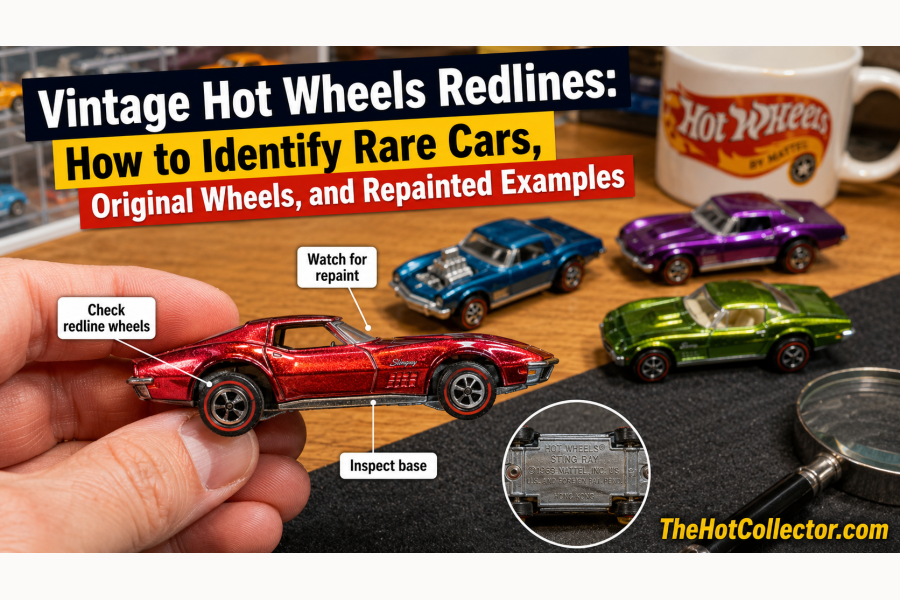
Dump a box of old toy cars onto a table and a longtime Hot Wheels collector will usually do one thing almost immediately: start looking at the wheels.
That tiny red stripe can change everything.
The earliest Hot Wheels Redlines arrived during one of the most exciting periods in American car culture. Custom cars, hot rods, drag racing, and wild concept vehicles were everywhere, and Mattel translated that energy into small diecast cars designed to look faster and roll farther than many competing toys.
The original 1968 lineup included cars such as the Custom Camaro, Custom Mustang, Custom Corvette, Custom Barracuda, Deora, Beatnik Bandit, and Python. Their bright translucent “Spectraflame” finishes made the metal bodies appear almost candy-coated, while the red-striped wheels gave them an unmistakable appearance.
Today, originality is where the serious collecting begins.
Collector’s Tip: never judge a Redline by the red stripe alone. Reproduction wheels are readily available, and worn originals can be replaced to make an ordinary car appear much cleaner than it really is.
Original wheel styles varied during the Redline era. Collectors examine the wheel diameter, hub design, axle construction, red stripe placement, and whether all four wheels are appropriate for the particular casting. A car with three original wheels and one modern replacement may still be desirable, but it should not command the same price as a completely original example.
The base is another important checkpoint.
Turn the car over and read everything. Country markings such as Hong Kong or USA, casting names, patent information, and Mattel markings can help identify production variations. Some models exist with different bases, interiors, windows, or wheel combinations depending on when and where they were manufactured.
Those small differences are why two cars that look identical from three feet away can have very different collector interest.
Right now on eBay
The paint deserves even more attention.
Original Spectraflame paint was designed to allow the polished metal beneath it to reflect through the color. That creates a depth and glow that can be difficult to reproduce convincingly. Genuine cars often show tiny chips around high points, door lines, fenders, or roof edges where children handled and raced them.
Ironically, a perfectly flawless 55-year-old loose car can sometimes deserve more scrutiny than a lightly worn one.
Watch Out For: repainted Redlines.
Restoration has become sophisticated enough that some repaints can look extremely convincing in photographs. Look inside wheel wells, around rivets, underneath bumpers, and along interior openings. Fresh paint hidden in recessed areas, unusually sharp color transitions, or paint covering areas that normally remained unfinished may indicate restoration.
The rivets are especially important. Most original cars were assembled using factory rivets that have a particular shape and finish. If a car has been drilled apart for repainting, the rivets may show tool marks, oversized holes, replacement screws, or reshaped heads.
That does not make a restored car worthless. Many collectors enjoy beautifully restored examples, particularly when originals are extremely expensive. The problem begins when restoration is not disclosed.
Certain castings attract especially strong attention. The Rear-Loading Beach Bomb has become legendary because of its unusual early design and extremely limited surviving examples. Other sought-after Redlines include variations of the Olds 442, Custom Volkswagen, Custom Camaro, Python, Red Baron, and several rare color or production combinations.
Color can dramatically affect desirability.
A common casting in an unusual factory color may attract considerably more attention than the same model in its most frequently encountered finish. Collectors therefore compare shades carefully and research whether a particular color combination is actually documented for that casting.
Look Closely: interiors and windshields can also be swapped. A clean replacement interior installed inside a worn body may look suspiciously fresh. Compare the plastic color, aging, fit, and casting details with known originals.
Packaging adds another dimension. Early blister cards can be extremely collectible, especially when the car remains factory sealed. Inspect the blister for cracks, yellowing, lifting, glue disturbance, or evidence that the card and car were reunited later. Card artwork, assortment numbers, and package variations can also help date the release.
Why Collectors Care: Redlines capture the moment when Hot Wheels changed what a toy car could be. They were not simply miniature copies of everyday automobiles. They represented California custom-car culture, imagination, speed, and the simple pleasure of launching a tiny metal car down an orange plastic track.
Many collectors chasing Redlines today owned Hot Wheels as children. Others discovered them decades later and became fascinated by the production variations, colors, wheel styles, and hidden factory differences.
The fun is that rare examples still occasionally turn up in old tackle boxes, childhood toy cases, estate-sale bins, and forgotten collections.
That battered little car with chipped purple paint may not look impressive at first.
But before tossing it back into the box, check the wheels, flip it over, and read the base.
With vintage Hot Wheels, some of the best finds are small enough to fit in the palm of your hand.