
Shadowless Pokémon Card
Collector Quick Guide
What collectors look for
Collectors look for authentic early Base Set cards with the shadowless artwork border, clean surfaces, sharp corners and strong centering. First Edition examples generally receive the most attention, while non-First Edition Shadowless cards are also highly collectible.
How to identify originals
Look at the right side of the Pokémon illustration box: a Shadowless card lacks the darker drop shadow found on later Unlimited cards. Early Shadowless cards also use thinner HP lettering, and non-First Edition Shadowless examples lack the Edition 1 stamp.
Red flags / reproductions
Be cautious of added First Edition stamps, recolored borders, trimmed edges and counterfeit cards made to imitate early Base Set printing. Never rely on the missing shadow alone; compare typography, printing, copyright information and the entire card.
Related collectibles
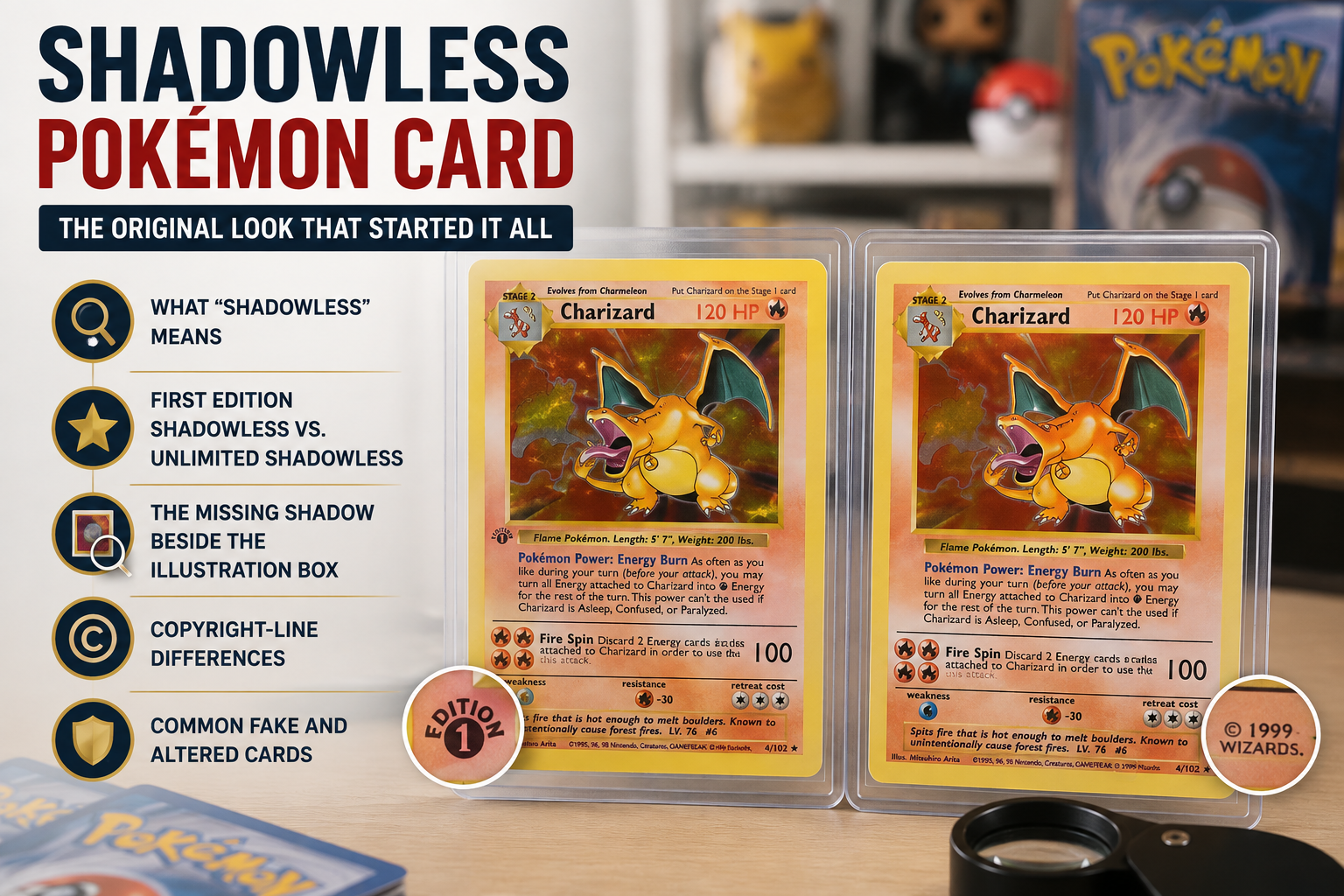
To someone unfamiliar with early Pokémon cards, a Shadowless card can look almost identical to the Base Set cards that filled binders and school backpacks in 1999. The difference is surprisingly small: look along the right side of the rectangular box containing the Pokémon artwork. On the later Unlimited printing, a darker drop shadow gives that box a slightly raised appearance. On a Shadowless Pokémon card, that shadow isn't there.
That tiny printing difference has become one of the most recognizable identification clues in vintage Pokémon collecting.
The story begins with the English-language Pokémon Base Set released in 1999. The earliest First Edition cards carried the familiar black Edition 1 stamp and also lacked the artwork-box shadow. After the First Edition run, the Edition 1 symbol was removed, but some of the original design characteristics remained. These subsequent cards still had the shadowless artwork treatment and thinner HP typography. Later Base Set production added the drop shadow and thickened the HP lettering, creating what collectors generally recognize as the Unlimited appearance.
This creates an important distinction that newer collectors sometimes miss. "First Edition" and "Shadowless" aren't simply interchangeable terms. The early English First Edition Base Set cards use the Shadowless design, but collectors also recognize a non-First Edition Shadowless printing. The latter has no Edition 1 stamp yet retains the missing shadow and other early characteristics. PSA describes Shadowless cards as typically more desirable than their Unlimited counterparts while generally ranking below First Edition examples in collector demand.
The copyright area provides another clue. PSA's Set Registry notes that Shadowless and First Edition examples show the early copyright-date sequence including "1995, 96, 98, 99." This is useful because identifying an early card should involve several matching characteristics rather than a single visual trick.
That's part of what makes Shadowless collecting so enjoyable. You don't necessarily need specialized equipment to begin learning. Put an early card beside a later Unlimited Base Set card and the differences gradually become obvious. The illustration border changes. The HP typography changes. The First Edition stamp may or may not be present. Even the small print along the bottom becomes part of the investigation.
For collectors who experienced Pokémon during its original explosion in popularity, these cards also have something condition reports and price guides can't measure: memory. These were cards children traded across lunch tables, stuffed into pockets and slid into inexpensive binders long before anyone imagined that tiny printing variations would someday be carefully studied.
A surviving Shadowless Base Set card therefore represents more than an early production variation. It comes from the opening chapter of the English Pokémon Trading Card Game, when nobody yet knew just how enormous the hobby would become.
Right now on eBay
The quickest Shadowless check is the illustration box, but experienced collectors don't stop there. Look immediately to the right and lower-right of the artwork frame. Later Unlimited Base Set cards have a visible dark drop shadow; Shadowless examples don't. PSA also identifies the thinner HP font as another characteristic shared by early First Edition and subsequent Shadowless cards.
Next comes the Edition 1 symbol. An English Base Set First Edition example normally carries the black circular Edition 1 stamp beneath and to the left of the artwork area. The later non-First-Edition Shadowless printing does not. This makes it possible to encounter two genuinely early cards that both lack the artwork shadow while only one carries the First Edition designation.
This is where careful inspection becomes important, particularly with expensive cards. A First Edition stamp creates a major distinction in the collector market, so a questionable stamp deserves scrutiny. Don't authenticate an expensive card from that stamp alone. The stamp, typography, artwork border, print characteristics and copyright information should make sense together.
Condition can be just as tricky. Pokémon cards were made to be handled and played, so whitening often hides along the blue reverse edges and corners. Holographic cards can develop fine scratches that disappear when viewed straight-on but become obvious when tilted beneath good lighting. Small dents and surface impressions can also be difficult to see inside sleeves.
And then there is the temptation to "improve" a card. Trimming an edge, recoloring white spots or otherwise altering damage may make a card photograph better, but it compromises originality. Natural wear should make sense. A card with heavily worn corners but suspiciously perfect-looking edges deserves a closer inspection.
Counterfeits create another challenge because "no shadow" by itself is extremely easy to imitate. Modern fake cards may reproduce the general layout while getting the cardstock, colors, fonts, holofoil or fine printing wrong. This is why First Edition Shadowless authentication should be based on the complete card rather than one famous feature.
Collectors should also remember that Shadowless doesn't automatically mean extremely valuable. Pokémon species, rarity, holographic status, condition, grading and collector demand all matter. A heavily played common Shadowless card occupies a very different market from a high-grade Shadowless holographic Charizard. What Shadowless does provide is an identifiable connection to the earliest English Base Set production.
That's really the charm of the term. The defining feature is something that isn't there. Once a collector learns where that missing shadow should be, an ordinary stack of old Pokémon cards becomes considerably more interesting. You start looking closer—and that's usually where collecting gets fun.