



Finding Value in Mixed Lots and Grouped Collections
Learn how to evaluate mixed collectible lots, identify overlooked pieces, calculate hidden costs, and establish a safe maximum price without letting one attractive item disguise an otherwise weak group.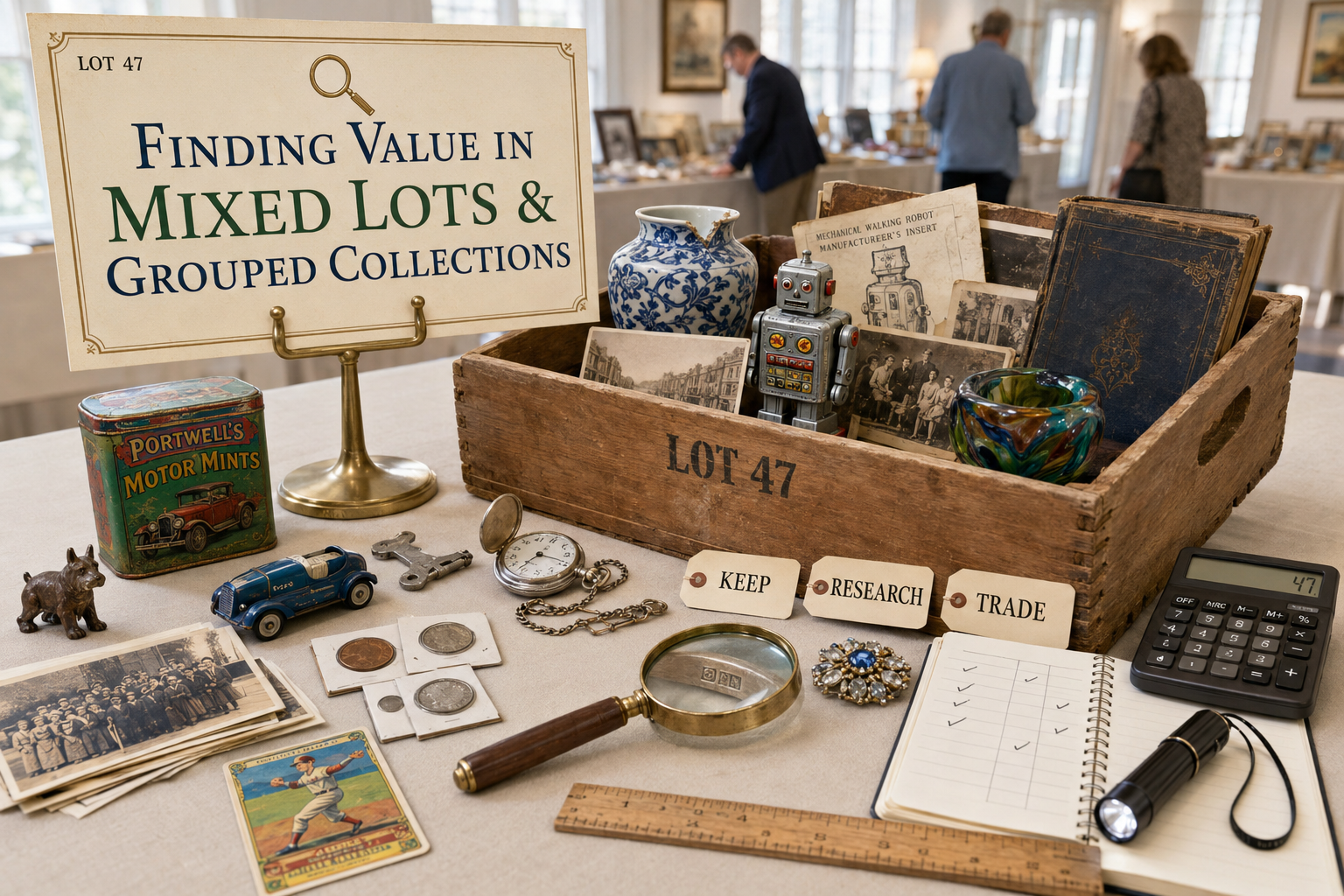
Ready to Browse Current Listings?
Search live eBay listings related to this guide through Deal Hunter.
Mixed lots can be among the most interesting opportunities in collecting. A box of unrelated objects, a binder of assorted cards, a shelf full of ceramics, or an estate group sold under one lot number may contain pieces that other buyers have overlooked. It may also contain damaged, incomplete, common, or difficult-to-sell items placed around one attractive collectible.
The key is to evaluate the group as a collection of individual objects rather than reacting to the lot’s overall appearance. A successful purchase begins with separating what you want from what merely comes with it.
What Is a Mixed Lot?
The word “lot” can describe a group of objects offered together or the numbered unit through which an auction accepts bids. A mixed lot may contain collectibles from several makers, periods, categories, or levels of quality.
Common examples include:
- A box of assorted postcards and photographs
- Several ceramic figures sold together
- A binder containing cards from different sets
- A tray of jewelry, watches, and small accessories
- A group of coins from different countries
- Vintage toys with loose parts and accessories
- Books, catalogs, advertisements, and other paper items
- The remaining contents of a collector’s shelf or estate
Some groups formed naturally over many years. Others were assembled by sellers specifically to move slow-selling inventory. Understanding which type you are examining can help you judge its potential.
Identify the Anchor Pieces
Begin by identifying the objects that create most of the lot’s appeal. These are the anchor pieces.
An anchor might be:
- A collectible from a desirable maker
- A scarce variation
- An object with original packaging
- A nearly complete set
- A signed or marked piece
- An item in noticeably better condition
- A collectible you would have considered buying separately
Do not assume the largest object is the most important. A small accessory, paper insert, manufacturer’s label, rare color variation, or overlooked supporting piece may have greater collector interest than the most visually prominent item.
Count the anchors and decide how much of your interest depends on them. If the entire purchase makes sense only because of one object, inspect and research that object carefully. One repaired, incomplete, or misidentified anchor can eliminate the value you expected from the entire group.
Divide the Lot into Four Groups
A practical way to analyze a mixed lot is to divide its contents into four groups:
- Keepers: Items that fit your collection and that you genuinely want.
- Trade or resale candidates: Desirable pieces you would be comfortable selling or trading.
- Research items: Objects that appear promising but require additional identification.
- Low-value or unwanted material: Common, damaged, incomplete, or unrelated items with little practical use to you.
This method prevents every object from receiving the same assumed value. It also reveals how much unwanted material you would need to store, sell, donate, or discard.
Be conservative with research items. An unidentified mark or unusual feature is a reason to investigate—not proof of rarity.
Examine Every Available Photograph
Online mixed lots are often presented with one appealing overview photograph. Look for additional images showing:
- The backs and undersides of objects
- Maker’s marks and signatures
- Box ends and package labels
- Missing components
- Cracks, chips, stains, and repairs
- Card corners and edges
- Book spines and title pages
- Coin surfaces and dates
- Jewelry clasps and metal marks
- Accessories hidden beneath larger objects
Enlarge the photographs and compare the objects shown in each image. Confirm that the listing photographs represent the same group throughout. Determine whether objects visible in the background are included or merely part of the seller’s staging.
If important areas are not shown, request additional photographs. Ask the seller to confirm the number of objects and whether all pictured pieces are included.
Read the Description Literally
Phrases such as “estate fresh,” “untested,” “as found,” “possibly rare,” and “I am not an expert” do not add evidence of value. Concentrate on statements that can be verified.
Look for answers to these questions:
- Is an exact quantity provided?
- Are important pieces individually identified?
- Is damage disclosed?
- Are mechanical items described as working?
- Are sets complete?
- Are reproductions included?
- Are boxes original to the objects?
- Are visible accessories included?
- Does the seller permit returns?
- Is the group sold as-is?
At auctions, condition information deserves special attention. Christie’s advises buyers that photographs may not show a lot clearly and that condition reports may not mention every fault, restoration, alteration, or adaptation. A condition report should therefore support your inspection, not replace it. Christie’s Conditions of Sale
Research the Pieces Individually
Do not search only for the seller’s lot title. Identify the strongest objects and research them separately.
Useful research details include:
- Maker or manufacturer
- Product line
- Model or pattern
- Approximate production date
- Materials
- Dimensions
- Country of origin
- Marks and labels
- Color or design variation
- Original accessories
- Condition
- Recent comparable sales
Use completed sales when possible rather than relying only on active asking prices. Compare objects in similar condition and configuration. A complete boxed example should not be used to value a loose or damaged example.
If you cannot identify an object confidently, assign it little or no monetary value in your calculation. Any later discovery then becomes a benefit rather than something required to justify the purchase.
Calculate a Conservative Lot Value
Start by estimating what the items you actually want would cost if purchased separately. Next, estimate the realistic recoverable value of the pieces you might sell or trade.
Do not add the highest price you can find for every object. Use conservative comparable sales and adjust for condition, completeness, selling fees, and the time required to find buyers.
A simple calculation is:
Value of keepers + conservative recoverable value of extras − expenses − risk allowance = maximum purchase price
If you are buying only for your collection, the keepers should drive the decision. Extras should not be treated as guaranteed profit.
Include Every Cost
The winning bid or advertised price may represent only part of the expense. Depending on where the lot is purchased, additional costs can include:
- Buyer’s premium
- Sales tax
- Shipping
- Insurance
- Handling charges
- Customs duties
- Travel expenses
- Storage materials
- Replacement parts
- Selling fees
- Return shipping
- Disposal costs
At auction, the buyer’s premium is added above the hammer price as part of the total purchase price. Other charges and taxes may also apply, so calculate your maximum bid from the final expected cost rather than the hammer price alone. Sotheby’s Buyer’s Guide
Shipping can erase the advantage of a bulky or fragile lot. A low-priced box of ceramics may require expensive professional packing. A group containing framed items, heavy books, or oversized toys can also cost more to transport than expected.
Look for Relationships between the Objects
Some of the best discoveries occur when objects that appear unrelated actually belong together.
Watch for:
- A toy paired with its missing accessory
- A box matched to an object elsewhere in the lot
- Correspondence identifying a photograph or autograph
- Catalogs documenting the maker of another item
- Several components from an incomplete set
- Original receipts or dealer labels
- Consecutive issues or numbered pieces
- A group from one family, business, club, or event
Do not separate documents, labels, packaging, or photographs until you understand their relationship to the objects. Provenance can be lost when a group is divided too quickly.
Recognize Deliberately Padded Lots
Some grouped listings contain one desirable piece surrounded by items that are difficult to sell individually. Possible warning signs include:
- Only the best item receives close-up photographs
- Damage is hidden beneath overlapping objects
- Most pieces are common or incomplete
- The title emphasizes quantity instead of quality
- Several objects are unrelated reproductions
- Boxes do not match the enclosed items
- Important accessories are visible but not included
- The seller refuses to provide additional photographs
- The price assumes every unidentified item is valuable
A padded lot is not automatically a bad purchase. It becomes a problem when the unwanted material raises the price, shipping cost, storage burden, or risk beyond what the desirable pieces justify.
Establish a Maximum Price before Bidding
Mixed lots encourage optimistic thinking. Buyers may imagine selling every unwanted object at a strong price, discovering several rarities, or recovering the entire purchase cost from one hidden piece.
Set your maximum price before bidding begins. Base it on what can be reasonably identified and verified. Do not increase it because other bidders appear interested.
Another bidder may possess information you do not have, but they may also be speculating, bidding emotionally, or valuing different objects in the group.
Evaluate the Time Commitment
A large lot may require hours of sorting, research, photography, listing, packing, and communication. That work has value.
Ask yourself:
- Do I have room to store the lot?
- Do I understand the included categories?
- Can I safely handle and package the objects?
- Is there a realistic market for the unwanted pieces?
- Would I still be satisfied if I could not resell anything?
- Is the lot improving my collection or creating another project?
If the answer depends entirely on reselling every extra item, the margin may be too thin.
What to Do after the Purchase
Photograph the lot before separating it. Record the original arrangement, seller’s description, purchase date, source, and total cost.
Create a basic inventory and note:
- Items retained
- Items requiring research
- Items intended for trade or sale
- Damage or missing components
- Packaging and documents associated with each object
Avoid aggressive cleaning. Dust, tarnish, labels, old tape, or surface coatings may provide identification clues or affect value. Research the material before attempting any treatment.
Mixed lots reward patience. The best value may be the anchor you recognized immediately, an accessory that completes something already in your collection, or a modest object that becomes important only after careful research. Purchase the group for what you can verify, leave room for uncertainty, and treat any genuine discovery as the bonus it should be.