
Exploring the Fascinating World of Error Coins: Planchet Division Errors
- May 2024
- Rigo
In the intriguing realm of coin collecting, error coins hold a special fascination for enthusiasts. These unique pieces, born from mistakes in the minting process, offer a glimpse into the complexities of coin production. One particular category of error coins, known as planchet division errors, occurs during the early stages of coin creation—when the alloy is being mixed and just after the planchet is made, but before the coin is struck by the working dies. Let's dive into the various types of planchet division errors that make these coins so captivating.
Rolled In Metal – Defective Planchet – Improper Alloy Mixture
One of the most fascinating planchet division errors is the "rolled in metal" defect. This occurs when foreign material, such as metal fragments, gets rolled into the planchet during the alloying process. The result is a coin with unusual and often striking inclusions that disrupt the smooth surface of the coin. Collectors treasure these errors for their uniqueness and the visual appeal of the embedded materials.
Another related error is the defective planchet, which can result from improper mixing of the metal alloy. This defect often manifests as irregularities in the coin's surface, such as rough patches or areas that appear porous. These errors provide a tangible link to the industrial processes behind coin production, highlighting the meticulous work involved in creating seemingly perfect coins.
An improper alloy mixture is another source of intriguing planchet errors. When the metals in the alloy are not correctly blended, the resulting planchets can exhibit a variety of anomalies, from color variations to inconsistent hardness. These errors are particularly valued by collectors for their rarity and the insight they offer into the complexities of metallurgy.
Plating Issue – Split Planchet – Lamination
Plating issues occur when the surface layer of metal does not properly adhere to the core of the coin. This can happen in plated coins, such as those with a thin layer of copper over a zinc core. When the plating process goes awry, it can lead to coins with flaking or peeling surfaces, creating a striking visual effect that draws the interest of numismatists.
A split planchet error happens when a planchet splits into two or more layers. This can occur if there is a flaw in the metal, such as an air pocket or impurity, which causes the planchet to separate under pressure. These errors are fascinating because they reveal the internal structure of the coin, often showing a clean break between the layers.
Lamination errors occur when the surface layer of the planchet begins to separate or peel away. This defect is usually caused by impurities or weaknesses in the metal. Coins with lamination errors often display dramatic peeling or flaking, making them highly collectible due to their distinctive and eye-catching appearance.
Right now on eBay
Clipped Planchet – Incomplete Clip – Blank (Type 1)
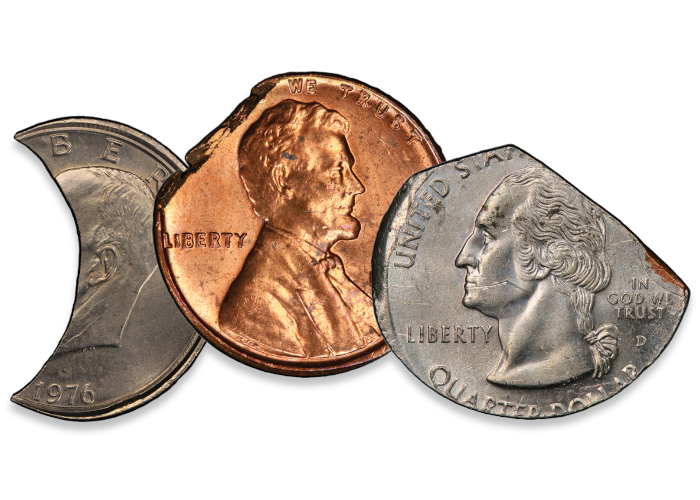
A clipped planchet error happens when a blank is improperly cut from the metal strip, resulting in a coin with a missing section or "clip." These clips can vary in size and shape, from small crescent shapes to large missing segments. Collectors appreciate clipped planchets for their clear deviation from the norm and the story they tell about the coin's journey through the minting process.
An incomplete clip occurs when the planchet is partially clipped but not fully separated from the metal strip. This results in a coin with a partially missing edge that can create interesting and unique shapes. These errors are sought after for their unusual appearance and the challenge they present in understanding the minting process.
A Type 1 blank, or planchet, is a coin that has been cut from the metal strip but has not yet been struck by the dies. These blanks are fascinating to collectors because they represent the earliest stage of coin production, providing a blank canvas that showcases the raw potential of the coin before it is minted.
Unstruck Blank (Type 2) – Incorrect Planchet – Off Metal Planchets
A Type 2 blank is similar to a Type 1, but with one key difference: it has undergone the edge-rolling process, which gives the coin a raised rim. These unstruck blanks are particularly interesting because they bridge the gap between the initial blank and the fully struck coin, offering a glimpse into the transitional stage of minting.
Incorrect planchets occur when a planchet intended for one denomination is mistakenly used to strike a coin of a different denomination. This can result in coins with unusual sizes, weights, or metal compositions. These errors are highly prized for their rarity and the clear minting mistake they represent.
Off-metal planchets happen when a coin is struck on a planchet made of the wrong metal. This can lead to dramatic differences in appearance, such as a copper-colored coin where a silver one was expected. Collectors are particularly drawn to these errors because they starkly contrast with standard coins and highlight the minting process's complexity.