




Behind the Gavel: An Interview with a Collectibles Auctioneer
What really happens before an auctioneer raises the gavel? This behind-the-scenes Q&A explores valuations, reserves, bidding strategies, condition reports, and the qualities that make collectibles stand out.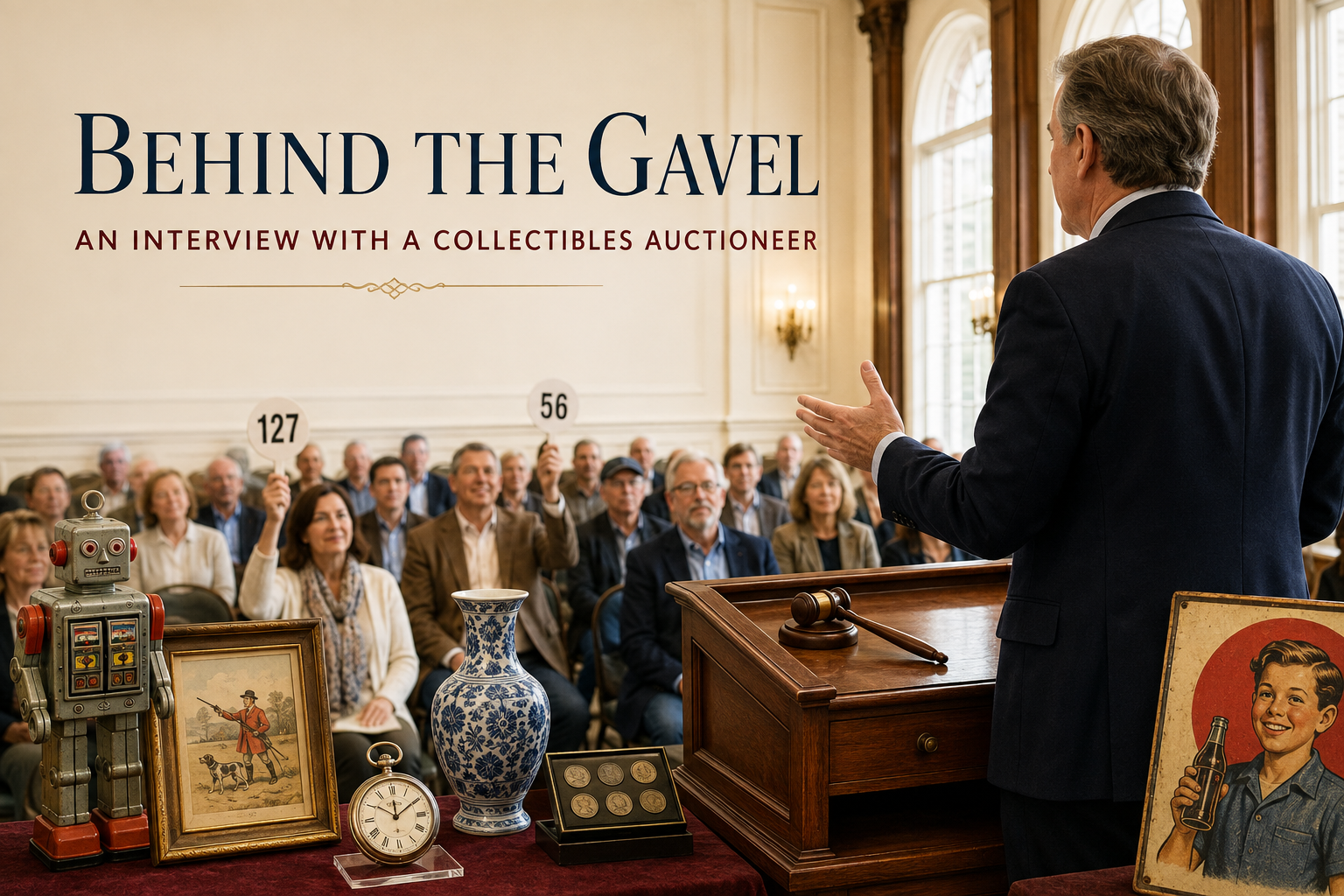
Ready to Browse Current Listings?
Search live eBay listings related to this guide through Deal Hunter.
Guide Category: Collector Interviews
Title: Behind the Gavel: An Interview with a Collectibles Auctioneer
Excerpt:
What really happens before an auctioneer raises the gavel? This behind-the-scenes Q&A explores valuations, reserves, bidding strategies, condition reports, and the qualities that make collectibles stand out.
Content
Auctions compress months of research, cataloging, photography, and promotion into a few exciting minutes of bidding. To collectors, the process can appear unpredictable. Why does one item inspire a bidding war while another passes without selling? How are estimates determined? And what does the auctioneer notice that bidders often overlook?
This interview-style guide distills established auction-house practices into a candid conversation with an auctioneer. Individual policies vary, so buyers and consignors should always read the specific auction house’s terms before participating.
What does an auctioneer actually do?
The Hot Collector: Most people picture an auctioneer calling bids and swinging a gavel. Is that the entire job?
Auctioneer: That is the most visible part, but it is only the finale. Before a sale, an auctioneer may work with specialists, catalogers, photographers, researchers, and client-service teams. We review the lots, study the estimates, learn where absentee bids are positioned, and identify pieces attracting unusual attention.
During the auction, the job is to manage the pace of bidding, recognize bids from multiple sources, follow the prescribed increments, and make it clear when a lot has sold or passed. A contemporary auction may involve bidders in the room, on telephones, through online platforms, and by absentee bid simultaneously.
The auctioneer must remain accurate and composed while making the sale feel energetic. A rushed auction can confuse bidders, but one that moves too slowly can lose momentum.
How does an auction house decide what an item may sell for?
The Hot Collector: Collectors often treat the auction estimate as an exact value. Is that how they should read it?
Auctioneer: No. An estimate is an informed opinion, not a guarantee.
Specialists examine factors such as:
-
Maker, artist, manufacturer, or brand
-
Age and period of production
-
Materials and construction
-
Rarity and known production quantities
-
Condition and restoration
-
Provenance
-
Completeness and original accessories
-
Current collector demand
-
Recent sales of comparable objects
-
The venue and likely audience for the sale
Major auction houses describe estimates as ranges based on an object’s characteristics and comparable auction records. These estimates can change after an in-person examination or the discovery of additional information. Sotheby’s explains its valuation process, while Christie’s notes that preliminary estimates remain subject to specialist examination.
A strong auction result usually requires more than rarity. The right object must appear in the right sale, at the right time, before the right bidders.
What should a collector submit when requesting an estimate?
The Hot Collector: What makes an initial submission useful to an auction specialist?
Auctioneer: Clear information saves time and helps prevent misunderstandings. A strong submission should include:
-
Photographs of the front, back, sides, and underside
-
Close-ups of signatures, labels, hallmarks, and serial numbers
-
Images of damage, repairs, or replaced parts
-
Exact measurements
-
A concise description of materials and construction
-
The item’s ownership and purchase history
-
Receipts, certificates, correspondence, or earlier appraisals
-
Original packaging and accessories
-
The item’s current location
Avoid hiding damage or using filters that distort color. Specialists will eventually inspect the object, and undisclosed problems can delay or stop a consignment.
Christie’s asks estimate seekers to provide a description, purchase history, location, supporting documents, and multiple photographs of each item. That is a sensible checklist for approaching almost any reputable auction house.
What is the difference between an estimate and a reserve?
The Hot Collector: These two terms are frequently confused. How do they differ?
Auctioneer: The estimate is the published range in which specialists believe a lot may sell. The reserve is the confidential minimum price the seller has agreed to accept.
At many auction houses, the reserve cannot exceed the published low estimate. If bidding fails to reach it, the lot is passed or bought in rather than sold. Christie’s provides a clear explanation of reserve pricing.
Collectors should not assume the low estimate is the reserve. Bidding may begin below both figures, and the reserve generally remains confidential.
What makes a lot inspire competitive bidding?
The Hot Collector: Why do some lots suddenly take off?
Auctioneer: Bidding becomes competitive when several motivations converge. Two collectors may need the same missing piece. A newly documented provenance can transform an ordinary-looking object into something historically important. An item may be the best example to reach the market in years.
Strong visual presentation matters, too. Online bidders respond to clear photography, complete descriptions, and confidence-inspiring condition information.
Other factors include:
-
Fresh-to-market material
-
Exceptional condition
-
A rare color, size, variation, or production error
-
Original packaging or documentation
-
Association with a notable person or event
-
A complete set rather than scattered pieces
-
A modest estimate that attracts a wide bidding pool
-
Several determined bidders with different maximum budgets
A bidding war does not automatically establish a permanent new market level. Sometimes it simply means two people wanted the same object very badly on the same day.
How important is provenance?
The Hot Collector: Collectors hear the word constantly. What does useful provenance look like?
Auctioneer: Provenance is the documented history of ownership. The best provenance forms a credible chain connecting an object to its earlier owners, maker, place of use, or historical context.
Useful evidence can include:
-
Original purchase receipts
-
Dated family photographs
-
Estate inventories
-
Exhibition labels
-
Published collection records
-
Letters or correspondence
-
Previous auction catalog entries
-
Manufacturer archives
-
Certificates from recognized experts
A family story can be a valuable lead, but it is not automatically proof. Dates, names, and documents must agree with the physical object.
Provenance may assist authentication and can significantly affect value, but it must be investigated critically. Sotheby’s identifies provenance as an important part of establishing an object’s ownership history and authenticity.
Why are condition reports so important?
The Hot Collector: Isn’t the catalog description enough?
Auctioneer: Not necessarily. A catalog description identifies and contextualizes the lot. A condition report focuses on its physical state.
It may discuss fading, cracks, losses, repairs, restoration, replacement components, surface wear, or structural concerns. However, a condition report is still an opinion rather than a warranty. Auctions commonly sell property “as is.”
Christie’s advises bidders to request and review condition reports and, whenever possible, inspect lots in person.
A careful bidder should:
-
Read every available image and description.
-
Request a condition report early.
-
Ask specific follow-up questions.
-
Compare the report with the photographs.
-
Arrange an in-person inspection or independent review for expensive purchases.
-
Account for restoration and conservation costs before bidding.
What mistake do inexperienced bidders make most often?
The Hot Collector: Is it bidding too quickly?
Auctioneer: The larger mistake is calculating only the hammer price.
The winning bid may be followed by a buyer’s premium, sales tax, shipping, insurance, customs charges, storage fees, or artist resale royalties where applicable. The buyer’s premium is an additional charge imposed by the auction house and can vary by house, platform, and price tier. Invaluable’s auction glossary explains several common bidding terms and charges.
Before the auction, determine your maximum total cost—not merely your maximum hammer bid.
For example, if your all-in budget is $1,000, you should not place a $1,000 hammer bid. Work backward after estimating the premium, taxes, and delivery expenses.
Do auctioneers recognize bidding strategies?
The Hot Collector: Can you tell when someone is nervous or trying to intimidate another bidder?
Auctioneer: Experienced auctioneers notice rhythm and hesitation, but there is no universal winning performance.
Some bidders enter immediately and confidently. Others wait until late in the bidding. Online bidders may appear at the last moment because of transmission delays or platform timing rather than strategy.
The safest approach is simple:
-
Register before the deadline.
-
Read the bidding terms.
-
Confirm the bidding increments.
-
Set an all-in maximum.
-
Bid clearly.
-
Never exceed your limit because another bidder appears determined.
An absentee or maximum bid can be useful when you know your ceiling and do not want the excitement of the room to influence you.
What should a seller ask before signing a consignment agreement?
The Hot Collector: Is the commission the only figure that matters?
Auctioneer: No. The contract should explain the entire financial and logistical arrangement.
Ask about:
-
Seller’s commission
-
Photography or cataloging fees
-
Insurance
-
Shipping and handling
-
Restoration or authentication expenses
-
Reserve price
-
Proposed estimate
-
Sale date and venue
-
Marketing plans
-
Payment schedule
-
Withdrawal charges
-
Unsold-lot fees
-
What happens if the buyer does not pay
-
Whether the property may be offered privately afterward
A lower commission is not automatically the best deal. An auction house with the right specialist audience may produce a stronger net result even if its fees are higher.
What happens when a lot does not sell?
The Hot Collector: Does an unsold result mean the item has no value?
Auctioneer: Not at all. A lot may fail because the reserve was too ambitious, the estimate discouraged participation, the cataloging was weak, or the right bidders simply missed the sale.
Afterward, the seller and auction house may:
-
Offer the lot to interested bidders
-
Move it into a later auction
-
Revise the estimate or reserve
-
Place it in a different collecting category
-
Offer it through a private-sale channel
-
Return it to the consignor
However, repeated auction appearances can make an item seem stale. Sellers should avoid immediately circulating the same piece through several venues without changing the strategy.
What should collectors look for during auction previews?
The Hot Collector: How can someone use preview time effectively?
Auctioneer: Arrive with a shortlist, a flashlight if permitted, a magnifier, and your condition questions. Examine the actual object rather than being guided by the estimate.
Check:
-
Scale and weight
-
Surface texture and color
-
Odors suggesting mold, smoke, or chemical treatment
-
Signs of refinishing or overpainting
-
Loose components
-
Replaced hardware
-
Chips, cracks, tears, and repairs
-
Marks that were difficult to photograph
-
Whether frames, cases, stands, or accessories are included
Previewing is also educational when you do not intend to bid. Handling—or closely viewing—authentic examples helps develop the visual memory needed to recognize quality later.
What separates a disciplined collector from an emotional bidder?
The Hot Collector: Passion is part of collecting. How do you prevent it from becoming costly?
Auctioneer: A disciplined collector can be excited without abandoning preparation.
They research comparable sales, understand condition, calculate all costs, and decide what role the object will play in their collection. They are also willing to let an item go.
The strongest collectors do not try to win every lot. They wait for objects that improve the collection rather than merely enlarge it.
What is your final advice for someone attending an auction for the first time?
Auctioneer: Watch one before bidding. Learn the tempo, vocabulary, and increments. Then begin with an item you understand and a budget you can comfortably afford.
The gavel creates urgency, but collecting rewards patience. Research the object, understand the terms, and know your limit before the first bid is called. If you do those things, the auction becomes less intimidating—and much more enjoyable.