
How Museums Research the History of an Object
Discover how museum professionals uncover an object’s identity, age, maker, ownership history, cultural meaning, and hidden alterations by combining close examination, archival research, scientific analysis, and expert collaboration.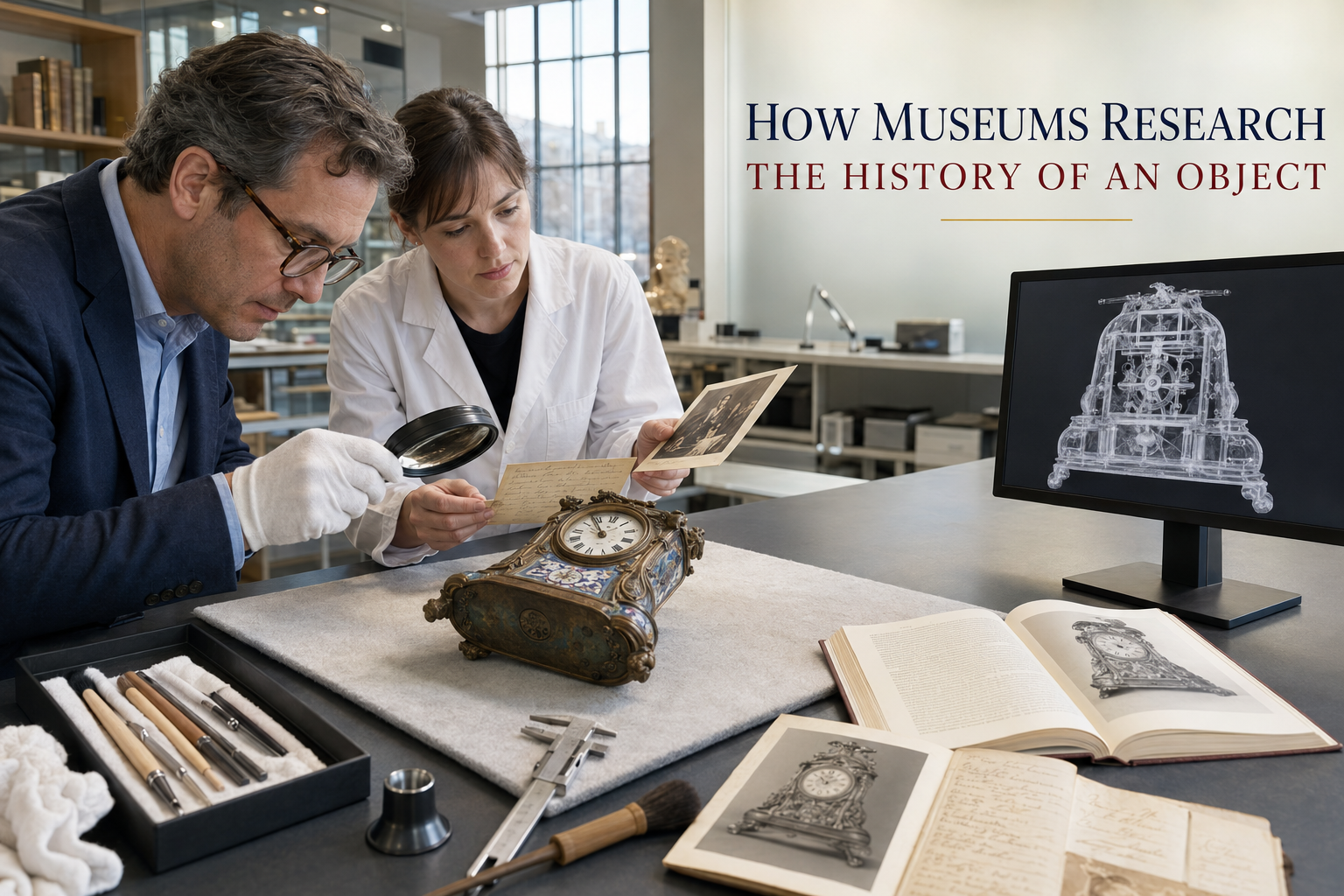
Ready to Browse Current Listings?
Search live eBay listings related to this guide through Deal Hunter.
Every museum object begins with questions.
Who made it? When and where was it produced? How was it originally used? Who owned it afterward? Has it been repaired, altered, stolen, exported, misidentified, or separated from other pieces?
A museum label may reduce those answers to a few polished sentences, but the research behind them can involve years of investigation. Curators, conservators, scientists, registrars, archivists, historians, and community experts may all contribute evidence. Even then, some questions remain unresolved.
Understanding this process can make private collectors better researchers. Museums do not rely on a single clue, family story, price guide, or expert opinion. They build an object’s history by comparing many forms of evidence and clearly separating confirmed facts from possibilities.
The Object Is the First Document
Museum research commonly begins with the object itself. Before searching archives or consulting reference books, researchers record what is physically present.
They may document:
-
Dimensions and weight
-
Materials
-
Construction methods
-
Surface decoration
-
Wear patterns
-
Maker’s marks and signatures
-
Serial, model, or pattern numbers
-
Labels and inscriptions
-
Repairs and replaced components
-
Residue from previous use
-
Mounting or framing methods
-
Evidence of later alterations
The object is photographed from multiple angles, including areas not normally seen during display. Details may be examined under magnification or different types of light.
Researchers avoid cleaning an unidentified object simply to make its marks easier to read. Dirt, corrosion, adhesive, paint layers, fingerprints, residues, and old repairs may contain evidence. Removing them prematurely can destroy part of the object’s story.
Collectors can follow the same principle: document first and clean later—if cleaning is appropriate at all.
Establishing a Reliable Object Record
Once the preliminary examination is complete, the museum creates or updates the object record. The record gives the object a stable identity within the collection.
It may include:
-
Accession or inventory number
-
Object name
-
Classification
-
Maker or manufacturer
-
Date or estimated date range
-
Place of production
-
Materials and techniques
-
Measurements
-
Condition
-
Acquisition method and date
-
Donor or seller
-
Provenance
-
Exhibition history
-
Published references
-
Cultural or historical context
-
Restrictions or questions requiring further research
The accession number is especially important. It connects the physical object with photographs, correspondence, conservation reports, loan records, deeds of gift, purchase documents, and scholarly notes.
A museum description is not necessarily permanent. Records change as evidence improves. The Smithsonian’s National Museum of Asian Art explains that provenance research continually develops as new primary sources are discovered, requiring collection records to be updated over time. Smithsonian National Museum of Asian Art
Reading Marks, Labels, and Inscriptions
Marks can provide some of the strongest clues, but they must be interpreted carefully.
A researcher may examine:
-
Hallmarks on silver or gold
-
Factory stamps
-
Pottery backstamps
-
Foundry marks
-
Patent numbers
-
Union labels
-
Retailer labels
-
Exhibition stickers
-
Shipping labels
-
Handwritten inventory numbers
-
Signatures and monograms
-
Dates and dedications
-
Repair labels
-
Customs stamps
A mark can identify a maker, but it may instead identify the retailer, importer, distributor, decorator, repairer, or later owner. Some manufacturers reused marks for decades, while others changed logos, wording, colors, and locations over time.
Marks must therefore be compared with documented examples. Researchers consult manufacturer catalogs, trade directories, patent records, advertisements, pattern books, archival photographs, and securely identified museum objects.
They also study how the mark was applied. A genuine-looking signature placed over old wear, for example, may have been added later. A printed label made with a process unavailable during the supposed production period can expose an incorrect attribution.
Identifying Materials and Manufacturing Techniques
Materials help narrow an object’s age and origin, but visual identification alone can be misleading. Painted plaster can resemble carved stone. Plated metal may look solid. Early plastics are easily confused with one another. A modern replacement component can appear older after years of use.
Conservators examine how the object was made:
-
Was it cast, carved, molded, stamped, woven, or assembled?
-
Are the fasteners handmade or machine-produced?
-
What tool marks are visible?
-
Is the surface naturally aged or artificially distressed?
-
Do all components appear to be from the same period?
-
Was the decoration applied before or after assembly?
-
Are modern adhesives or synthetic coatings present?
Manufacturing evidence can reveal that an object is older or newer than its appearance suggests. It can also show that a supposedly complete object combines parts from different dates.
The National Gallery of Art’s object conservators study fabrication and materials to understand objects and determine how they should be preserved. They collaborate with conservation scientists when materials require further analysis. National Gallery of Art Object Conservation
Comparing the Object with Known Examples
Museum researchers rarely identify an object in isolation. They compare it with securely documented examples in museum collections, published catalogs, archaeological reports, manufacturer archives, and specialist databases.
Useful comparison points include:
-
Dimensions and proportions
-
Material composition
-
Construction
-
Decoration
-
Typography
-
Marks
-
Hardware
-
Pattern details
-
Known variations
-
Documented production dates
-
Geographic distribution
A close resemblance is not enough by itself. Popular designs were copied, revived, and reproduced. Researchers look for combinations of characteristics that support the same conclusion.
When consulting auction records, they also evaluate the quality of the cataloging. An earlier auction description may provide a lead, but repetition does not turn an unsupported attribution into a fact.
Searching Archives and Published Sources
After gathering physical evidence, the investigation moves into documentary sources.
Museum researchers may search:
-
Acquisition files
-
Dealer records
-
Auction catalogs
-
Exhibition catalogs
-
Estate inventories
-
Census and immigration records
-
City directories
-
Newspapers
-
Company archives
-
Patent and trademark records
-
Shipping documents
-
Photographs
-
Diaries and letters
-
Scholarly books and journals
-
Archaeological reports
-
Oral histories
The Smithsonian notes that the Hirshhorn Museum’s collection files contain photographs, official documents, correspondence, research notes, published references, provenance information, exhibition histories, and comparisons with related works. Smithsonian Hirshhorn Collection Archive
Old auction catalogs are particularly useful because they can connect an object with previous owners or sales. The Metropolitan Museum of Art maintains research resources that include digitized auction catalogs, museum archives, dealer records, publications, and historical labels. The Met’s Provenance Research Resources
Reconstructing Provenance
Provenance is the documented history of an object’s ownership and movement from its creation to the present.
A provenance entry might include:
-
The original maker or owner
-
A family inheritance
-
A dealer or gallery
-
An auction sale
-
A private collection
-
A museum donation or purchase
Researchers attempt to verify each step using dated documentation. Names, locations, lot numbers, physical descriptions, and photographs must align.
Complete provenance is uncommon. Records disappear, dealers close, estates are divided, and objects change hands privately. The Smithsonian describes provenance research as detective work because ownership histories frequently contain gaps that may never be filled. Smithsonian Provenance
A responsible record makes those gaps visible. It should not use phrases such as “private collection” to disguise missing information.
Why Ownership History Can Become an Ethical Question
Provenance is not only about prestige or monetary value. It can reveal theft, wartime seizure, illegal excavation, colonial removal, forced sale, or unlawful export.
Museums may need to determine:
-
Whether an owner had legal authority to sell the object
-
Whether the object left its country of origin legally
-
Whether it was taken during conflict or persecution
-
Whether it belongs to a descendant, community, tribe, or nation
-
Whether cultural-property laws apply
-
Whether the museum should retain, share, or return it
The Met describes provenance research as a collaborative effort involving curators, conservators, scientists, and outside partners. Its research has also contributed to the return of objects when evidence demonstrated that restitution was appropriate.
For collectors, this is an important warning: a convincing object can still have an unacceptable ownership history. Before buying culturally sensitive or archaeologically significant material, investigate when and how it entered the market.
Scientific Examination
When visual and documentary evidence cannot answer every question, museums may use scientific instruments.
Depending on the material, testing might include:
-
X-radiography
-
Ultraviolet or infrared imaging
-
Microscopy
-
X-ray fluorescence
-
Raman spectroscopy
-
Chromatography
-
Pigment analysis
-
Wood identification
-
Fiber analysis
-
Radiocarbon dating
-
Dendrochronology
-
Analysis of adhesives, coatings, and corrosion
These methods can identify materials, reveal internal construction, detect hidden repairs, distinguish original paint from later additions, and compare an object with known manufacturing practices.
Scientific testing does not always produce a simple yes-or-no answer. Results must be interpreted alongside historical and physical evidence.
A British Museum investigation of the Gayer-Anderson cat used X-ray fluorescence to determine the bronze’s composition. X-radiography also revealed repairs and an internal metal support that had been concealed beneath green paint. British Museum: The Gayer-Anderson Cat
The National Gallery of Art similarly uses microscopy, chromatography, spectroscopy, and scientific imaging to investigate artists’ materials and production methods. National Gallery of Art Scientific Research
Consulting Specialists and Communities
No curator knows everything. Museums regularly seek help from outside specialists.
Depending on the object, collaborators may include:
-
Historians
-
Archaeologists
-
Scientists
-
Linguists
-
Manufacturer archivists
-
Artists and craftspeople
-
Dealers and collectors
-
Cultural organizations
-
Indigenous or descendant communities
-
Former factory employees
-
People who used the object in daily life
Community knowledge can correct museum terminology, restore an object’s original name, explain its use, or identify information excluded from older academic records.
Museums must also consider whether certain objects, images, or knowledge should be publicly displayed. The Smithsonian’s National Museum of the American Indian emphasizes collaboration with Native and Indigenous communities and may restrict culturally sensitive images or information at the request of authorized representatives. National Museum of the American Indian Collections
Separating Facts from Interpretations
Responsible research distinguishes between what is known, what is probable, and what remains uncertain.
Museum descriptions may use terms such as:
-
Made by
-
Attributed to
-
Probably
-
Possibly
-
Workshop of
-
School of
-
Style of
-
After
-
Formerly attributed to
-
Maker unknown
These phrases are not evasive. They communicate the strength of the evidence.
Collectors should use similar language in their own records. If a family member believed a vase was purchased in Paris in the 1920s, record that as family history unless documents confirm it. If a signature resembles a known artist’s mark but has not been authenticated, describe it as a signature appearing to read that name.
Precision builds credibility.
Research Is Never Completely Finished
An object can remain in a museum for decades before a label, photograph, newly digitized archive, or scientific technique changes its identification.
New information may reveal:
-
A previously unknown owner
-
An incorrect maker
-
A later restoration
-
A different production date
-
A connection to another object
-
A culturally significant use
-
An unlawful transfer
-
A modern reproduction
Museums therefore preserve earlier research notes while updating public records. The history of the investigation can be almost as important as the history of the object.
Applying the Museum Method to Your Collection
Private collectors may not have conservation laboratories or institutional archives, but they can adopt the same disciplined process.
For each object:
-
Assign it a unique inventory number.
-
Photograph every side before cleaning or repair.
-
Record measurements, materials, marks, and condition.
-
Save receipts, messages, listings, and shipping labels.
-
Write down the seller’s information and claims.
-
Compare multiple authoritative references.
-
Track earlier owners and sales when possible.
-
Separate verified facts from family stories and assumptions.
-
Preserve copies of important online sources.
-
Update the record when new evidence appears.
Do not force an exciting identification when the evidence supports a less dramatic answer. A carefully documented unknown object is more useful than one accompanied by a confident but inaccurate story.
The museum approach teaches collectors to slow down, observe carefully, question every claim, and allow evidence to change the answer. That process does more than establish age or value. It restores the people, places, technologies, and events that give an object its real historical meaning.