


Shipping Framed Art, Mirrors, and Advertising Signs
Learn how to inspect, protect, pack, document, and ship framed artwork, mirrors, and advertising signs while reducing the risks of broken glazing, bent edges, damaged frames, and surface abrasion.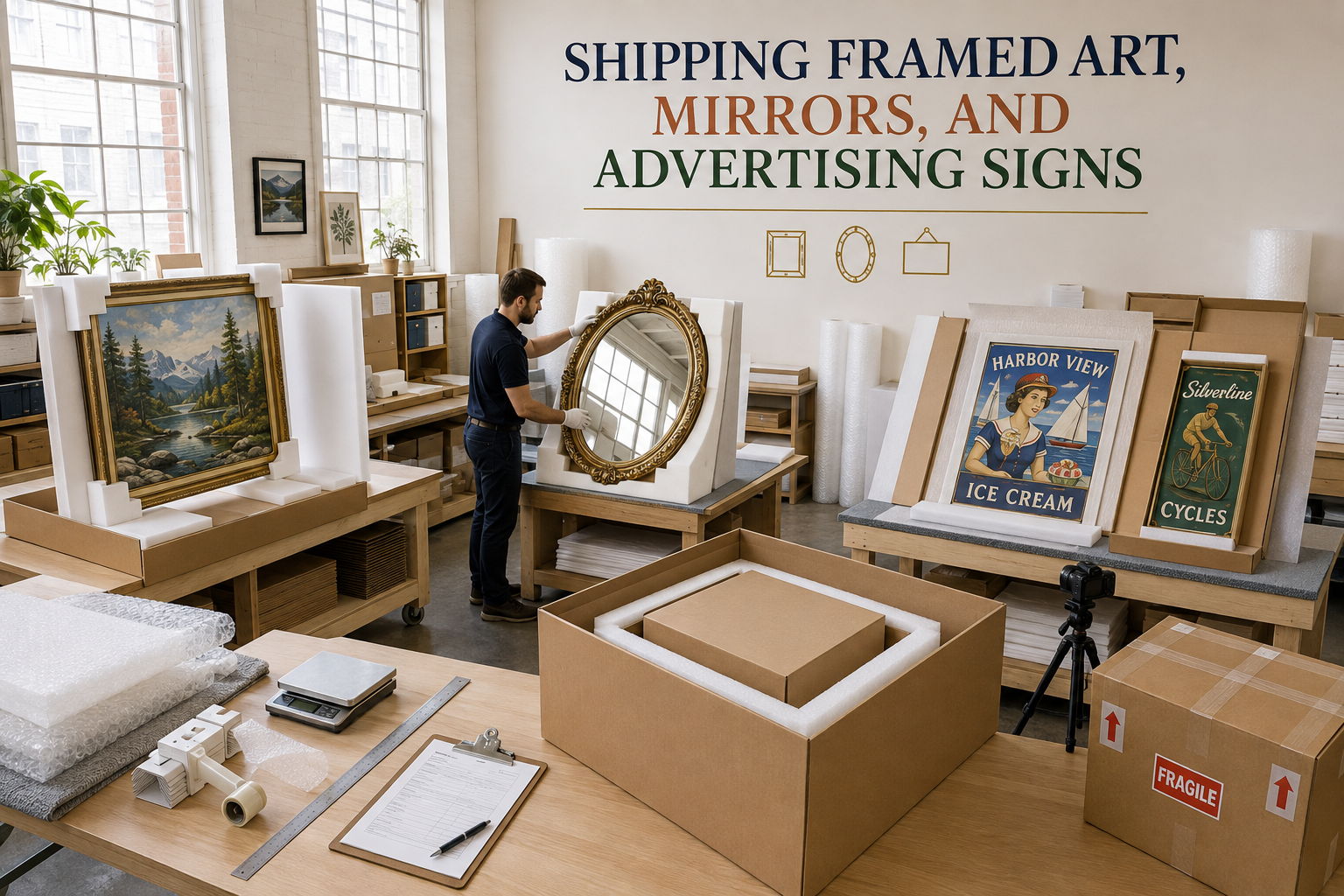
Ready to Browse Current Listings?
Search live eBay listings related to this guide through Deal Hunter.
Framed art, mirrors, and advertising signs are among the most difficult collectibles to ship. Their wide, flat shape makes them vulnerable to bending and punctures, while glass, decorative frames, sharp corners, painted surfaces, and projecting hardware introduce additional risks.
A package can look substantial from the outside and still fail if the object is able to move inside it. Safe shipping requires several protective layers that work together. The surface must be isolated, the corners and edges reinforced, the object immobilized, and the outer container strong enough to withstand impacts and compression.
Large, valuable, unusually fragile, or irreplaceable pieces may require a professional art shipper or custom crate. No general packing method can eliminate every risk.
Inspect the Item before Packing
Do not begin wrapping until the entire object has been examined. Shipping can worsen existing weaknesses, especially when a frame or sign appears sturdy but has loose components.
Check for:
-
Loose frame joints
-
Cracked or unstable glazing
-
Flaking paint
-
Lifting paper or labels
-
Weak backing boards
-
Protruding nails or screws
-
Loose hanging wire
-
Detached decorative elements
-
Bent metal edges
-
Rust around mounting holes
-
Chips in porcelain enamel
-
Previous repairs
-
Parts moving inside the frame
Gently tilt the object and listen for movement. If pieces shift inside a frame, stop and determine what is loose before packing it.
Do not ship artwork with actively flaking paint, unstable pastel, loose glass, or a collapsing frame without professional advice. The Canadian Conservation Institute recommends confirming that a painting and its frame are stable enough to travel before packing begins. Canadian Conservation Institute
Photograph and Document Everything
Take clear photographs before applying any wrapping materials. Photograph:
-
The complete front
-
The complete back
-
All four corners
-
Frame joints
-
Glazing
-
Hanging hardware
-
Maker’s marks and labels
-
Existing scratches, cracks, dents, or chips
-
Serial numbers
-
The item beside a ruler or measuring tape
-
Every stage of the packing process
-
The sealed box and shipping label
Record the object’s dimensions, weight, materials, condition, and identifying information.
If damage occurs, photographs can help establish what the item looked like before shipment and demonstrate how it was packed. Keep sales records, appraisals, receipts, correspondence, and tracking information together until delivery has been confirmed.
Identify What You Are Shipping
Not every flat collectible should be packed the same way.
Framed Art
Determine whether the frame contains glass, acrylic glazing, or no glazing. Identify the artwork’s medium whenever possible. Oil paint, watercolor, photographs, prints, charcoal, pastels, textiles, and mixed-media works have different sensitivities.
Never allow bubble wrap, plastic film, foam, cardboard, or packing paper to press against an exposed painted or powdery surface.
Mirrors
Mirrors combine heavy glass with frames that may be decorative, brittle, or weak at the joints. Antique mirrors may also have aged silvering, loose backing, or unstable decorative elements.
A mirror should be supported around its entire frame rather than lifted or suspended from one edge.
Advertising Signs
Advertising signs may be made from porcelain enamel, painted metal, cardboard, paper, wood, glass, plastic, or several materials combined.
Porcelain signs can chip where their edges or mounting holes receive an impact. Thin metal signs can bend or crease. Cardboard signs can be punctured, crushed, stained, or permanently warped. Internally illuminated, neon, or electrically wired signs should be evaluated by a qualified specialty shipper.
Remove or Secure Loose Hardware
Remove detachable hooks, brackets, chains, easel backs, and hanging hardware when doing so will not damage the object. Place the hardware in a labeled bag and secure it inside the package where it cannot contact the collectible.
Do not leave a loose wire, nail, or bracket positioned against the back of a frame. Vibration can cause it to scratch, puncture, or press through the backing.
If hardware cannot be removed, cover and immobilize it with a protective structure. Never place adhesive tape directly on the frame, artwork, sign, original label, or historic surface.
Protect Glazing Carefully
Glass introduces the possibility that broken shards could damage the object beneath it. Glazing protection should not be approached as simply placing ordinary tape across the front.
The Canadian Conservation Institute notes that compatible low-tack protective film or tape may help retain pieces of broken glass during transportation. It also warns that tape can damage coated glazing and that static created during application or removal may disturb unfixed pastel, charcoal, and other powdery media. Paintings: Considerations Prior to Travel
Before applying anything to glass:
-
Identify whether it has an anti-reflective, ultraviolet-filtering, or other coating.
-
Confirm that the material is compatible with the glazing.
-
Never place tape on acrylic without verifying compatibility.
-
Do not use this method over unstable pastel, charcoal, or flaking media.
-
Remove temporary protective material carefully after arrival.
-
Never rely on taped glass as the main form of protection.
For important framed works, consult a professional framer or conservator about laminated glass, suitable acrylic, spacers, or temporarily removing the glazing.
Acrylic glazing eliminates the risk of sharp glass shards but can generate static and scratch more easily. It is not automatically appropriate for every artwork.
Protect the Face without Touching It
The front of the object needs a rigid shield that cannot press against the artwork, mirror, or sign surface.
For a stable framed object, place a rigid sheet such as foam board, corrugated plastic, or strong cardboard over the front and another over the back. Cut both sheets slightly larger than the frame.
If the frame has raised ornament, deep molding, protruding lettering, or an exposed painted surface, create spacers so the rigid sheet rests on safe structural areas rather than the decoration.
For a flat metal or cardboard advertising sign, use an oversized rigid sandwich with clean, non-abrasive material between the object and protective boards. The sign should not slide inside the sandwich.
Do not wrap an exposed painting directly in bubble wrap. The bubble pattern can mark surfaces, catch lifting paint, or transfer under pressure.
Reinforce Every Corner and Edge
Corners usually receive the greatest force when a package is dropped. They are also among the weakest areas of a frame.
Use fitted corner protectors made from dense foam, layered corrugated board, or a purpose-designed frame-packing system. Each protector should remain in place without pressing against decorative surfaces.
Edge protection should:
-
Extend along the full frame or sign edge
-
Prevent contact with the outer box
-
Resist crushing
-
Spread impacts across a wider area
-
Keep the object centered
For porcelain advertising signs, provide additional cushioning around the mounting holes and enamel-covered edges. Do not place concentrated pressure on a chipped or previously damaged area.
For thin metal signs, use rigid boards on both sides to prevent bending. A large box alone does not provide adequate rigidity.
Wrap the Protected Object
Once the face, back, corners, and edges are protected, wrap the entire assembly.
Appropriate materials may include:
-
Clean polyethylene film
-
Glassine for suitable paper surfaces
-
Soft foam sheeting
-
Bubble wrap used outside the rigid surface protection
-
Corrugated board
-
Strong cardboard
-
Archival tissue for compatible objects
-
Stretch film applied around the packing structure
The wrapping should protect against abrasion and limited moisture exposure while holding the protective boards and corner blocks in position.
Do not allow adhesive tape to touch the collectible. Tape should attach only to disposable wrapping or packing materials.
CCI recommends rigid boards above and below a suitably wrapped framed painting, with additional cushioning and an outer moisture-resistant layer where appropriate. Wrapping a Painting
Choose a Strong Inner Box
The first box should closely fit the protected object while leaving enough room for cushioning on every side. The object must not touch the box walls.
Use a strong, undamaged corrugated box. Lightweight reused boxes may have lost much of their strength through crushing, moisture, old folds, or previous handling.
Center the object and fill the surrounding space with material that absorbs shock without settling excessively. Suitable cushioning may include firm foam, layered bubble wrap, engineered corner blocks, or a fitted packaging system.
Avoid relying on loose packing peanuts. They can shift, settle, and allow a heavy flat object to migrate toward the box wall.
Before sealing the inner box, gently move it in different directions. Nothing inside should slide, knock, or rattle.
Double-Box Fragile Pieces
Double-boxing separates the inner container from exterior impacts.
Place the sealed inner box inside a larger, stronger outer box. Surround it on every side with an even layer of firm cushioning. The inner box should remain centered and unable to move.
The outer box must be large enough to create an impact zone but not so oversized that it becomes difficult to handle or allows excessive movement.
Seal all major seams using quality packing tape. Reinforce the center seam and both edge seams on the top and bottom.
For very heavy, oversized, ornate, or valuable objects, corrugated boxes may not offer sufficient protection. A custom wooden crate with fitted cushioning, handles, and internal supports may be necessary.
Know When a Crate or Professional Shipper Is Necessary
Consider professional packing or custom crating when the object is:
-
Very valuable or irreplaceable
-
Too large for ordinary parcel handling
-
Extremely heavy
-
Glazed with a large sheet of glass
-
Framed in plaster, gesso, or heavily carved molding
-
Actively flaking or structurally weak
-
An antique mirror with unstable components
-
A large porcelain sign
-
A neon or internally illuminated sign
-
Made from several fragile materials
-
Traveling internationally
-
Being shipped in extreme weather
FedEx Office and The UPS Store advertise specialty artwork boxes, custom packing, and packing services for artwork, mirrors, antiques, and oversized objects. Availability and protection terms vary, so ask exactly how the item will be packed and which written coverage applies. FedEx Artwork Shipping and UPS Artwork Shipping
For museum-quality, historically important, or especially fragile pieces, use a fine-art transportation company rather than standard parcel service.
Measure the Finished Package Accurately
Measure and weigh the fully packed outer box—not the object or inner box.
Record:
-
Length
-
Width
-
Height
-
Actual weight
-
Declared value
-
Destination
-
Package orientation
Large, lightweight packages may be charged according to dimensional weight. Oversized packages can also trigger extra handling charges or require freight service.
Carrier limits and pricing rules change. Check the carrier’s current requirements immediately before purchasing a label. UPS, for example, currently instructs customers to calculate combined length and girth as:
Length + 2 × width + 2 × height
Its published small-package limit is currently 165 inches in combined length and girth, but current rules should always be verified before shipping. UPS Shipping Guide
Understand Declared Value and Coverage
Do not assume that entering a declared value automatically provides unlimited insurance against every type of damage.
Review:
-
Maximum declared value
-
Exclusions for artwork, antiques, mirrors, or collectibles
-
Packaging requirements
-
Proof-of-value requirements
-
Claim deadlines
-
Signature options
-
Restrictions for international shipments
-
Coverage when the customer packs the item
-
Coverage when the carrier or shipping store packs it
Save screenshots or copies of the applicable terms at the time of shipment. For high-value objects, consider separate specialty insurance.
Require tracking and an appropriate signature service. Avoid leaving a valuable framed object unattended outdoors.
Label the Package Clearly
Use orientation arrows when the object should remain upright. Add contact information inside the package in case the exterior label is damaged.
“Fragile” labels may communicate the nature of the shipment, but they are not a substitute for internal protection. Pack the object as though the box will be stacked, tilted, vibrated, and handled by machinery.
Do not advertise the exact contents or value on the outside of the package.
Give the Recipient Unpacking Instructions
Safe packing can be undone by careless unpacking. Send the recipient instructions before delivery.
Ask the recipient to:
-
Photograph the unopened outer box.
-
Record any punctures, crushing, moisture, or open seams.
-
Keep the package upright if marked.
-
Open the box on a clean, padded surface.
-
Avoid cutting deeply into the carton.
-
Remove the inner box before opening it.
-
Lift the object with help when necessary.
-
Inspect the glazing and frame before removing the final wrap.
-
Photograph damage immediately.
-
Retain all packaging until the item is accepted.
If a package has been exposed to very cold or hot conditions, allow it to adjust gradually indoors before removing sealed protective layers. Rapid temperature changes can cause condensation. CCI advises allowing a cold crated painting time to acclimatize before opening. Caring for Paintings
The strongest shipping method treats the object as a complete system. The artwork or sign, glazing, frame, backing, hardware, inner protection, cushioning, box, carrier, and recipient all affect whether it arrives safely. Careful inspection and documentation take time, but they are far easier than trying to repair shattered glass, a bent sign, or an irreplaceable surface after a preventable packing failure.