


Trading Cards and the Culture of Set Building
Explore why collectors build trading-card sets, the different meanings of a “complete set,” and practical ways to organize, trade, budget, and finish a collection without losing sight of the enjoyment behind it.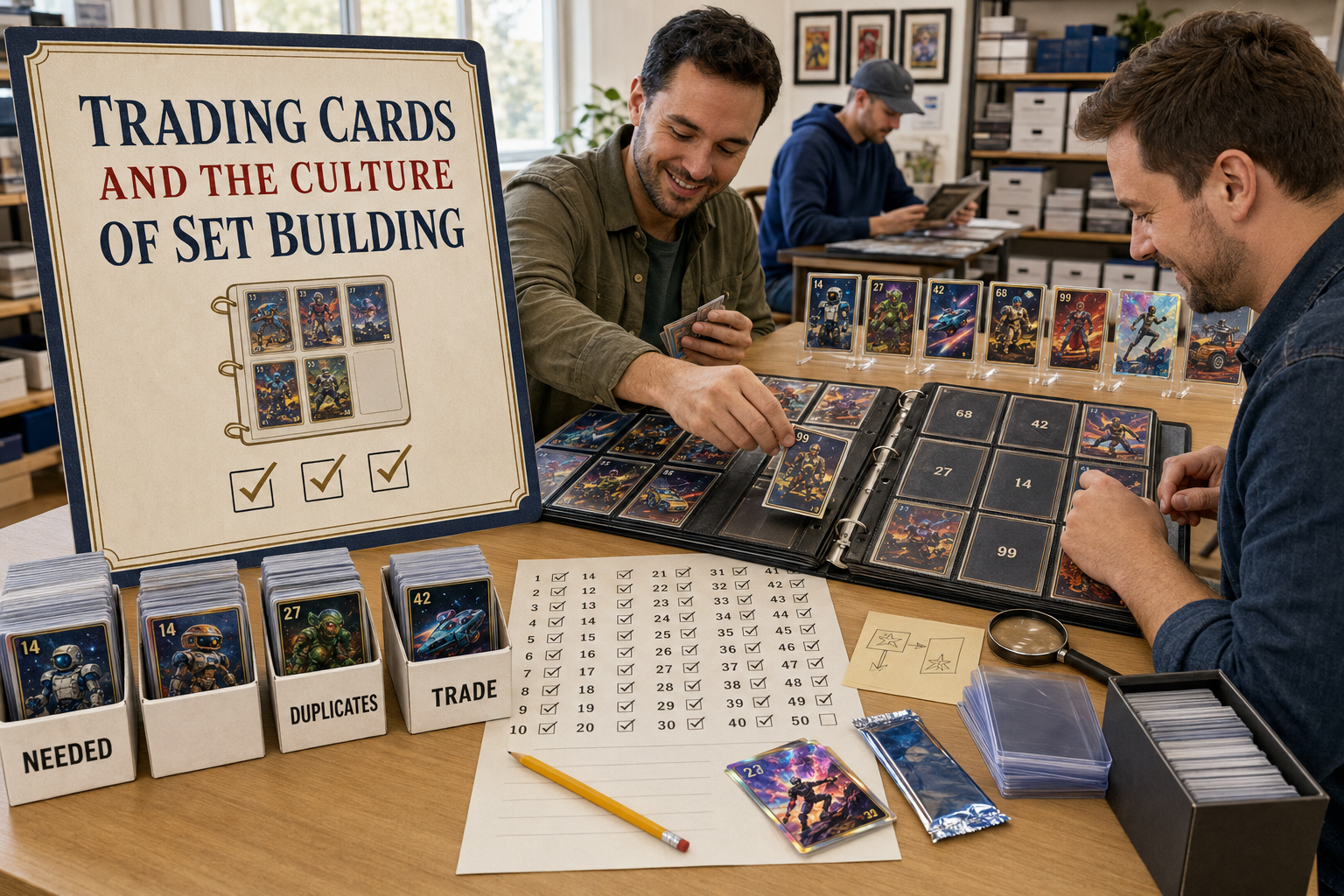
Ready to Browse Current Listings?
Search live eBay listings related to this guide through Deal Hunter.
For some collectors, the excitement of trading cards comes from finding one favorite player, character, rookie, autograph, or rare design. For a set builder, the goal is different. Each card is part of something larger, and even an inexpensive common card can become important when it fills the last empty space in a binder.
Set building transforms a stack of separate cards into a defined project. It gives collectors a beginning, a measurable path forward, and a moment when the collection can be called complete. It also creates one of the hobby’s strongest social traditions: collectors helping one another locate missing cards and exchanging their duplicates.
How Set Building Became Part of Card Culture
Collectible cards were produced long before the modern hobby developed. During the late 1800s and early 1900s, cards appeared with tobacco, candy, gum, food products, and other consumer goods. Subjects ranged from athletes and actors to military figures, animals, transportation, and historical events.
The National Baseball Hall of Fame notes that tobacco companies were using baseball players’ images on cards by the 1880s. Bowman later became an important postwar producer, and Topps entered the baseball-card market with its first set in 1951. Its larger 1952 release helped turn baseball-card collecting into a widespread hobby. National Baseball Hall of Fame
As numbered card series became common, collectors had a clear reason to keep buying, sorting, and trading. The checklist established the finish line. Duplicates were not necessarily disappointing because they could be exchanged for cards someone else needed.
Today, set building extends far beyond traditional sports cards. Collectors pursue sets devoted to entertainment franchises, comic-book characters, television programs, movies, music, anime, video games, historical subjects, and trading-card games.
What Counts as a Complete Set?
The phrase “complete set” does not always mean the same thing. Before beginning a project, define exactly what completion means to you.
Base Set
A base set contains one example of every regularly numbered card in the main checklist. If a product has cards numbered 1 through 300, completing those 300 cards generally completes the base set.
This is the most accessible and clearly defined form of set building.
Insert Set
Insert cards belong to a separately named group placed within packs. They may use different numbering, artwork, themes, or production methods.
A collector may build one particular insert set without attempting the entire product.
Parallel Set
A parallel uses the same basic subjects as another set but changes the border, color, foil, finish, pattern, or serial numbering. Collecting every card in one parallel is sometimes called a parallel set.
These projects can become expensive when rare or serial-numbered versions are included.
Master Set
A master set usually includes the base cards and a broader selection of inserts, variations, or related cards. However, the term has no universal definition.
One collector may consider all base cards and standard inserts a master set. Another may include promotional cards, short prints, parallels, autographs, relics, errors, corrected cards, and regional variations.
Write down your definition before spending money. Otherwise, the goal may continue expanding every time another variation is discovered.
Team, Character, or Player Set
Some collectors pursue every card in a product connected to one team, player, character, artist, or subject. This creates a smaller project within a much larger release.
Rainbow
A rainbow consists of the available color or design parallels of one card. Depending on the product, this can range from a manageable group to dozens of versions, including extremely limited cards.
Start with an Official Checklist
A checklist is the foundation of any set-building project. It identifies the cards that belong to the release and helps separate base cards from inserts, parallels, promotional cards, and other variations.
Topps defines a checklist as a list of every card in a product, potentially including its base cards, parallels, autographs, and other categories. Its official checklist pages separate these components so collectors can understand the structure of a release. Topps Checklist Definition
Official Pokémon Trading Card Game galleries similarly provide card lists for individual expansions, giving collectors a defined lineup for each release. Pokémon TCG Card Galleries
When an official checklist is unavailable, consult established reference books, manufacturer catalogs, collector organizations, archived product information, and well-researched specialty databases.
Record uncertainties separately. Do not add an unverified card to the required checklist simply because it appears in an online listing.
Decide What Condition You Will Accept
A completed set can contain cards in mixed condition, or it can follow a consistent condition standard. Either approach is valid if it matches the collector’s purpose and budget.
Before buying, decide whether you will accept:
-
Writing or marks
-
Rounded corners
-
Surface scratches
-
Creases
-
Off-center printing
-
Staining
-
Fading
-
Wax or gum residue
-
Minor paper loss
-
Cards removed from albums
-
Professionally graded cards mixed with ungraded cards
For older sets, requiring every card to look nearly perfect may make completion extremely difficult. A collector assembling a childhood favorite may prefer honest, evenly worn cards that can be handled and enjoyed.
Condition becomes especially important when one expensive card represents much of the set’s total value. Examine that card independently rather than assuming its condition matches the rest of the group.
Choose an Acquisition Strategy
Most sets are built through a combination of unopened products, starter lots, individual purchases, and trades.
Opening Packs
Opening packs creates excitement and provides duplicates for trading. It is usually most productive near the beginning of a current set, when almost every card is needed.
As the checklist fills, the likelihood of pulling a missing card decreases. Continuing to open large quantities of packs can become an expensive way to chase a small number of cards.
Buying a Starter Lot
A starter lot or partial set can provide a large portion of the checklist at once. Ask whether the lot has been picked through for valuable cards and request an exact count or list of included card numbers.
A cheap group containing hundreds of duplicates may be less useful than a smaller lot with wider checklist coverage.
Buying Singles
Purchasing individual cards is often the most direct way to finish the final portion of a set. Search using the year, manufacturer, product name, card number, subject, and variation.
Confirm that the listing matches the exact release. Similar designs, reprints, updates, regional issues, and parallels can easily be confused.
Trading
Trading is central to traditional set-building culture. It gives duplicate cards a purpose and connects collectors working on compatible projects.
Create two lists:
-
Cards needed
-
Duplicates available
Update both lists before attending shows, joining trading groups, or arranging a trade online.
Organize before Buying More
Poor organization causes collectors to purchase cards they already own. Sort new cards as soon as practical and record them on the checklist.
Common organizational methods include:
-
Numerical card order
-
Alphabetical order
-
Team or character
-
Subset
-
Parallel color
-
Release date
-
Needed, duplicate, and trade categories
A spreadsheet or collection app can help with large projects, but a printed checklist is often sufficient for a single set.
Keep uncertain variations in a separate research group until they are correctly identified.
Protect the Cards during the Project
Set builders handle cards frequently, which increases the possibility of corner wear, scratches, fingerprints, and accidental bending.
Depending on value and sensitivity, use:
-
Soft sleeves
-
Rigid holders
-
Binder pages made for trading cards
-
Archival storage boxes
-
Dividers
-
Resealable protective bags
-
Professionally graded holders for high-value cards
Avoid overfilling binder pages or storage boxes. Cards should be supported without being compressed.
Store the collection away from direct sunlight, moisture, excessive heat, food, smoke, and unstable areas such as garages or attics. Keep cards off floors where leaks and flooding could reach them.
Understand Variations before Chasing Them
Variations can make set building more interesting, but they can also create confusion. A release may contain:
-
Corrected and uncorrected errors
-
Different card backs
-
Alternate photographs
-
Regional versions
-
Promotional stamps
-
Short prints
-
Factory-set variations
-
Color parallels
-
Printing differences
-
Reprints
Not every printing flaw is an officially recognized variation. Small shifts, ink spots, cutting differences, and production defects may be random manufacturing issues rather than checklist additions.
Research whether the variation was intentionally produced, consistently documented, and recognized by knowledgeable collectors.
Build a Budget around the Difficult Cards
Many sets have a small number of cards that cost far more than the rest. These may feature important rookies, popular characters, short prints, scarce variations, or limited inserts.
Identify these cards before beginning the project. A set that appears inexpensive based on its common cards may be unrealistic once its key cards are included.
Divide the project into three groups:
-
Easily available cards
-
Moderately difficult cards
-
Key or scarce cards
Research the third group first. If those cards exceed your budget, adjust the project before buying hundreds of inexpensive cards.
Possible alternatives include:
-
Completing the base set without premium inserts
-
Accepting lower-grade key cards
-
Building a team or character set
-
Pursuing one series instead of the entire release
-
Leaving an intentional placeholder for an unobtainable card
A clearly defined modified set is still a meaningful collection.
Avoid Completion Pressure
The final missing cards can create urgency. Collectors may overpay simply because an empty checklist space feels unfinished.
Set a maximum price for each difficult card. Record recent comparable sales and wait for an example that meets your condition and budget requirements.
Scarcity should also be verified. A card can appear unavailable because few sellers have listed it recently, not because only a few examples exist.
Completion is satisfying, but it should not erase the judgment used to build the rest of the set.
Watch for Altered and Counterfeit Cards
Valuable cards are sometimes counterfeited, trimmed, recolored, repaired, or otherwise altered. Reprints may also be presented without clear disclosure.
The Smithsonian’s National Postal Museum advises collectors to watch for forged signatures, altered cards, counterfeit items, and false authentication documents. National Postal Museum
When purchasing an important card:
-
Compare its dimensions with verified examples
-
Examine printing patterns and cardstock
-
Study the edges and corners
-
Confirm the card number and back design
-
Research known counterfeits
-
Question prices far below the established market
-
Use reputable authentication when appropriate
Do not let the desire to finish a set override normal authentication standards.
Record the Story of the Set
A completed set becomes more personal when its history is preserved. Record when the project began, where important cards were found, which cards were traded, and who helped complete it.
Keep relevant materials such as:
-
Checklists
-
Wrappers
-
Empty boxes
-
Promotional sheets
-
Dealer receipts
-
Trade notes
-
Correspondence
-
Photographs of the completed set
These materials document the collecting experience and can help future owners understand the set’s structure and history.
Set Building Is More than Filling Empty Spaces
The culture of set building is built around patience, organization, shared knowledge, and exchange. Common cards matter because every number has a place. Duplicates matter because someone else may need them. Checklists become maps, and trades become part of the collection’s story.
A set does not need to contain every parallel, promotional issue, or nearly impossible rarity to be successful. The collector decides where the boundaries belong. A well-defined set completed thoughtfully can be more satisfying than a larger project pursued without direction.